



Abdullah Al Othman's Syntax of the Ever-Changing
Salvaged wood, rusted metal and old photographs become Abdullah Al Othman’s language for a city that never sits still. Syntax of the Ever-Changing is at ATHR Gallery, Riyadh, until 20 August.
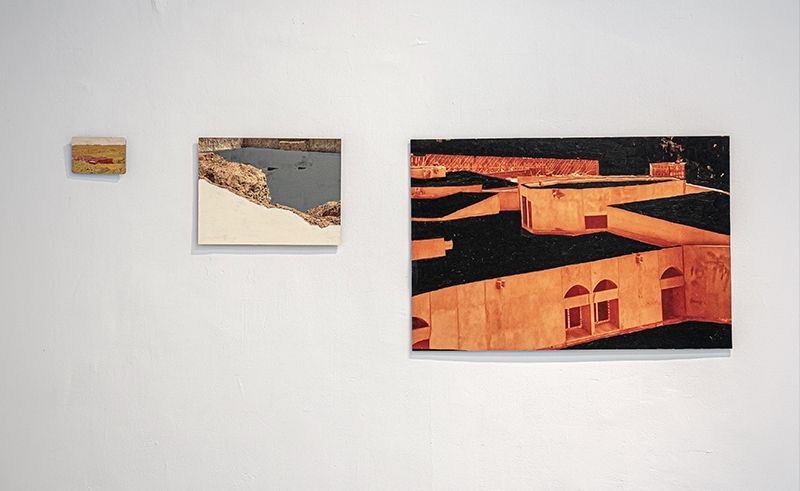
Ribbed metal sheeting, salvaged wood, rusted nails, and sepia photographs of a Saudi Arabia from decades ago fill the walls of ATHR Gallery in the JAX District of Diriyah, Riyadh, in Abdullah Al Othman's solo exhibition Syntax of the Ever-Changing, on view until August 20th. Everything on display was pulled from buildings, facades and street corners, fixed into new configurations that still carry the marks of where they came from.
Al Othman builds the show around a single conviction: "Permanence is temporary, and change is the very structure from which a place is composed." He arrived at the notion after long, painstaking thinking about how space and time work on each other, and about how emptiness gets occupied and transformed through building and accumulation. Place, for Othman, is a condition formed and reformed by time and human presence.
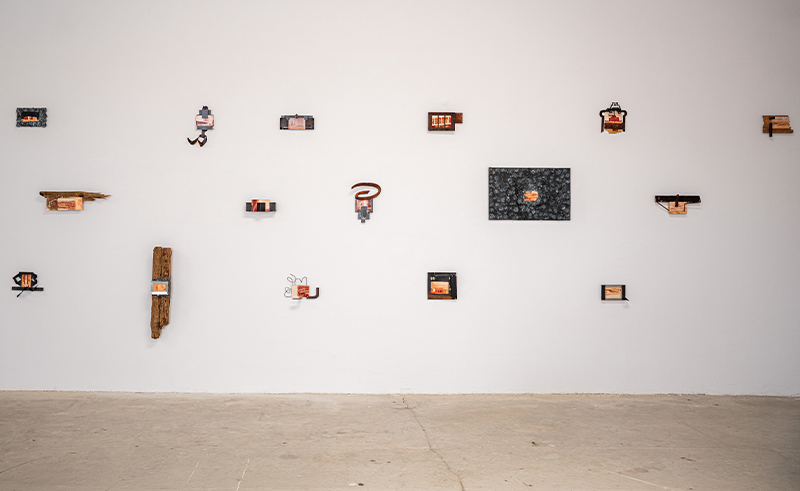
The title of the show shows how the artist thinks. "Syntax", as he defines it, is "the order through which the relationships between material, trace, image and architecture arrange themselves."
Language has always been Al Othman's medium and method. He's a published poet, and for years he's approached the city with the same proximity.
Manifesto: The Language & the City, the recurring project that grew out of this habit, reassembles the typography of Riyadh's street signs; it began as a 2021 commission for the inaugural Diriyah Contemporary Art Biennale, then traveled to the Lyon Biennale the following year.
In 2025 he mounted Structural Syntax in the UAE. Set alongside those appearances at Desert X AlUla and the Lyon and Diriyah biennales, Syntax of the Ever-Changing reads like the latest chapter in a project he's been working on for a long time.
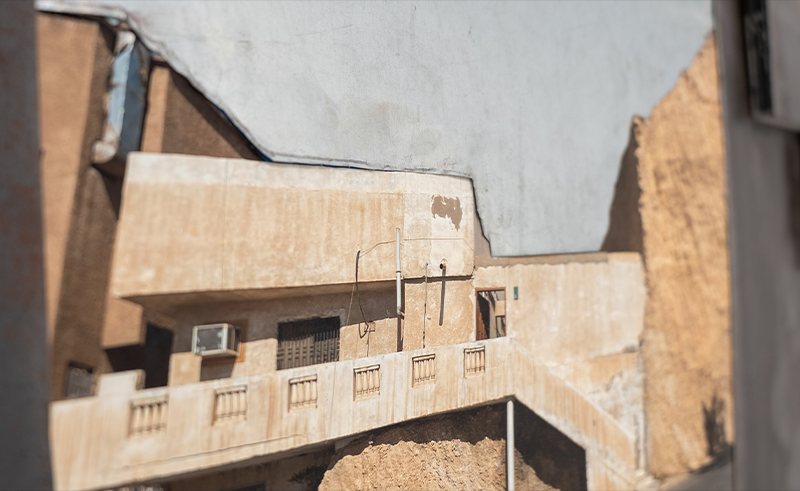
Othman treats his materials as anything but inert. "I see material as accumulated time," he says, "each material containing the trace of nature it came from." The trace, he says, is condensed enough to hold natural and human time in a single moment.
"Sometimes I see material as frozen nature," he adds, "nature having a long geological history in its origin and being born anew in the process of creation of bridges, facades, windows and the spaces that a person inhabits, until the passing of time leaves its marks of labour and passage and turns the material into a record of the whole life that developed around or within it."
He reads the time of the exhibition through memory, which he keeps clear of nostalgia. "Here memory is less a revival of the past but its constant presence in the present," he says, "a way to register the changes taking place in time." The archive, in turn, becomes "a sentence recorded in the rhythm of development," one layer of the place among many, holding the history of its transformations and staying open as a field for re-reading and making meaning.
Gathered in one space, the salvaged materials, the painted photographs and the collected frames all circle back to the same idea, which the artist states plainly. "The space we inhabit now is an outcome of previous accumulations," he says, "and in its turn it will become a new layer of transformations yet to come." So in his hands, the city's present is already its future archive.
Related Articles
Trending This Week
-
 Oct 06, 2026
 -
-
-