


Sara Alwagfi Designs a Palestinian Banknote That Never Existed
Multimedia artist Sara Alwagfi works with embroidery, transparency and destruction to examine Palestinian memory, complicity and the paperwork that makes power look official.
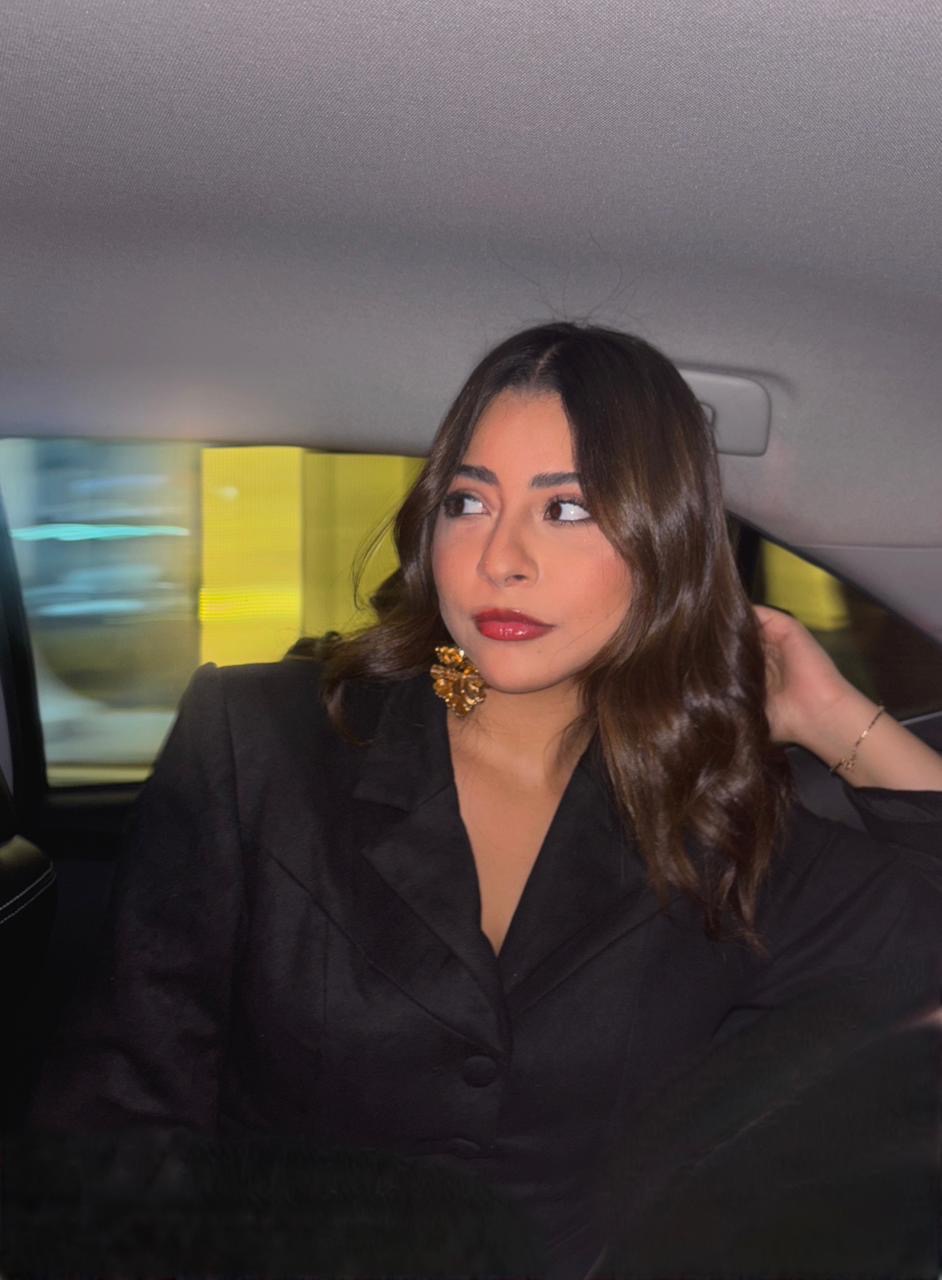
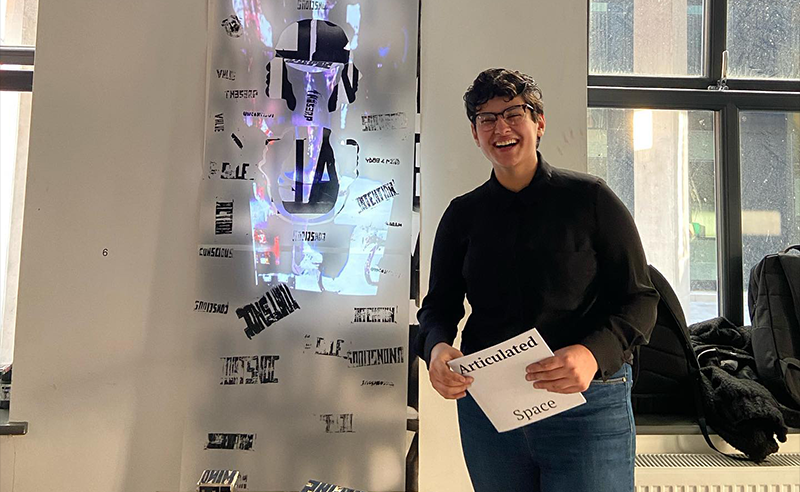
Sara Alwagfi is Palestinian, Mexican and American, and no single one of those has ever fit. "I've never been enough of one," they say. "I have never felt like the right version of the Arab person."
That unresolved question sits underneath everything they make. Their route into art was oblique. They were failing subjects at school and took graphic design during their IGCSEs because it offered an alternative to memorisation.
Visual thinking gave Alwagfi somewhere to put ideas, then an appetite for methods, then for methodologies. They have since read their way through philosophy, economics, physics, semiotics, sociology, anti-apartheid studies and consciousness.
A lecturer called them a polymath in 2021. The word meant nothing to them then and they have come round to it since.
"I've been looking at so many systems, from philosophy, economics and physics to semiotics and sociology," Alwagfi tells CairoScene. "I can take this, I can take that. It's almost like someone was to craft their own religion and they take what they like."
Which is more or less what they did with money. Displaced Traditions, from 2022, is an installation built around a 1926 Palestinian banknote of Alwagfi's own design, worked in historic Palestinian motifs by digital embroidery.
Visitors are asked to pin the note up, a small and faintly absurd gesture. Participation stands in for the collective effort Alwagfi argues is needed to protect Palestinian land, tradition and existence.
After 1948 and the expulsions of the Nakba, Palestinian needlework changed function. A regional practice language became a portable assertion of continuity.
The piece began with a book. "I had been working through Ruben Pater's CAPS LOCK, which argues that graphic designers are the people who manufacture the appearance of legitimacy," they say.
States and corporations run on that manufacture: passports, licences, letterheads, banknotes. "He was talking about how the graphic designer plays a part in creating that illusion of power and control," they explain.
"The government wants to look official. They are trying to sell us some level of reality that we buy into it. But do I have to buy into it? Can I just make something new?"
The question turned out to be about them rather than about the currency. "It started from a place of, can I use the method to actually create myself."
Chasing the motifs took them into the histories attached to them, into Nablus and Jenin and Haifa, and eventually back to the cross stitch that had hung in their family's houses all their life without ever being examined.
"My grandmother always had Palestinian cross stitch in my home, but I never really analysed it to think about what it meant to me."
Alwagfi works without a studio, and for a long time without an object in the conventional sense. "I am always thinking of how many people will be in the room and what they can do with each other," they say.
"It is definitely the concept first; sometimes, I get a sense of the medium but actually, it boils down to the concept, and this is where I find that I have no limits on medium."
For their final year of a master's at Manchester Metropolitan University in 2023, they made a miniature sculpture built to be destroyed. It was sized to sit in one hand, with a card printed with a figure tucked inside.
They carried out the work in the street outside a company their research had identified as an investor in the Israeli military manufacturer Elbit Systems.
The sculpture was smashed in front of the general public and the figure on the card was read aloud or held up: the sum that company had put into the industry, set against what Palestinians had paid for it. The piece is called Hidden Truths.
The manufacturer markets some of its products as battle-tested. Alwagfi's project text takes the phrase at its word and turns it over, since testing implies a population to test on. Their text names Gaza, along with Guatemala, Chile, South Africa, Rwanda and Myanmar.
"Genocide is profitable, and Hidden Truths was an attempt to shatter that illusion through theatre."
Their research method is obsessive rather than sequential. "I work as though I were living in a world globe," they say.
"I know I have hit the right trail when all the unrelated subjects, history, geography, chemistry, start intersecting in a new way that has not been done before."
They are also willing to throw research away on ethical grounds. "I, to be quite honest, vet the politics of the people I read and discard those I find compromised. If you're going to preach something to me, I need to know your stance on Palestine, I need to know what your baseline is."
They had been reading The Serviceberry, Robin Wall Kimmerer's book on gift economies and indigenous models of exchange that take money out of the transaction, and went chasing the writers cited inside it. One of them held positions they could not build on.
"I read his book and I was like, this is a dead end. I have to stop and find a different way. That was a really big word in my research: am I complicit? What are the systems of complicity? Who is complicit? I'm constantly reminding myself of my responsibility."
Much of their work is transparent: acetate, dissolvable fabric, clear acrylic, resin. "Why do I have a tendency for it to be invisible?" they say. "I don't have an answer yet."
They like visual complexity and find it inert lying flat on a page. "When I can pull them from the page, you can overlap things that have never been overlapped before, and you get this beautiful matrix of details."
When they finished the embroidered banknote they started winding it round their hand. "Even wrapping this invisible thing around my hand, it became more alive, as if it stayed with you, as if it made an imprint on you."
"We often move through life with blinders on, taking familiar things for granted. Invisible elements reveal what we overlook: ego, consciousness and other intangible forces whose presence we can still feel."
Elements of Identity, also from 2022, made that literal. Alwagfi suspended three surfaces in sequence, acetate, foil and a paper backdrop printed with text, then projected a film of their own body through all of them, rotating and distorting until their image fragmented across the layers.
Visitors were invited to stamp the surfaces. Their marks threw shadows over their projected figure.
"I wanted to see myself not simply as a body, but as a collection of imprints and inherited systems. We absorb what others project onto us, and those impressions, some faint, some lasting, they help shape who we become."
Alwagfi teaches a foundation course called Fundamentals at the Victoria College of Arts and Design, covering fashion media and marketing, fashion design and graphic design.
The course runs as part of a widening participation programme and draws students older than the usual art school intake, many of them working full time, raising children, speaking English as an additional language or entering higher education for the first time.
"The course is about accessibility," they say. "It's about allowing people to get back into their creative, or to rewrite their careers away from labour work."
Teaching also handed them a way of thinking about their own exposure. "I create when I need release, transmuting anxiety and anger into something tangible. My body of work is ultimately a record of the resolutions I have found in my own life."
Once they reach that resolution, the line between private and public more or less dissolves. "I realised that vulnerability can hold a mirror to others, this is especially true when I am teaching: what I have resolved may still be unresolved in them, and vice versa. We're all kids playing adults, and you can release that, and you can really have fun."
They reach for Meow Wolf to explain where all of it is heading, the American immersive art complex where household objects are rebuilt at the wrong scale in playful materials.
"There comes a point when an object stops feeling familiar and begins to seem almost alien. You stop ranking things by value and start seeing each one with the same sense of wonder, whether it is an artefact or a paperclip. It is like stepping into an alien kitchen, where even the most ordinary object can feel like magic."
Related Articles
Trending This Week
-
 Oct 06, 2026
 -
-
-