


Tar, Exile & Memory: Hani Zurob’s Art of Displacement
Hani Zurob traces exile, tar and light from Rafah to Paris, refusing victimhood as he turns darkness into art and a return home.
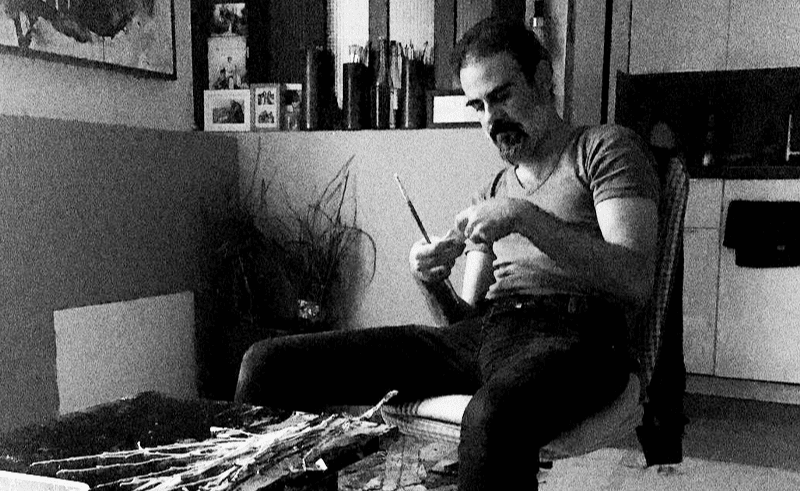
Tar moves through Hani Zurob’s work like something alive. It pools, seals, stains, suffocates; it hardens and cracks open, carrying with it the weight of borders, waiting, memory, and return. For years, the Palestinian artist has worked inside its darkness so closely that it started working its way into his lungs. At one point, he tells me, he had to choose between smoking for its own modest pleasures and the overdose of tar that came with his practice. He gave up the cigarettes.
There’s something almost fated in that exchange, the artist surrendering one kind of smoke for the darker substance through which he had learned to breathe. It was through this tar-black language that Zurob would become the first Arab to receive the Bourse et Prix Renoir residency in 2009. But recognition didn’t turn his work into triumph, just as exile didn’t turn it into defeat. What Zurob paints is more difficult than either: the politics of a life that refuses to be reduced to injury. As our call winds down, he makes a gentle request in our native tongue, Arabic. “I don’t want readers to cry. Palestinians are not victims, I reject the premise of pity. We are a people with a right, and we resist with every ounce of strength we possess, no matter how great the cost.”
He speaks to me from his studio, with Flag (2024) hanging on the wall behind him; the piece that brought him back to art after Israel’s genocidal campaign on his hometown, Gaza, had trapped him in grief. He carved the Palestinian flag into wood, then flooded it with tar, raising what he calls his black flag. “I raised my black flag in reflection on feelings of grief and mourning, but it’s not merely a representation of sorrow. It’s a space for contemplation—of the self and others—to reveal these emotions within a broader artistic perspective. And indeed it saved me, I couldn’t go back to myself otherwise,” he tells CairoScene.-fbefc827-ffce-41ad-9b3c-ae20804e935f.png) Tar is the material Zurob first stumbled upon in a construction-supply store in Paris, a cheaper alternative for materials at a time when he didn’t have much to spare, and it has since formed and informed his practice. It’s not a medium most artists would choose; it's crude and belongs on roads and rooftops and the underside of things.
Tar is the material Zurob first stumbled upon in a construction-supply store in Paris, a cheaper alternative for materials at a time when he didn’t have much to spare, and it has since formed and informed his practice. It’s not a medium most artists would choose; it's crude and belongs on roads and rooftops and the underside of things.
In Arabic, it's zeft: something awful, wretched, unbearable. And for a man who has always trusted words as much as images, the collision was irresistible; literature was Zurob’s first gateway into art. As a twelve-year-old under First Intifada curfews in Rafah, his world was reduced to continuous night, wooden shutters pulled shut against the street. He retreated to a corner with two bookshelves, “the ultimate refuge,” where he began drawing the scenes Naguib Mahfouz and Taha Hussein delivered. “Language and literature were practically my window into art. I’ve always felt like paintings are poems without letters,” he smiles. So when a word arrived carrying the full weight of what he had lived, he built a world out of it.
But tar was discovered in Paris only after the condition it described had already been lived. It was the texture of every exit he had gone through, first from Rafah to Nablus in pursuit of a degree in Fine Arts; where he understood that leaving, for him, would become a condition of no return. “I don’t think the world really understands that a Palestinian cannot move freely; even between cities. I left Gaza ‘illegally’ and lived in the West Bank ‘illegally’ —as though I was a criminal, a fugitive, everyone looking for me,” he explains.
The fugitive feeling followed him through his second exit towards Ramallah, where the occupying forces entered as soldiers, paperwork, fingerprints, broken doors, and a studio torn apart. For fifty-five days, he was detained, interrogated, and questioned like most Palestinians during the Second Intifada. I don’t linger on the details of the interrogation, asking instead what he had longed for. “A pencil,” he says, holding one up. “It was the first time in my life where I had spent fifty-five days without drawing. I also longed for coffee and cigarettes, life’s pleasures, you know, but drawing is therapy and how I’m able to both resist and love life.”
It's almost too small an object to hold that much. A pencil. But Zurob’s work has always trusted the small object more than the grand slogan; the thing left in the hand after the world has made itself unbearable, “I don’t work from a heightened emotional state. I like things to ferment.” Pain, for him, is not automatically art. It has to survive its first impulse.
It survived, eventually, in a thirty square-metre studio in Paris, where he tried to reconcile his exile in Standby (2007–2008). The collection moves through multiple pieces held in one setting, with one subject: himself, waiting on a return flight that never arrives. “From the day I became aware of the world until now, it seems that leaving Palestine has always been a one-way journey. I return through my ideas, my paintings; everything that comes out of me,” he says.
And so what Zurob couldn’t say in words, he expressed in tar. “I sought all my life to float on water and failed,” he says. “Today, I managed to float in zeft and walk on its surface.” He let the dark matter move according to its own logic, sometimes trapping it beneath glass and allowing it to negotiate with oxygen over months until it cracked open into spirals and veins of light. The collections follow one another like a body of work unravelling into parts, each a darker entry point into the same argument: that the most honest light is the kind that has had to fight its way through. Tar became Zeft (2016–2017). Land became Zeftland (2017–2019). Time itself, in his later work, became ZeftTime (2020–ongoing). “My philosophy is that it’s impossible to see the light if you haven’t lived through darkness, and it extends to this material that’s only used for insulation because no living being would come near it. I’m able to draw light from it, and I believe it’s far stronger than anything that might otherwise be conventionally beautiful,” he asserts.-8594bb16-5a47-4b5a-97e3-9fe0c65ad44c.png) None of it is resilience, not in the way the word gets used about Palestinians, as though survival is the whole story. Zurob’s work doesn't say that beauty cancels violence, or that art redeems what has been taken. It says something more difficult: that even after injury, one can still insist on forming, becoming, and sending something forward. A child in Rafah draws the illustrations he cannot wait for; a prisoner comes out asking for a pencil; an exile finds tar in Paris in a construction-supply store and teaches it to speak.
None of it is resilience, not in the way the word gets used about Palestinians, as though survival is the whole story. Zurob’s work doesn't say that beauty cancels violence, or that art redeems what has been taken. It says something more difficult: that even after injury, one can still insist on forming, becoming, and sending something forward. A child in Rafah draws the illustrations he cannot wait for; a prisoner comes out asking for a pencil; an exile finds tar in Paris in a construction-supply store and teaches it to speak.
“The most important thing for me is for light to reach any child sitting in a camp, sitting in a tent, because I was in a camp, and the light reached me through the great figures I had read about in those books,” he says. “I was able to step outside the picture they painted for me: that I should be living in a camp, as a refugee, my voice unheard, living just as my father and grandfather lived. So today, I feel like it’s my duty and responsibility to send a greater light.”
Related Articles
Trending This Week
-
-
-
 Sep 28, 2026
 -