





Pro Clown Nada Elissa Wants You to Put on a Red Nose & Stop Performing
The Cairo-based educator is using clown workshops to help people drop their social masks and confront what’s underneath.

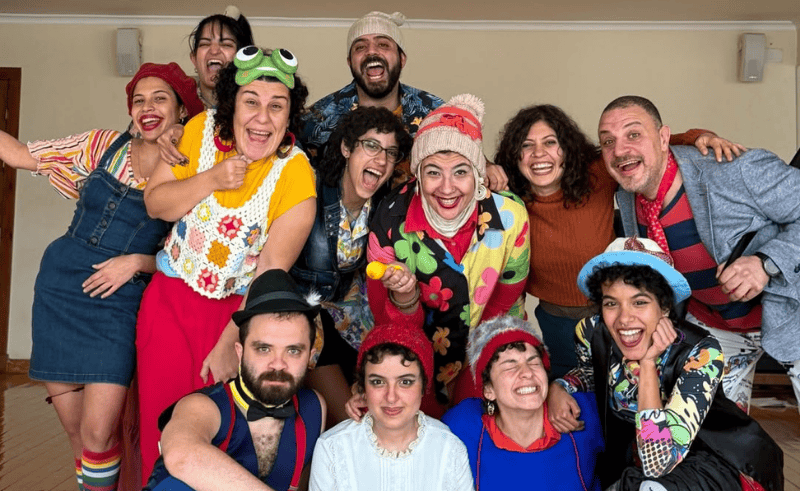
Nada Elissa will put a red nose on you, place you in front of a room of people, and ask you to stand there. Just be. The room watches.
As a reflex, you may twitch — your hand moves involuntarily to your face, something shifts behind your eyes. The audience, if they're doing it right, starts to see you — really see you — maybe for the first time. Maybe you do too.
There is terror in this. There is also, Elissa believes, a strange sense of liberty.
Elissa is an educator, clown and biophiliac. Thirty-six and based in Cairo, she teaches clown workshops out of the conviction that clowning is not just a performance style but a philosophical stance at life — a way of arriving at yourself by making yourself ridiculous. "The clown," she tells CairoScene, with characteristic matter-of-factness, "is the ultimate way of expressing oneself."
She has workshopped it in studios and studied it across Egypt, Spain, and beyond, brought international clown teachers to Cairo, and built — workshop by workshop — a small community of people willing to come back every month and make fools of themselves together. On the internet, she used her own clown to talk about fear, desire and rejection.
Having always been obsessed with the natural world, Elissa pursued her dream to study marine biology in France. But over time, the arts became creeping obsessions as well, threading through the margins of a scientific education. She played piano seriously, and took dance classes. She wrote little theatre pieces that she recently found again and reread in disbelief. “I looked at them and thought why wasn’t I developing these things?” She was 18 and told, as most 18-year-olds are, that the arts are something you do on the side.
So she did, up until her return to Cairo, where she worked as an environmental educator with Daima, taking children out of classrooms and into the actual living world through observing plants, doing data collection, and so on. The teaching instinct, she says, was always innate. “I think I have a gift for it. I realised it later, but all my work was directly related to education.”
In the period following the 2011 revolution, Cairo was electric with street art and public performance. People were using whatever tools they had to express themselves out loud. It was here, for Elissa, that the clown first made a proper entrance. An Egyptian clown troupe called Uta Hamra was performing in demonstrations, in public spaces, in the street. Elissa was fascinated. “I was always attracted to the clown,” she says. “But not the McDonald’s clown or the circus clown. I always had this connection to the clown that is more magical, more poetic, unexplainable.” When Utahamra announced workshops, she applied immediately. Her first official clown training was in 2014. “Since then,” she says, “everything opened up.”
Not long after, someone offered a workshop in Pochinko clowning, a Canadian method involving deep mask work, the construction of a persona that becomes something like a second self. Elissa was, she says, inexplicably desperate to attend. The workshop kept being postponed. She had paid in advance, waited a year and then it was cancelled. “I needed to do this workshop,” she says. “I don’t know where this drive was coming from. It wasn’t me leading it.”
Looking back, she thinks she understands. “I’m a very emotional person. I feel a lot of things, I’m like a sponge.” The clown, she realised, offered a space to hand your emotions to a character and let that character run with them, it’s a genuine act of relief. “I think I was finding this freedom of play, and I love to play. I love entering and exiting different states.”
She kept studying contemporary dance, physical theatre, and movement at CCDC. There was, in 2019, what she describes only as “an event” in her life that shifted something fundamental. She then decided to take performing arts seriously. “I asked myself: before I die, what would it be? It would be performing arts.” In 2022, she went to Spain to study physical theatre. Her first time performing on a real stage for a real audience, a piano-induced stage fright that had calcified at 16 dissolved.
When Elissa mentions clowning to uninitiated Cairenes, she is often faced with an immediate and predictable reaction. Fear, specifically. Killer clowns, IT, the Joker, various blood-soaked pop-culture associations have made the word “clown” roughly synonymous with “something wrong with the children’s entertainer.”
This conviction is illuminating to Elissa.
“The clown can access everything,” she explains. “They can feel everything. They can be psychopaths and they can be tender, innocent children. Because of this full spectrum, because the clown has the ability to access the darker aspects of human beings, a lot of people have played with that.” The horror clown, in this reading, is the shadow version of the same figure, it is what happens when you take the archetype’s access to the forbidden and aim it at the audience rather than for them. And the clown gets away with it precisely because, as Elissa puts it: “The clown is not really a human. So they’re allowed to be cannibals, they’re allowed to go there. And that’s how people used them.”
The sacred clown, the court jester, the Hopi Koshare: these are, as anthropologists and Jungian psychologists have long noted, among the oldest social roles in human civilisation. The clown is the figure who can tell the king he’s wrong, who can take death and make it briefly lighter, who can play with things that would destroy a person if they tried to hold them directly. “What I did was just be myself,” she says, on the question of how she convinced Cairo to take this seriously. “I put my clown out there more and more. Doing videos, sharing, using my clown to talk about fear, about being rejected, about desire, about love.” People started to see that the clown was a deep container.
Elissa’s program runs over eight sessions and it begins right with the unbearable experience of simply being looked at. The red nose goes on, nothing is asked of you except presence. And presence, it turns out, is the hardest thing in the world. “The clown commences through the eyes,” she says. “A lot happens through the eyes. You share your inner world. In everyday life, we wear masks. Calibrated, socially useful masks that allow us to navigate Cairo, navigate work, navigate each other. The clown workshop begins by identifying these masks and, with some patience and a great deal of structured provocation, dismantling them.”
Elissa devotes a full weekend of her program exclusively to emotions as territory to be known and navigated. Anger, despair, sadness, anxiety, joy. “As human beings, we never learned how to deal with our feelings,” she says. “There are emotions that the clown needs to access, without fear, in order to say no, to take a scene in a different direction, to cry on stage, to feel the despair.” The clown cannot play with the heavy stuff, she explains, until the performer has made some peace with it themselves. And the mechanism for that peace is surprisingly simple: “The clown takes whatever emotion you’re feeling and adds three drops of joy to it. Once you do that, you start having pleasure with that emotion; pleasure in showing it, pleasure in being seen. The chief reaction I have seen on people once you place the red nose on their face is cry.”
Elissa brings international teachers to Cairo: her Argentinian teacher, who works extensively with the emotional terrain of clowning; Bricophonic, a French-Italian company with links to Clowns Without Borders, who will be offering a week-long intensive ending in an open clown cabaret; a Portuguese performer coming in June to work on physical comedy and group scene creation.
Once a month, everyone who has passed through her workshops gathers for a clown cabaret. A topic is chosen - loneliness, most recently - and people create short pieces in response. “The workshop finishes but now we have to practice. It keeps the family feeling.” The topics are not gentle but the clown does not ask you to rise above your material but dive into it headfirst. “You can give the clown your sexual desires, your shame, your loneliness. The clown can make something of all of it. That’s why it’s powerful. You transmute it, not bypass it. Transmute it.”
Related Articles


Trending This Week
-
 Oct 06, 2026
 -

-
-