



Tarabband Map Fear, Control & Feelings of Inferiority on ‘Hub o Harb’
Led by Iraqi vocalist Nadin Al Khalidi, the band brings a fusion of Jazz and Arabic melodies with a folk-rock edge on their latest album.

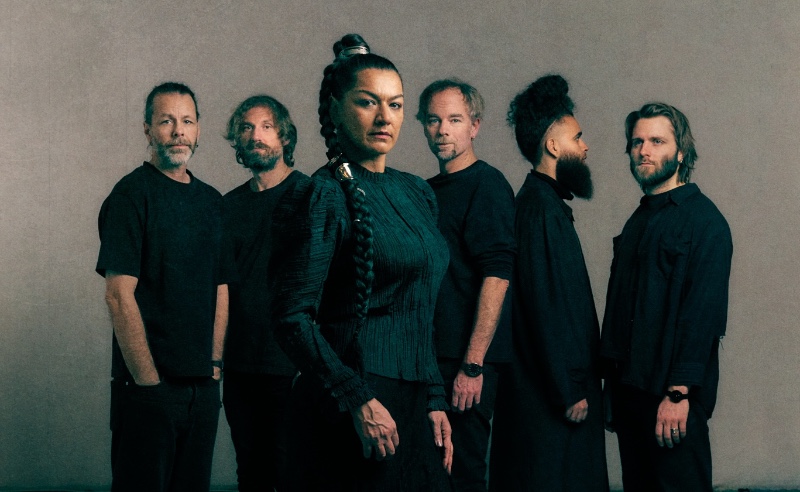
For nearly two decades, Tarabband has operated as an anomaly on the international stage. Founded in Malmö, Sweden back in 2008 by Iraqi-born vocalist and composer Nadin Al Khalidi, the six-piece outfit has spent 18 years subverting the rigid expectations often placed on Arab artists in the West. They refuse to serve as a convenient geopolitical archetype or a textbook introduction to the Middle East; instead, their extensive touring across Europe, North Africa, and North America has been driven by a radical, cross-cultural honesty.
On their latest offering and fourth studio recording, Hub o Harb (Love & War), the band translates this long history of boundary-crossing into an internal, psychological excavation, delivering an album that feels less like a traditional folk record and more like a tightly wound, visceral battlefield of human intimacy and connection.
Thematically, Hub o Harb rejects macro-political posturing to dissect the quiet, violent friction that lives inside the architecture of closeness. Al Khalidi’s lyrics loop around a central, agonising question: how does a love that once tethered two people together mutate into a desperate power struggle? Rather than operating in abstracts, the album zeroes in on three specific psychic forces that routinely derail our private lives: fear, control, and feelings of inferiority. Al Khalidi unpacks the moments where boundary-setting is misconstrued as an assault, and where tolerance curdles into pure, destructive passivity. It is an exploration of the ways we weaponise our own inadequacies against the people we claim to hold closest.
Sonically, this friction is staged through an organic, live-room production style that completely avoids highly processed digital tracking. Mixed by Markus Nilsson, the record favours spatial dynamics over uniform loudness, allowing the physical room to breathe before smashing it with dense, full-band crescendos. Traditional Arabic rhythms are forced into conversation with heavy jazz-rock fusion and minimalist Nordic folk textures, creating an unresolved sonic tension that mirrors the emotional instability of the lyrics.
On the lead single ‘Djai’, the band establishes a groove-heavy, driving cadence where traditional Arabic percussion like the darbouka and rikk hits with an assertive, modern syncopation against Andreas Hourdakis’s jazz-infused electric guitar riffs. The title track, ‘Hub o Harb’, functions through dramatic shifts in volume; fragile, exposed acoustic pockets built around Al Khalidi’s raw saz playing are suddenly swallowed whole by full-band explosions that mimic the violent onset of an argument. When they take on Ziad Rahbani's classic ‘Kbirel Mazha Hay’, the pace slows into a cinematic, melancholic gravity. The track breathes through low, brooding double-bass lines and intricate violin ornamentations, framing Al Khalidi's vocal performance as it shifts between breathless, vulnerable whispering and commanding, melismatic chest tones.
Ultimately, Hub o Harb is a masterclass in friction, showing that after 18 years, Tarabband’s greatest evolution is their willingness to step out from behind the noise and lay out the unvarnished, complicated truth of the human heart.
Related Articles

Trending This Week
-
 Oct 28, 2026
-

-

-