





How a 17th-Century Dragon Carpet Found New Life in Alexandria & Cairo
A 17th-century dragon carpet was recreated, cut into 100 pieces, and scattered across the world. Two ended up in Egypt.

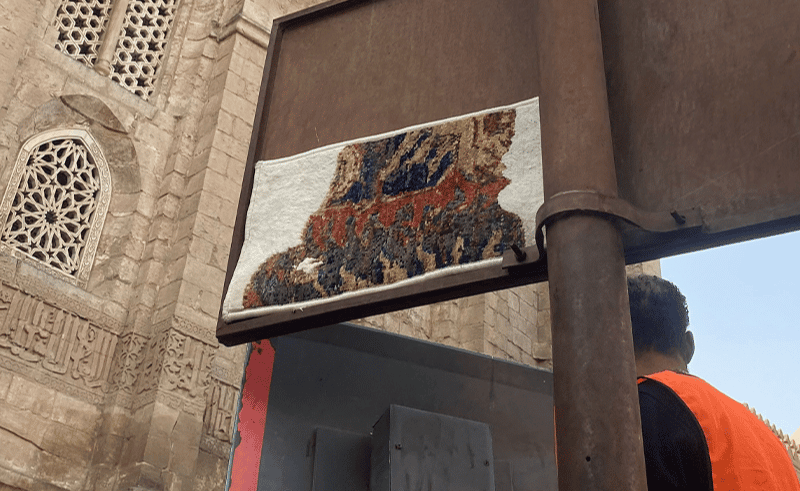
When a 17th-century Caucasian dragon carpet was partially burned during the Second World War, it held on through the wreckage, waiting for peace. It survived, eventually finding its home in the collection of the Museum for Islamic Art at Berlin's Pergamon Museum. Decades later, when the museum closed its doors for renovation in 2023, the curators found themselves with an unusual kind of time on their hands and an equally unusual idea to make use of it.
A master weaver in Rajasthan, India was commissioned to recreate the dragon carpet in full, a meticulous double of something that history had already tried to erase. And then, in the courtyard of the James Simon Gallery, that replica was cut into a hundred pieces. Each fragment was sent out into the world to live different chapters with artists, architects, musicians—everyday people across the world. They all had one instruction: to carry the fragment somewhere, do something with it, document what followed, and pass it onto its next temporary keepers.
The project, CulturalxCollabs – Weaving the Future, keeps art in circulation until the museum reopens in 2027, at which point every fragment returns home, carrying with it all the stories it's become part of.
Two of those fragments eventually found their way to Egypt.
Fragment no. 78 docked in Alexandria, into the hands of artist and muralist Aya Tarek, while fragment no. 88 travelled further to Cairo, where architect Mariam Korashy was in the middle of breathing new life into a house that had forgotten what it felt like to be alive. A carpet that had already survived a war was about to enter the beautiful, unpredictable mess of being handed to people with too many ideas and not enough time.
Tarek received it and found herself at a loss; there was no obvious story waiting to be told, no ready-made concept. So, the fragment simply travelled with her, tucked away in the back of her car, accumulating kilometres without any particular destination. "I kept it in my trunk for four months," she laughs. "It just came with me everywhere."
The answer, when it came, arrived the way most good things do in Alexandria, through a friend and over food. Karim Moselhi, founder of Alexandria Deli, suggested they throw a gathering, and landed on a name that said everything about where they come from. Kebdet Ibril folded April Fools' Day into kebda, the Alexandrian liver sandwich that has fed the city's streets for as long as anyone can remember. Tarek called her people, let the night do what it wanted, and somewhere between the noise and the laughter, the fragment finally found its place.
What the fragment carried was the particular texture of belonging to a place and the people in it. Tarek connected the fragment to her grandfather, whose studio—still standing in the family since the 1950s—once produced hand-painted cinema posters on a scale that no longer exists anywhere. She works in that same space now, with the same brushes, and says she can still smell the turpentine in the walls. "That thread was always there, and the fragment, in a way, became a reason to trace it," she smiles. The night at Alexandria Deli became an extension of that same impulse; the fragment sharing a table with plates of kebda and a stack of prints from her solo show TOKEN, culture passing between hands rather than sitting behind glass.-39c3b6a6-e185-4b09-98b3-d8f85ead845b.png) That instinct to reach backwards while planting herself more firmly in the present makes sense when you understand where Tarek has been. After years of travelling, she returned to Alexandria and began the slow, deliberate work of finding her way back in — reconnecting with the scene, the people, whatever version of the city was still there waiting. "I've been trying to revive it ever since."
That instinct to reach backwards while planting herself more firmly in the present makes sense when you understand where Tarek has been. After years of travelling, she returned to Alexandria and began the slow, deliberate work of finding her way back in — reconnecting with the scene, the people, whatever version of the city was still there waiting. "I've been trying to revive it ever since."
Kebdet Ibril became part of something larger that Tarek had already been slowly building, and fragment no. 78 arrived with an excuse for the artist to gather the people her story already belonged to. "It was never really about the fragment," she explains. "It was about the people around it."
If Alexandria taught fragment no. 78 that culture lives in people, Cairo was about to remind fragment no. 88 that it also lives in the weight of what walls have witnessed. It found itself at the crossroads of different eras and stories, landing in a house that has quietly carried its own heritage from one generation to the next. It arrived in the hands of architect Mariam Korashy at Beit Tulun, tucked into one of Cairo's oldest neighbourhoods beneath the gaze of the city's most enduring landmarks.
The building was once the workspace of Korashy's mother, architect Mona Zakaria, who seems to have passed down both the profession and obsession that comes with it. After years of sitting dormant, with its lights switched off and its furniture gathering dust, the mother-daughter duo decided the house deserved another life.
Today, Beit Tulun houses exhibitions, conversations, workshops, and the kind of ideas that need space to breathe. Its transformation is inseparable from its surroundings. Just across from the house rises Ibn Tulun Mosque, one of the oldest surviving mosques in Egypt, a monument that has spent centuries at the centre of a city in constant motion. "I think heritage needs to be kept alive," Korashy tells CairoScene. "It loses part of its meaning the moment we think of it as something frozen in time."
It was into this setting that Fragment no. 88 arrived, just as Beit Tulun was opening itself up to the city around it. Its first appearance was not as a quiet object on display, but almost as a guest at the book signing for EL Cinema… Leh?, a book exploring the relationship between cinema and the city as a living archive.
For Korashy, the timing felt instinctive. The room was already holding conversations about image, memory, and place, so the fragment entered naturally, adding another layer to a gathering already concerned with how cities are seen, remembered, and retold. "It was a moment that brought together a lot of things," she says. "Culture, Cairo, cinema, heritage. They were all there in the same place." And somewhere along the way, the fragment became a participant in an ongoing conversation, an object that had quietly accumulated a much larger story than the one it started with.
Standing opposite Ibn Tulun Mosque, the fragment's arrival felt like welcoming home a distant relative as opposed to receiving something foreign. After all, the original Dragon Carpet emerged from the wider Arab and Islamic world that shaped so much of the city's visual and cultural history.
Cairo has never been a city that simply receives. Throughout its history, waves of people, ideas and aesthetics have arrived from elsewhere, only to be absorbed into the city's fabric and transformed into something unmistakably its own. "Whatever comes from outside eventually receives an Egyptian stamp," Korashy smiles. "It becomes something that belongs to Cairo."
Perhaps that's what happened to Fragment no. 88 during its time at Beit Tulun, entering a place already occupied by a thousand years of stories spilling out into the world. It became part of a living space, surrounded by books, discussions, architecture, and the everyday life of the city and its creatives.
- Previous Article Around the World Cup: Fish Hauls & a Plea for Peace
- Next Article This Alexandrian Cook Thinks Cairenes Aren't Spicy Enough