





The Saudi Nonprofit Changing How Society Sees Stuttering
Mutalaathem is a Saudi nonprofit where people who stutter can openly discuss their experiences without fluency being treated as the only goal.
For much of his childhood, Saad AlMunajem was taught to think about stuttering the way many people still do today: as something to overcome through fluency. Speech therapy focused largely on techniques designed to reduce it, while success was measured by how closely he could speak like everyone else.
Today, that experience shapes everything he is trying to change. After returning to Saudi Arabia from the University of Washington in the US, AlMunajem founded Mutalaathem in 2021 to build something he felt had been missing from his own experience: a space where people who stutter could openly discuss it without fluency being treated as the only goal.
The organisation now runs support groups, discussion events, webinars and children's camps. It has also developed creative awareness projects such as Faces of Stuttering, a photography series exploring the shared emotional experiences of people who stutter across cultures.
Like many people who stutter, AlMunajem attended speech therapy from a young age. Those around him wanted to help, and fluency was often presented as the solution.
"The techniques themselves don't really work outside the clinic setting. I felt really helpless, because all around me no-one really understood at all what it meant to have a stutter, and every time I would speak to the people around me, wishing the best for me, they would tell me to practise techniques without knowing that techniques don't work for me. So my solution was to build a wall around myself, and put on a face that it was okay to stutter but in reality I hated it and hated every part of it."
Even routine interactions became something to prepare for. He remembers mentally rehearsing conversations and anticipating moments where he might stutter, while the pressure to speak quickly only intensified the struggle.
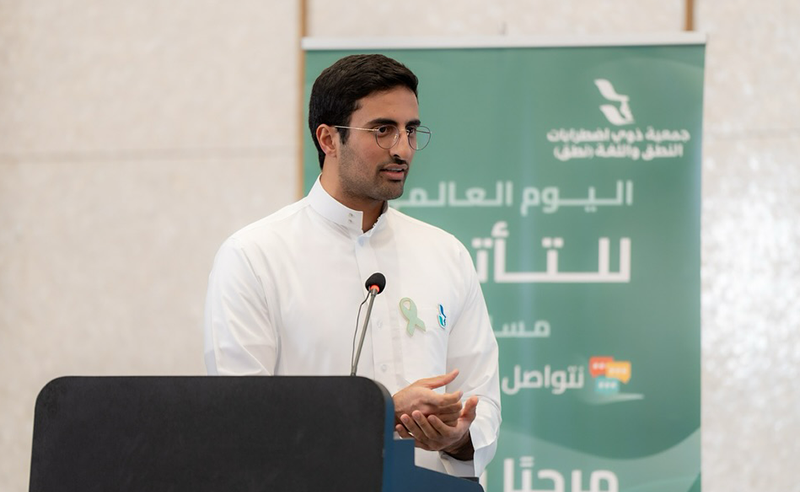
"I want people to imagine how many times they speak in a day," he says. "Now imagine that every time you try to speak, the words just won't come out the way you want them to. People become impatient because they don't know what's happening, or you feel pressure to speak quickly, so you put that pressure on yourself. The harder you try to get the words out, the longer it takes."
It was only after moving to the US for university that he encountered a different approach. Living independently gave him the freedom to explore his relationship with stuttering on his own terms, and for the first time, going to speech therapy was his decision rather than someone else's.
Instead of treating fluency as the destination, his therapists encouraged him to explore the emotions behind his stutter and use speech techniques selectively rather than constantly. The experience changed how he thought about communication altogether.
"My goal stopped being to speak fluently," he says. "My goal became to get my message across. Because I stutter, I simply need more time."
That distinction became the foundation of Mutalaathem's work. Rather than promoting fluency as the primary goal, the organisation helps people who stutter build confidence, understand the emotions behind their speech and recognise that effective communication does not depend on fluency.
AlMunajem believes this kind of support is particularly important across the Middle East, where stigma around mental health can make it difficult for people to talk openly or seek help. Mutalaathem aims to provide what's been missing: a community where people who stutter can share their experiences, explore the emotional impact of stuttering and meet others who understand them.
That philosophy recently took a significant step forward when Mutalaathem partnered with the University of Texas at Austin to bring Camp. Dream. Speak. Live to the Middle East for the first time. Held in Riyadh, the five-day camp welcomed 18 children and teenagers aged between 8 and 17.
Camp. Dream. Speak. Live. focuses on helping young people who stutter become more confident communicators.
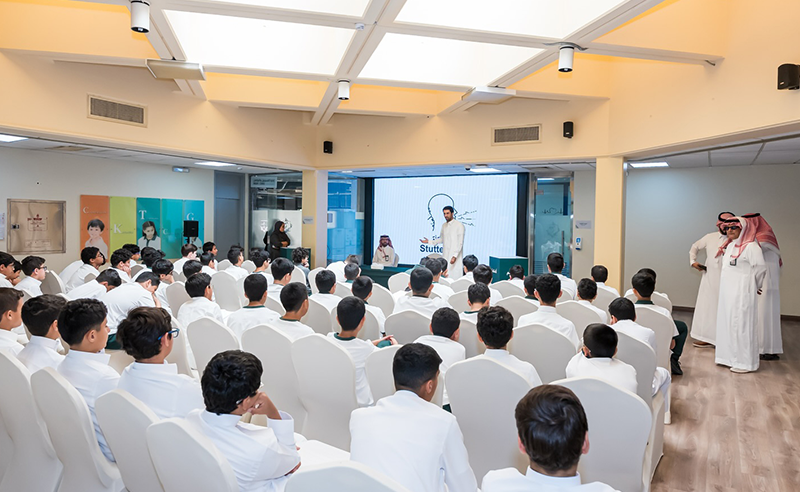
"The goal of the camp was to teach kids and teens that you can still be an effective communicator and stutter," AlMunajem says. "You can be completely fluent and have horrible communication skills, or you can have a severe stutter and still be a great communicator."
Initially, he questioned whether five days would be enough to have a lasting impact. Instead, parents began contacting him almost immediately.
"From the first day of camp I started hearing from parents, 'My kids are saying on their own, "Please stop and do not complete my sentences, I just need more time."' These are 9-year-olds, 10-year-olds, 15-year-olds."
For AlMunajem, those conversations reinforced the importance of reaching children early.
"We're planting seeds that it's okay to stutter so that they grow up without having internalised stigma on the way that they speak."
The same philosophy underpinned a recent webinar, Understanding Stuttering: What Every Parent Needs to Know, which encouraged families to reconsider what support should look like for children who stutter.
"A lot of parents do want to help their kids but they don't really know how," AlMunajem says. "Yes of course it's very human to want your child to speak fluently, to want your child to not go through the struggles of having a stutter. But if you really want to help, you should create a safe space where they can share their thoughts and feelings instead of constantly trying to make them speak fluently."
Mutalaathem's latest project, Faces of Stuttering, extends that conversation beyond Saudi Arabia. The photography series brings together people who stutter from around the world, each answering the same question: in one word, what does your stutter mean to you, and why?
So far, AlMunajem has photographed more than 50 participants from countries including Saudi Arabia, Oman, the United States, the United Kingdom, Mauritius, Iceland, Belgium, Hungary, Norway, Finland, Spain, Australia and New Zealand. He hopes to exhibit the series later this year.
"The goal of this project is to show how diverse we are and yet how the emotional feelings that are associated with the stutter are very similar, no matter where you're from," he says.
Looking back over the past five years, AlMunajem says Camp. Dream. Speak. Live remains his most significant achievement.
"Hearing directly from the kids in how this camp helped them accept themselves more, and hearing directly from their parents that they have been witnessing the change at home and not just in the camp, that has definitely been my most rewarding experience."