






A New Luxury Train Retraces the Silk Road From Beijing to Tashkent
A new train recreates 1,500 years of Silk Road trade in carved wood and lacquer, running 2,400 miles from Beijing to Tashkent across six countries this September.
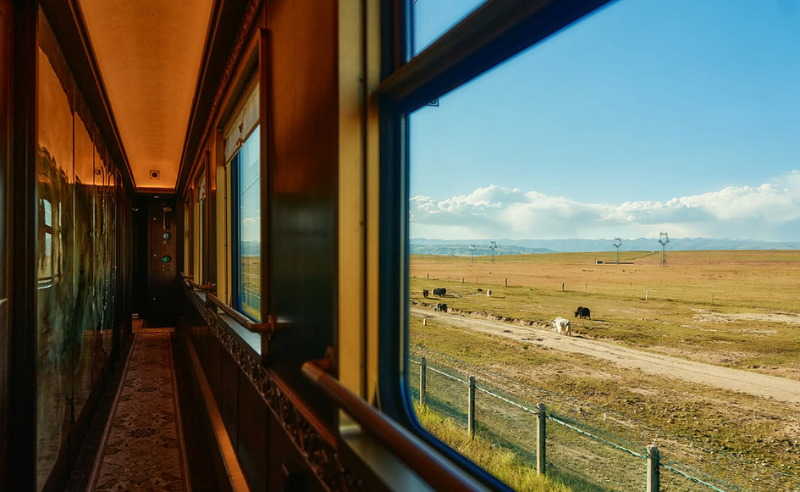
The Golden Eagle Silk Road Express is set to launch in September 2026, with interiors shaped by the history and visual language of the trade route that gives the train its name. Global interior design firm Studio HBA drew on references ranging from Chang’an cityscapes carved into wall panels to the sweeping curves of Han Dynasty chariots echoed in the doorways.
The launch marks Golden Eagle Luxury Trains’ return to China and Central Asia for the first time since 2019. Pale blue, crimson and gold run across the exterior from top to bottom. The train carries up to 76 passengers across 10 sleeping cars, two dining cars, a bar lounge car, an observation car and a storage car. Inside, imperial Chinese craft is paired with early-20th-century rail glamour, with carved wood alongside velvet and brass set against lacquer.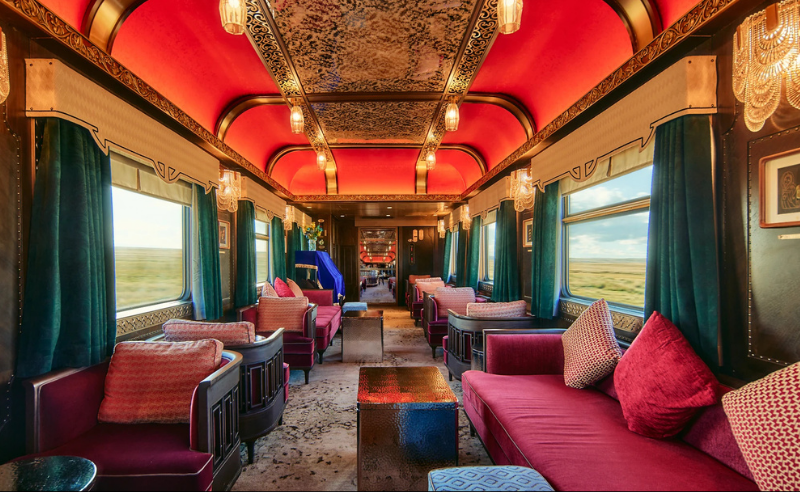 Guests choose between two cabin categories. By day, the Superior Cabin works as a sitting room, with twin sofas facing each other, and at night, it folds down into a bed. The Han Dynasty Suite keeps its living-room feel even after dark, with a separate lounge, a dressing table, and a bathroom big enough for a soak.
Guests enter the bar car through a door shaped like a Han Dynasty chariot. Inside, with low lighting, mahogany and deep crimson wrap around a piano.
Across the corridor, the observation car takes the opposite approach. A 270-degree window pulls the view into the room, and the walls around it are carved with a map of ancient Chang'an, the Silk Road's eastern starting point, now known as Xi'an, China's ancient capital, its imagery recurring throughout the train's design. Two dining cars serve the train, one set up for Western-style banquet service, and both serving food built around the regions the train is moving through.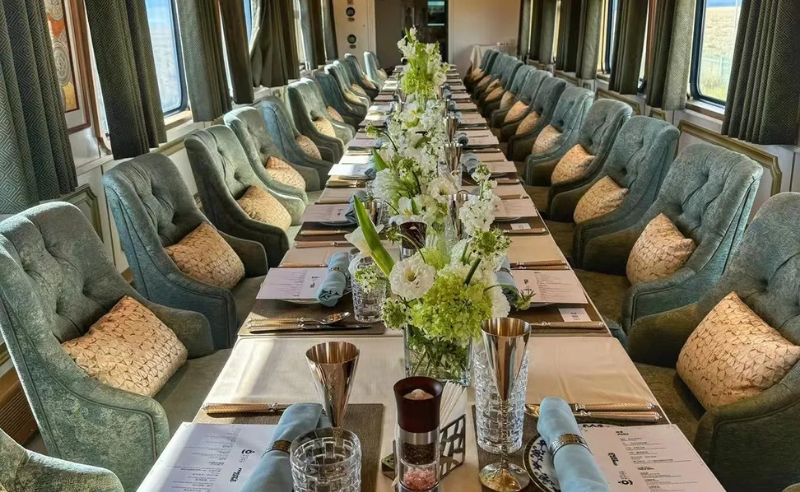 The flagship journey is the 22-day Grand Silk Road, running roughly 2,400 miles from Beijing to Tashkent. It crosses China, Kazakhstan, Kyrgyzstan, Tajikistan, Turkmenistan, and Uzbekistan, with stops including the Terracotta Warriors in Xi'an, the Mogao Caves at Dunhuang, the Gobi Desert, Samarkand, Bukhara, Khiva, and Lake Issyk-Kul.
The historical Silk Road was far larger. It connected China and the Mediterranean, passing through Central Asia, Iran, and the Middle East, and at its longest, stretched around 6,400 kilometres. Cities along its path included Xi'an, Dunhuang, Kashgar, Samarkand, and Bukhara, several of which appear on the new train's itinerary.
Although the name "Silk Road" itself is relatively recent - German geographer Ferdinand von Richthofen coined it in 1877, long after the routes had fallen out of active use - the historical and cultural impact of the trading route can still be seen throughout the journey. The Han Dynasty formally opened the Silk Road as a trade corridor in 130 BCE, when it opened trade with the West, and that trade corridor stayed active for 1,500 years, until 1453 CE, when the Ottoman Empire closed off trade with the West.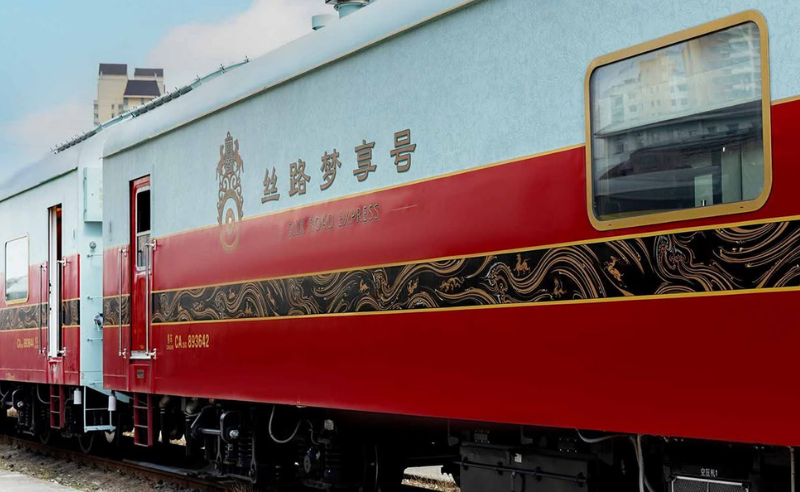 Two shorter itineraries also run on the new train: the 12-day Ancient China by Private Train, and the 13-day China & Tibet Rail Discovery, which crosses the Tangula Pass, the world's highest railway at 5,072 metres.
On board, days combine guided off-train excursions with time in the bar and observation cars. Evenings include a Tang Dynasty dinner accompanied by traditional music and dance, and the dining car doubles as a space for lectures and film screenings between meals.
- Previous Article KOTN Taps Alana Hadid & More for ‘Nothing to Declare’ FW Campaign
- Next Article Ahmed Tohamy’s ‘Special Request’ Is Service to Anti-Fashion