






Shaharah is Yemen’s Mountain Village in the Clouds
High in Yemen’s mountains, Shaharah's dramatic stone bridge forms the nexus between two summits with fortified architecture, ancient water systems and agricultural terraces.

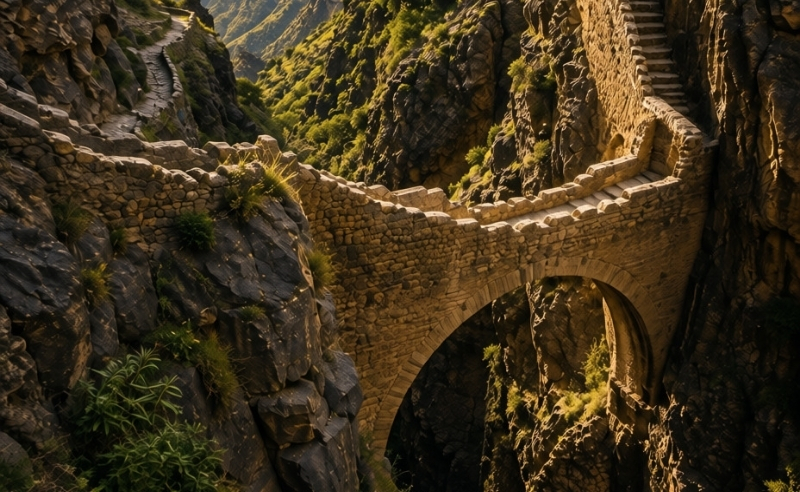
If you are one of the roughly 240 million people in the world who report a profound fear of heights (also known as acrophobia), you may want to sit this one out. Or, to raise the stakes, you can face your fears and pay a visit to Shaharah, where you are guaranteed to find an unforgettable view.
At around 2,600 metres above sea level, this mountain settlement sits across two sections of Jabal Shaharah in Yemen’s Amran Governorate. It's a town best known for its narrow limestone bridge spanning the gorge between the two sides, forming just one part of a much larger story about how communities adapted to Yemen’s highlands.
Shaharah was built as a fortified settlement. Steep terrain forms much of its natural defence. Its historic structure includes stone houses, mosques, gates, watchtowers, agricultural terraces, cisterns and reservoirs. Settlement in the area dates back to pre-Islamic times, and as the years went by, Shaharah later became an important Zaydi stronghold and centre of religious learning. In 2025, the settlement and its bridge were added to Yemen’s UNESCO World Heritage Tentative List.
For most visitors, the bridge is the obvious place to start. It connects the two parts of Shaharah, and eliminates the laborious descent into the valley and the subsequent climb back up the other side. Built from local stone, the structure is around 20 metres long and about three metres wide. UNESCO describes it as an important example of traditional Yemeni engineering.
When exactly it was constructed, most historians cannot quite tell. The bridge is commonly described as dating to the 17th century, although older Yemeni tourism documentation attributes the surviving structure to 1905. For that reason, it is safer to describe it as a historic bridge rather than give a definitive construction date without qualification.
Shaharah is located roughly 50 kilometres west of Khamir, the nearest sizeable town, while the regional capital of Amran lies farther to the south. Sana'a, Yemen's capital, is the main practical base for arranging travel into the country's northern highlands.
But of course, the pressing question: how does one get there?
Shaharah is not currently a straightforward tourist destination. Foreign visitors have historically required permission to travel to the settlement, with travel accounts describing police or security permits and checkpoints along the route. The precise arrangements can change, however, and should be confirmed with Yemeni authorities or a licensed local operator before any journey is contemplated.
In practical terms, there are really only two options. Since 2014, there has been a paved albeit extremely narrow road that takes visitors up and down the mountain. The other option, and you may have already guessed it, is hiking. It's certainly one way to avoid the vertiginous road, that is if you don't mind what most climbers report to be a six-hour trek. Either way, once you get to the summit, you will immediately remember why you made the journey in the first place.
The town itself is just as interesting to explore as the bridge. UNESCO estimates that around 80 to 90 percent of Shaharah’s historic architectural structure survives, including traditional residential areas, religious buildings, public spaces and defensive structures. Houses are constructed from local stone and can reach several storeys, with traditional layouts incorporating spaces for storage, grain, livestock and domestic use.
One of the more curious elements in Shaharah is its water infrastructure, another important part of the settlement. The area developed cisterns, reservoirs and rainwater-harvesting systems to support life in the highlands, while agricultural terraces allowed crops to be cultivated on the steep surrounding slopes. Historical crops included wheat, corn, barley, coffee, fruit, vegetables and medicinal plants.
There is little conventional tourism infrastructure in Shaharah, and visitors cannot currently stay overnight in the settlement, so be sure to plan it as a day trip. A sturdy pair of hiking shoes, light food, water and other essentials would go a long way.
Related Articles

Trending This Week
-
 Oct 06, 2026
 -

-

-