





AI Lets You Finally Step Inside Alexandria's Sunken City
A UNESCO museum was planned for Alexandria's sunken ruins and never built. AI imagines what we have all been missing.

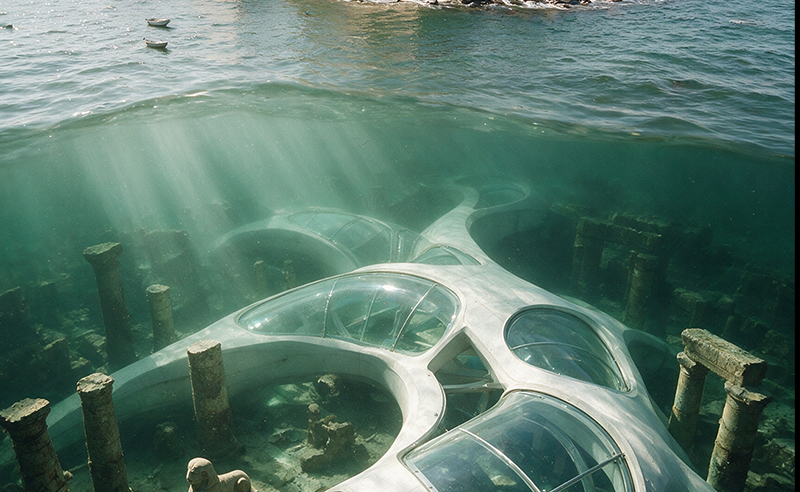
Picture descending into Alexandria's Eastern Harbour on a clear Mediterranean morning, the water shifting from turquoise to a deep, living green as a fibreglass tunnel carries you six metres below the surface of Abu Qir Bay and the world above simply disappears. Before you, lit by shafts of filtered sunlight, sit the remains of a civilisation that spent roughly 1,400 years resting undisturbed on the sea floor: column drums, broken pediments, sphinx fragments, and the scattered bones of a royal city that once made Alexandria the intellectual and political capital of the ancient world.
This almost happened. The Alexandria Underwater Museum, a UNESCO-backed project first conceived in the mid-1990s, moved through years of planning, architectural design and feasibility studies before stalling just as it should have begun to rise. To understand what we came so close to having, and what remains possible in imagination if not yet in practice, we asked AI to visualise what it might have looked like.
French architect Jacques Rougerie developed the project's most complete vision in 2008. His design imagined an inland building on the shoreline connected to a submerged complex through a network of tunnels, with four towering edifices shaped like felucca sails announcing the museum from the harbour, something between a monument and a mirage. The proposed complex spanned 22,000 square metres and was designed to receive up to three million visitors a year, with glass submarines available for those who wanted to drift through the ruins rather than walk among them. These AI images are our attempt to fill in what architectural drawings and ministerial announcements never quite could.
Down there, a sunken royal quarter holds what archaeologists believe to be the remains of Cleopatra VII's palace, along with busts of her son Caesarion and her father Ptolemy XII, lying more or less where they fell as the eastern Mediterranean gradually swallowed the city between the 6th and 7th centuries AD through centuries of earthquakes, tsunamis and coastal erosion. Imagine standing beside them in person, in the ambient quiet of filtered seawater, just six metres beneath the surface of a modern city going about its day.
Further out in Abu Qir Bay lie the ruins of two entire cities, Canopus and Heraklion, prosperous urban centres that predated Alexandria and sank under circumstances archaeologists are still piecing together. Recent dives by French underwater archaeologist Franck Goddio have brought up falcon-headed crocodile sphinxes, priests clutching canopic jars, and statues bearing the faces of the Ptolemaic dynasty, all emerging from the silt like figures stepping out of a dream.
Altogether, the sea floor holds more than 2,500 catalogued relics, including the massive stone blocks believed to be the remains of the Pharos Lighthouse, one of the Seven Wonders of the Ancient World, which collapsed into the bay in the 13th century. The proposed museum would have placed visitors within arm's reach of all of it.
The reasons it never got that far are considerably less poetic than the treasures it would have contained. Egypt's 2011 revolution froze the project at a critical planning stage, and the estimated $150 million price tag has kept the scheme circling between feasibility studies and ministerial announcements ever since. As recently as May 2025, Egypt's prime minister ordered a fresh inventory of the site, with UNESCO coordination still ongoing, suggesting the conversation remains alive even if construction does not.
The fixed remains, the palace foundations, the lighthouse blocks and the submerged street grids of Canopus, are far too large and too embedded to relocate to a conventional museum. The underwater setting is the only place they can truly be experienced as they are. For now, the Mediterranean is keeping them to itself, and these images are the closest most of us will come to standing inside that tunnel, watching a lost civilisation hold its breath beneath the waves.