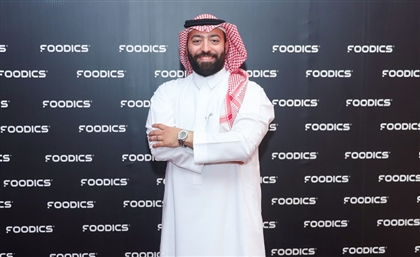





Armin Najib Left Engineering for Art and Took the Engineering With Him
Armin Najib handed his father a mechanical engineering degree and walked away from it. Fifteen years later, everything he makes runs on the physics he was supposed to have left behind
There's a particular kind of ceremony in Middle Eastern households, unspoken but rigorously observed. Doctor, lawyer, engineer. The list gets drafted long before a child can walk, and everyone plays their part when the time comes.
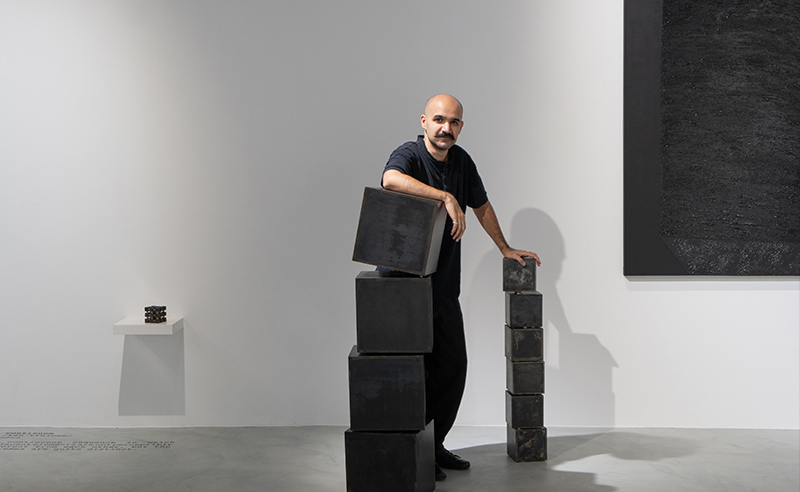
Armin Najib performed his version on cue, five years of mechanical engineering leading to the moment he placed the degree into his father's palms like a debt finally settled. Then he said his goodbyes and went to build things his father never asked for.
Fifteen years on, he has made a world out of that decision, one show and one material at a time, most recently in RE-FLEKT, which opened at Double J Collective in Dubai Design District in May. The crowd kept circling back to pieces that begged to be touched, worn and argued with rather than admired from behind glass.
That hazy line where the viewer becomes the subject is the crux of Najib's work. He has built an identity around the idea that a piece is rarely finished when it's simply observed.
"I started practising art when I was a teenager, and in a way, it followed me everywhere," Najib tells SceneNowUAE.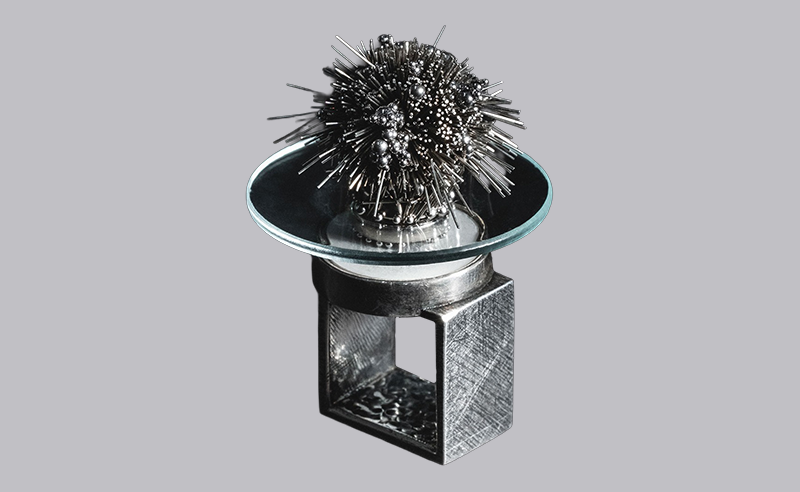 Back then the tension of his becoming came with the hiss of an espresso machine, as he wiped down tables at a café in Tehran. Upstairs, a gallery filled with people who spend their evenings arguing about meaning.
One morning that gallery traded its usual crowd of curators for a small circle of unmade artists, gathered around an expert talking about contemporary jewellery as though it were scripture. A forgotten cappuccino led the overqualified barista into the room, where he watched hands turn a sheet of metal into something that made him linger.
"Within a few minutes I felt completely connected to what was happening," he says.
With nothing to his name, no goldsmith in Tehran's bazaar interested in anything other than traditional fine jewellery, and no tutorials to follow, Najib bought books, second-hand tools and a jewellery bench, and taught himself the craft he had fallen for.
The rusty, hand-me-down bench became his closest companion for years. It watched his trials go on for ten hours at a time as he learned to cut and bend metal at a scale that eventually gave him arthritis.
"There were lots of failures, lots of melting down the whole alloy and starting over. It took a very long time for me to understand what was happening," he says.
So in 2012, determined that no one else would have to learn the way he had, Najib founded Najib Studio in Tehran; a space built to pass on the knowledge he'd spent years scraping together on his own.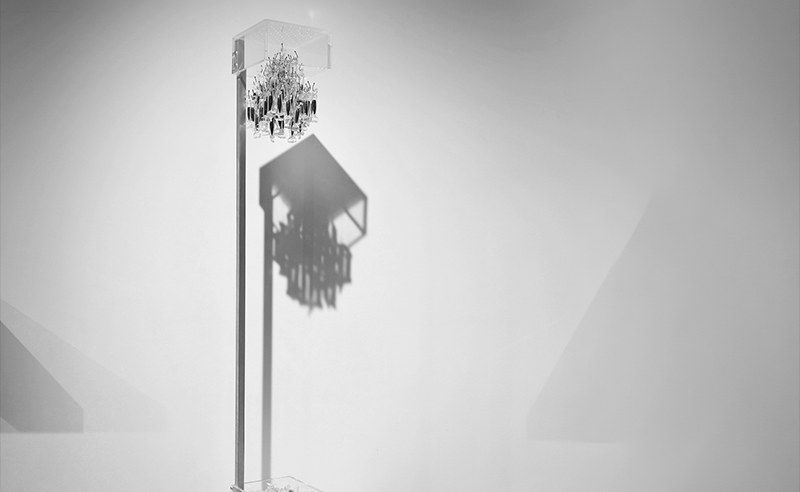 That long, arthritic apprenticeship found its reward in 2014, when Najib mounted his first solo show at the Association of Contemporary Architects in Tehran.
Titled Behind Human, A City, it held 130 pieces in sterling silver, each one an everyday object wrenched loose from its job and reborn as jewellery. A fork bent itself into a ring. A hammer shrank to sit on a finger. A pair of scissors, a paperclip, all made strange enough to look at twice.
A national newspaper ran a report and put the young artist on the front page, standing among his own work. His father, who bought his paper every morning without fail, found his son staring back at him.
"I think he bought about thirty copies and sent them to friends and family," Najib says, smiling at the memory. "That's when I proved to my family that I was an artist."
The engineering degree was never entirely discarded either. It taught him how materials behave and how structures fail, and gave him the confidence to alter objects others treated as sacred. Files were cut down. Expired dental instruments became carving tools.
"This needs to serve me," he says of one file he modified. "We need to become friends."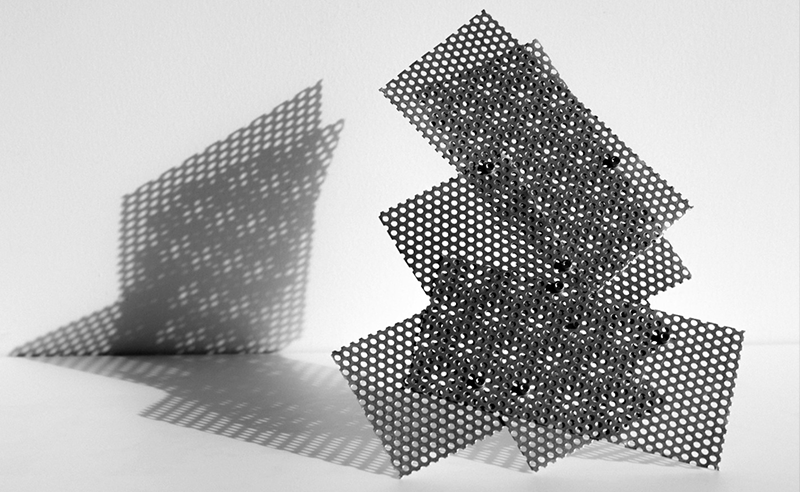 That instinct began much earlier, in the engine room of a cargo ship.
Najib's father was a marine captain who trained in England before the Iranian Revolution and spent more than two decades at sea. Sometimes Najib travelled with him, moving through ports while young enough to absorb each place without needing to name its effect.
Before GPS reached the ship, his father drew their route by the stars, and Najib still carries one of the instruments he used for it.
"Just imagine navigating from Iran to Brazil by the stars," he says. "I have so much respect for him."
Above deck, the world narrowed to blue water and sky. Below, it became steel, grease, smoke and noise. The engine room ran across seven floors, alive with generators, machinery and perforated metal sheets that captivated the boy and drew him back down every day.
"That whole environment had a lot of influence on me," he says.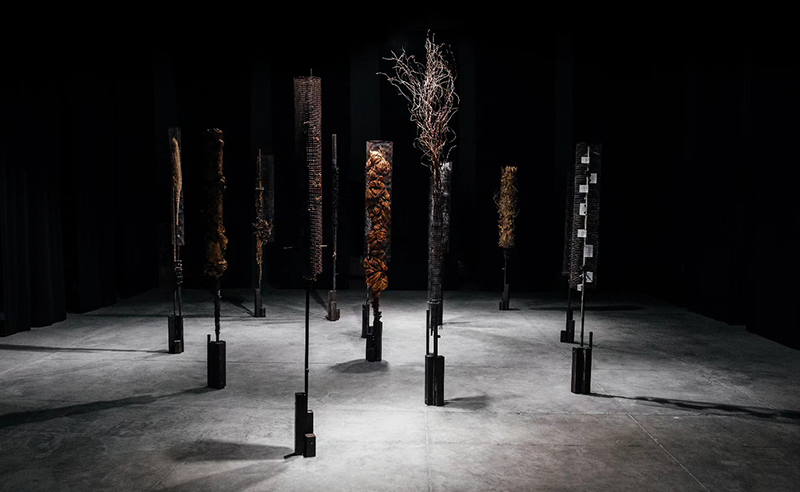 Those sheets recur throughout his work now, alongside magnets, iron filings, ball bearings and ferrous liquid, held together in something he wants to be both "intellectually and aesthetically beautiful."
"I started using magnets in my work, studying the poles, the attraction and repulsion between them," he says. "I wanted people to interact with the jewelry, not just have it sit there and become an object."
The materials came out of his native city's bazaar, where stalls carry industrial tools alongside spice sacks and trinkets, everything crowded together with no particular order. He liked to poke through it looking for anything unfamiliar.
"Instead of introducing myself as a customer I'd say: I'm an artist, show me something you don't show your regular customers."
One merchant took the bait, handing him a box stuffed with tiny ball bearings and waiting to see what he would make of it. What he made became the Mars series, shown at O Gallery in Tehran in 2019.
"I thought adding this to my jewellery would make it unique, interesting, and answer my own curiosity," he says. "I had a question, and as I searched for an answer, the outcome became the work. You can't imagine the final answer until you make it. As a designer you're solving a problem; as an artist there's nothing to solve, you're just answering your own curiosity."
Two years later that same restlessness carried him and his studio to Dubai, and to a material that fought back at every turn. He wanted ferrous liquid moving inside his rings rather than sitting still in them, using it to explore how movement plays out physically and psychologically.
The failures piled up fast.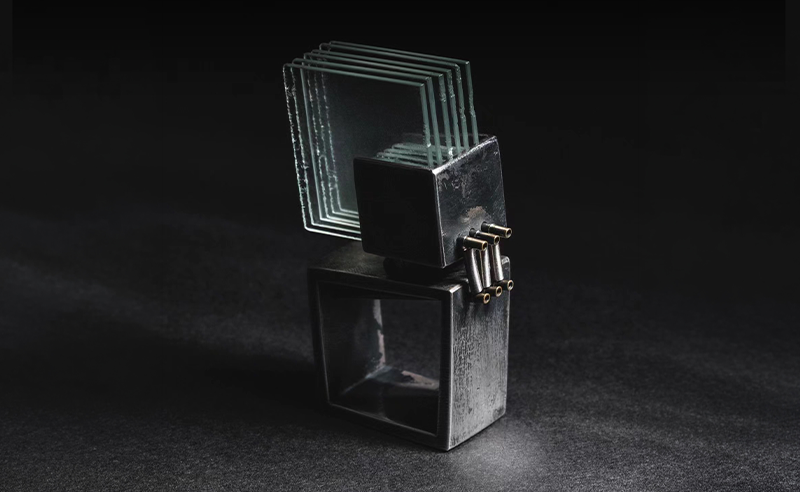 "I failed eighteen times working with the liquids, and fifty-two times figuring out how to secure the glasses on top of each other," he says. "I lost a lot of money before I got the first one working, but it's beautiful, intellectually, aesthetically, mechanically."
The first working ring opened onto a full body of kinetic and interactive rings, the liquid moving and settling with the smallest turn of a hand, turning something you would expect to sit still into something that seems to think for itself.
"The way they move is not just a matter of physics, but also psychology," he says.
By 2022 his fascination with invisible forces had become the Cube series, where magnets, glass, iron dust and steel worked as collaborators rather than materials. Suspended inside geometric forms, the particles shifted and pooled in response to hidden magnetic fields, turning each piece into a living demonstration of movement.
It also began his fixation with the cube, not as a shape so much as a frame for holding chaos, precision and constant transformation.
"We're the only creatures on this planet that find peace and tranquillity in a square," he says. "I think it's something that's been brought to this planet somehow, that differentiates us from everything else. Is it peace, tranquillity, or just design convenience? I don't know, but that question is central to my work."
Once he had proved the ideas could work at an intimate scale, Najib started asking what would happen if they occupied a room instead of a hand.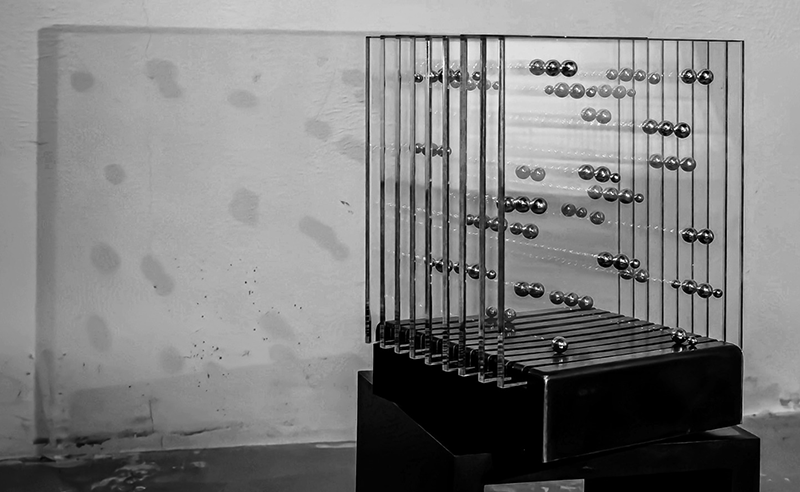 The answer was The Wall, his 2023 sculptural series at Sima Collective in Dubai, and the turning point in his practice. Built from steel, magnets, glass and natural elements, the works took the wall, traditionally a symbol of protection or separation, and left it caught between construction and collapse, asking whether the barriers we build ever really keep us safe.
"I wanted people to interact with my art, not just have it sit there and become an object."
Scaling up wasn't about making bigger pieces. It was about making work that could hold a conversation, letting people experience the invisible forces that had fascinated him rather than watch them.
If The Wall asked what separates us, -continuum wondered what connects us. Shown at Aisha Alabbar Gallery in Dubai in 2024, it pushed his exploration of magnetism past movement and into relationships, tracing the unseen forces that bind matter, people and memory together.
In the Perfect Cubes series, the cubes were no longer rigid containers but shifting systems suspended between order and entropy. Magnetic fields became visible through iron filings, steel seemed to defy its own weight, and every work carried the sense that what we cannot see is often what exerts the greatest pull.
The work is often brutalist at first glance, dark and patinated, and then the severity breaks into movement and microscopic care, which comes from his years in jewellery. When Najib moved from objects measured in fractions of a millimetre to sculptures three metres high, he refused to treat scale as simple enlargement.
"A big sculpture isn't just an inflated small sculpture," he says. It has to survive from across a room, then reward someone who comes close enough to inspect a two-centimetre decision.
He avoided welding entirely, refusing the reaction that would alter the metal's colour, and riveted instead. But every rivet punctured the design in a way he couldn't leave hollow, so even knowing it would go unnoticed, he bent over the structure for days, setting thousands of Swarovski crystals with a reverence one reserves for Sundays.
That, to Najib, is preciousness. Not the price of gold or the legitimacy of a gemstone, but the attention given when no one is there to watch.
Colour would compete with that attention, which is one reason much of his world stays black, white, steel-grey or rusted. Raised inside the colour-rich visual language associated with Iran and the wider region, he resisted becoming an artist recognised through inherited symbols.
"I'm trying to remove the borders of my work," he says. "If I just became one more of them, what would that add?"
That resistance runs all the way down to the art itself. Ask Najib what any of it is for and he'll tell you: nothing.
"Art is useless," he says, almost offensively. "There's no use for it, because it's not used."
Give a piece a use and it becomes an object, something to be resolved once and then ignored. Leave it useless and it keeps circling back through your mind.
"That's the only answer we have," he says, "to fight against whatever is happening."
Related Articles

Trending This Week
-
-
 Oct 15, 2026
 -
-