

Saudi Artist Alif is Sculpting Out the Arabic Letters
Saudi artist Alif turns Arabic letters into three-dimensional sculptures pushing the boundaries of traditional calligraphy.
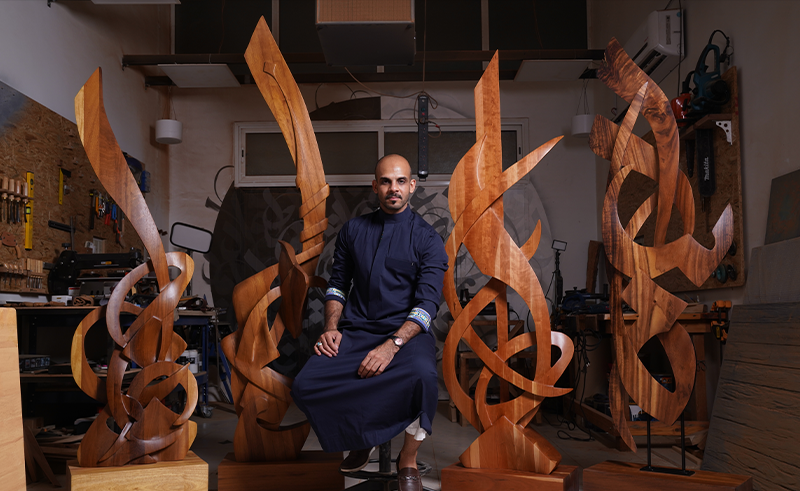
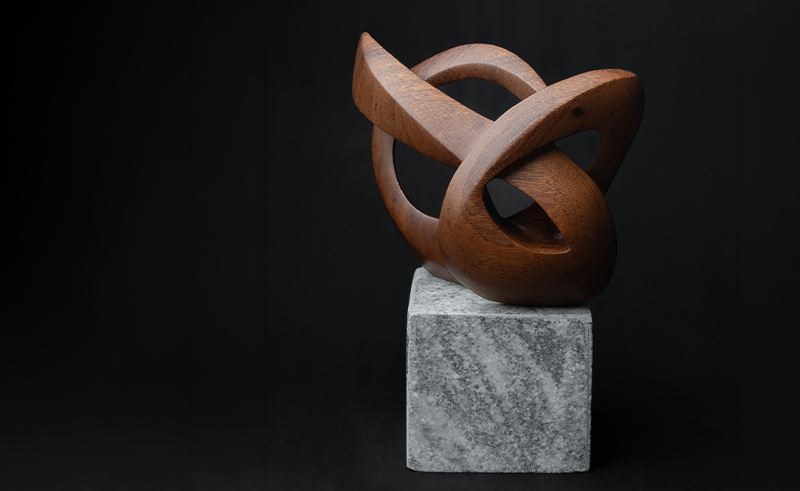
Saudi artist Alif approaches Arabic calligraphy as more than a written art form and takes it beyond the page, turning letters and words into sculptural forms carved into granite, wood and other materials. In his work, the written word becomes something you can move around, examine from different angles and experience as a physical object, with each material bringing its own character to the idea behind it.
That relationship between form, material and meaning came into focus in Out of Black, his latest solo exhibition, which opened at Katara Art Center in Doha in April 2026. Drawing on his own experience of leaving a secure career in the energy sector after 17 years to pursue art full-time, the exhibition explored what happens when the comfort and security we've built around ourselves start to feel restrictive.
“I imagined what the air feels like inside your comfort zone,” he says. “You think you’re safe because you’ve built walls around yourself, but those same walls make the air inside suffocating. It doesn’t circulate. New air can’t come in, and old air can’t get out. It becomes stale and ruined.”
Featuring granite sculptures with burnt surfaces, alongside wooden works and a fabric installation, Out of Black translated those feelings into material and form. Most of the sculptures featured the Arabic letter Haa' (هـ), a recurring element in the exhibition.
“At the core of my practice, and why I do art, is calligraphy,” Alif says. He first explored it through graffiti in 2014, drawn to the idea of making art in public spaces, where people could come across his work outside a gallery.
 Originally from Tarout Island, off Saudi Arabia’s Eastern Province, Alif painted his first major wall at Hammam Tarout that same year, spending 10 days turning Adnan Al-Awami’s poem Al-Awda (The Return) into more than 120 square metres of calligraphy. Around that time, many Saudi artists entering the graffiti scene were choosing English names influenced by hip-hop culture. He wanted an Arabic name, choosing Alif, the first letter of the Arabic alphabet. Its single upright stroke reminded him of the amoud al-khaimah, or tent pole, of words. “It’s not there, but it holds all the words together,” he says.
Sculpture came later, almost by accident, when Alif decided to make a spoon for cooking, something he loved doing for the people close to him. “The first one looked pretty stupid, but the experience was overwhelming. It stopped me in my tracks,” he admits.
Alif began making more spoons, initially just for the sake of it, before art entered the picture in 2018. Then the studio came along and everything moved quickly. What started as an experiment eventually grew into a sculptural practice built around Arabic calligraphy, with words carrying a different kind of weight when translated into physical form.
“If you choose a pattern, an abstract or ornamental form, or something based on plants, and turn it into a sculpture, it carries the weight of the idea or the thing you’re representing,” Alif says. “But if you put words into it, it carries the weight of a human being, which is truly heavy. That’s why I chose calligraphy over everything else. It tells you a lot without saying much.”
“A lot of people see Arabic calligraphy as rigid, as though the classical styles have reached their limits. But I don’t see it that way,” Alif says. In sculpture, he explains, you can stretch the script however you want, and the two pull against each other like opposite poles of a magnet: one demands planning and engineering, the other requires you to feel the words.
Alif’s range of materials extends beyond the stone and wood that feature prominently in his practice. He has also worked with silver, glass and fabric, exploring what each material brings to a piece. Fabric was a first during a residency in Paris, and he was struck by how different it was from stone. “Fabric is different because it moves. It’s so delicate, especially the type I chose,” he says. Glass, on the other hand, didn’t start so smoothly. “I hated myself on the first day. Believe me, I hated myself. But it’s great.”
-75da9785-b778-40e6-af12-1a9e007d018f.png) “Every material adds a different spirit, and you can’t avoid that,” Alif says. “If something requires stone, you can’t achieve the same result with another material. At the same time, working with an unfamiliar material opens up new horizons, even for the other work you’re doing.”
For Alif, that experimentation begins with a fairly traditional approach. Despite the range of materials he works with, calligraphy remains the starting point for his sculptures, with each piece taking shape around the words themselves. “I’m quite old-fashioned, and I adore the traditional approach. I use a classic Arabic pen and ink to start all my sculptures,” he says.
From there, he begins thinking about the theme and visual feel of the piece before working through its structure, paying particular attention to its weak points and weight distribution. The process can take between 20 and 30 days, though designs he has never attempted before can take longer. “The last 20% of the work takes around 80% of the time,” he says. “It’s the part that never seems to end, especially if you’re a perfectionist.”
That attention to detail is especially important when carving letters into a three-dimensional form. Each letter needs to work alongside the others, with its thickness, curvature and proportions carefully balanced. Even a small change can mean adjusting another part of the sculpture to maintain that balance. If he loses a centimetre in one line, he has to make it up somewhere else, and he has to decide on the spot.
“There’s always adrenaline, and that’s probably why I’ve stuck with sculpture,” Alif says. “You have to trust yourself, even when you have no solid ground to stand on, and just keep going.”
His relationship with sculpture began with the humble spoon, and it is one he has returned to with Silver Soul. The collection revisits the calligraphy-carved spoons he made by hand when he first started sculpting, casting those original designs in silver in 2026.
-08d5bfc1-03f5-4188-a2c6-5ea5284721f6.png) When he first began carving, Alif didn’t even have the proper tools. After a carving knife he had ordered failed to arrive, he took a knife from his kitchen and started working with it instead, cutting himself several times in the process. He still has the cheap Swedish carving knife he eventually got.
The very first spoon, Spoon No. 1, is the one piece he says he will never sell. “The first piece kick-started everything, which is why I love it,” he says. When one collector wanted it badly, he made a replica with the same dents and mistakes and didn’t tell them it wasn’t the original.
The spoons also connect to Alif's first collection, Synonyms of Love, which explored the many words Arabic has for love. There are around 40 of them, and Alif created seven pieces before moving on to larger sculptures, leaving the smaller works behind for a time. The first of those larger pieces was two metres long, carved from wet wood he sourced locally, and it was a real challenge. It also changed things for him. Sculpture had always occupied a very small corner of the Saudi art scene, and that piece opened the door to selling his work. It led to a commission for four pieces of the same length, which are now displayed in AlUla.
In revisiting the spoons, Alif found a way to reflect on the difference between something that looks valuable and something that holds meaning. In Islam, eating with silver or gold is forbidden, making silver spoons beautiful objects that cannot serve their intended purpose.
“It’s the same with our emotions,” he says. “If they’re superficial, they might look nice, but they’re useless. We need deeper emotions and more meaningful connections with one another.”
Love runs through Alif's work beyond the spoons, too. Al-Wadud, which Alif says was probably the second piece he made from the Asma’ Allah al-Husna, the 99 Names of God, takes its name from one of them. Rather than going for a name that was already popular, he chose this one, which means “The Most Loving.”
“The driving force that keeps humanity moving, despite all the madness we see, is the need to love one another,” he says. “You have to love what you do, your work, your neighbours, your plants and the animals around you. Without love for any of those things, you can’t continue living.”
For Alif, the point is not to force a message onto an object, but to find something that resonates with him enough to reach someone else.
“If you force a story into something, you create a wall between the viewer or listener and what you’re trying to communicate,” he says. “But if the story is honest, and it touches me, I know it can touch others.”
Despite the years he has spent developing his practice, Alif feels there is still more of himself he wants to bring into his work; becoming more open about what is going on in his heart and mind, and allowing more of his own experiences and emotions to find their way into his sculptures.
“I want to put more of myself into my work and become more transparent,” he says. “I still have a long way to go in that regard.”
Related Articles
Trending This Week
-
-

-
 Nov 09, 2026
-