






REVIEW: ‘Everytime’ Asks What Remains When Someone Dies
Rather than simply depicting this psychological condition, 'Everytime' inscribes it into the very fabric of the film form.


It is increasingly rare to come across a film that does something genuinely new with the cinematic form, one that reminds you of the seemingly inexhaustible possibilities of the medium. Sandra Wollner’s Everytime begins as an intimate exploration of grief, then gradually evolves into something metaphysical. It interrogates the very boundaries between memory, consciousness, time and death. It might just be my favourite film of the year.
Following a tragedy, a mother, a daughter and a teenage boy are brought together by circumstances none of them could have anticipated. Struggling with guilt and forgiveness, the unlikely trio travel to Tenerife for a family holiday. Beneath the warmth of the island’s sun, the boundaries between past and present gradually begin to collapse.
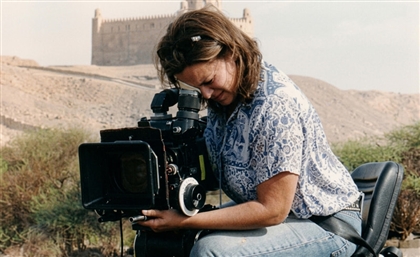
 The film was shot by Gregory Oke, thecinematographer behind Aftersun, which happens to be one of my favourite films of the last twenty years. Everytime is an equally extraordinary achievement in cinematography. Particularly in its third act, Oke makes exquisite use of the fleeting natural light of magic hour, infusing the images with a dreamlike quality that is both hypnotic and strangely ethereal. There is something very poignant about photographing a film concerned with loss during that brief interval of the day when light itself is on the verge of disappearing.
What I found particularly moving about Everytime is its understanding of the nature of mourning in the digital age. The dead continue to inhabit the spaces of the living through the material and digital traces they leave behind. They exist in photographs attached to fridges, in old text messages, in the voices preserved in audio recordings and in videos capturing seemingly inconsequential moments. These so-called “digital ghosts” occupy a strange space between presence and absence. Technology has afforded us a means of revisiting the dead without granting us the possibility of ever truly interacting with them again. We can hear their voices, but sadly it’s only a one-way communication channel.
When my father passed away, I found myself clinging to what little audio-visual evidence I had of his existence. I would revisit old messages, listen to recordings of his voice and watch videos whose significance I could never have anticipated at the time they were taken. Even something as mundane as changing phones became an emotional ordeal, accompanied by the fear that I might inadvertently lose another fragment of him. Death had fundamentally altered my relationship with these objects and recordings. Ordinary remnants of everyday life had become irreplaceable artefacts of a life that no longer existed. The past becomes endlessly accessible, yet permanently unalterable. Everytime understands this contradiction and, remarkably, finds a cinematic language through which to express it.
-b7038757-86dd-40a0-a530-b222533c0687.png) As the film progresses, memory ceases to function merely as a recollection of the past and becomes something that seemingly coexists with the present. The distinctions between subjective experience and objective reality, between the living and the dead, become increasingly impossible to locate. This formal departure emerges from the emotional experience of grief and unfolds seamlessly. Come to think of it, mourning itself is a profoundly nonlinear experience. A person can be physically situated in the present while emotionally inhabiting a moment that occurred years ago. The dead can feel overwhelmingly present one moment and unbearably absent the next. Rather than simply depicting this psychological condition, Everytime inscribes it into the very fabric of the film form.
Much of my current PhD research revolves around the question of how cinema makes the invisible perceptible. In this respect, I found this film so fascinating. André Bazin understood the photographic image as a means of preserving existence against the passage of time. Roland Barthes understood the photographic image as something ghostly. In its final passages, Everytime taps into this fundamental property of the medium to devastating effect. It becomes a film not only about our inability to let go of the dead, but about cinema’s extraordinary capacity to momentarily suspend the finality of death.
- Previous Article Lora Reworks Sudanese Wedding Classic into Pop-Rap Debut ‘Naseeb’
Related Articles

Trending This Week
-
 Nov 22, 2026
-

-

-