





How Siwa Inspired Esraa Badawy’s Journey Into Contemporary Ceramics
Handmade tiles, mirrors, and clay pieces became Esraa Badawy’s language of storytelling, each one shaped through a process infused with heritage, memory and nature.

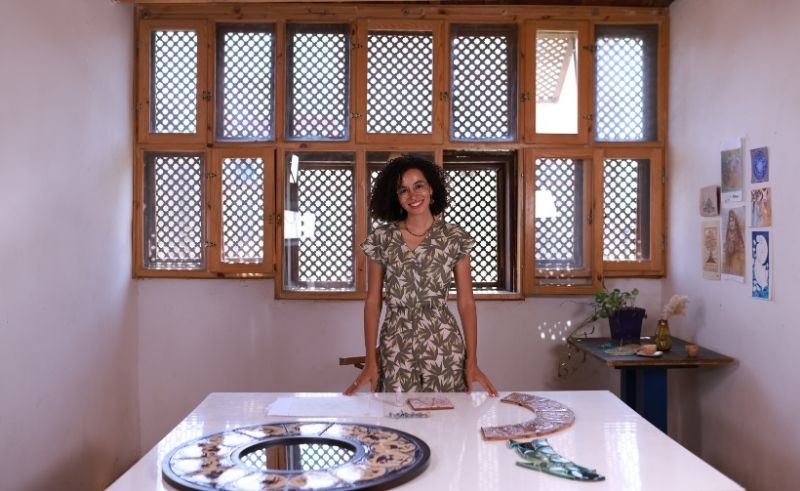
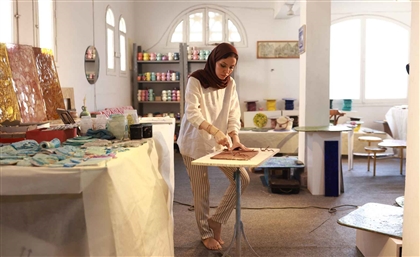
After nearly a decade in architecture, Esraa Badawy decided to take a different path, one that was slower and deeply rooted in storytelling. Today, under her brand Esraa Badawy Ceramics, she creates tiles, mirrors, wall panels and different home décor pieces that blend heritage, nature and culture with contemporary designs.
“I worked for about eight years in architecture before I realised I wanted something more personal, something with soul,” Badawy tells SceneHome. “My job as an architect was fast-paced and often trend-driven, but I wanted to make pieces that carry stories.”
Her brand now spans two main lines: custom handmade tiles and home décor. The tiles, she explains, are designed to reflect identity and memory. “Some homeowners want to preserve nature they love, so we imprint real leaves and flowers into the tiles, almost like fossils. Others want to carry memories of places like Siwa or Dahab into their homes, with engraved skylines or architectural motifs from those landscapes.”
-e916e739-a765-435d-ac15-67dee5d25d20.jpg)
The home décor line takes inspiration from Egypt’s layered heritage, from the lotus mirrors echoing ancient temples to wall panels abstracting the skyline of Shali’s mud-brick fortress in Siwa. “The lotus mirror has a colour gradient that gives a blooming effect that symbolises rebirth,” she says.
Badawy traces the beginning of her ceramics journey to Siwa in 2020, at the height of the pandemic. Restless with routine, she impulsively cycled away from her architectural office job and travelled west. “Siwa was raw, slow and pure. I was walking when I found a small handmade ashtray with a smiley face on it. It turned out a young girl had made it from the clay on her family’s land," Badawy says. "That was the moment that made me wonder how many children had this passion but no outlet to grow it.”
-825f3a98-9bd7-4179-8519-fcfafe1997d3.jpg)
She discovered that traditional pottery in Siwa was fading, practised only by elderly women and often producing fragile, non-functional pieces. Back in Cairo, she decided to experiment with clay herself. “I self-taught for months before I ever went back to Siwa. I had to be confident with my hands and with the material. It was about learning how clay reacts, how to prepare it, how to fire and glaze it properly before I could pass it on.”
Determined to bridge design with craft, Badawy began teaching Siwi children to work with stronger, more durable materials while letting them express their own shapes and forms. “I didn’t tell them what to draw. They engraved what they felt, what belonged to them," she says. "It became a vernacular design language.” Pieces from that project are still being produced and sold locally.
-ec3c292f-160a-490c-bc80-5dc20a9fa046.jpg)
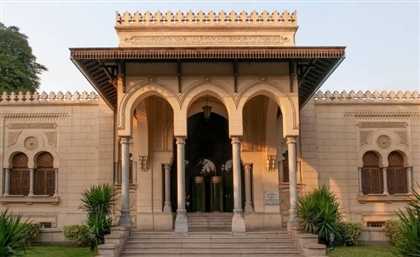
That experience pushed her to study more formally, completing a two-year diploma at the Jameel House of Traditional Arts. “I wanted to understand not just ceramics but the heritage behind them, tracing Egyptian arts from Pharaonic to Islamic to Amazigh influences. Every motif, every symbol has an origin,” she explains.
Her designs often reinterpret these layered histories. One example is the Agro Mirror, inspired by a traditional Amazigh silver necklace passed down through generations of women. “It’s a necklace that celebrates every stage of a woman’s life. I translated that into a mirror made of twelve puzzle-like pieces, each carrying motifs from different civilisations.”
-e956c0e9-dc3d-420d-9c1c-b8dfa8289864.jpg)
What drives her practice, she explains, is bridging the gap between craftsmen and designers. “Craftsmen know the material but often repeat the same forms. Designers create new ideas but don’t understand the making. I try to bring the two together by respecting the slow process, while innovating in design.”
Today, Badawy collaborates with interior designers, embedding her ceramic work into larger projects. For her, it’s about building awareness of handmade craft in an age of mass production. “Tiles today are industrial, replicated. But once upon a time, like Iznik tiles, they carried colours and stories. That’s what I want to bring back.”