





The Arches That Outlasted an Empire in Moorish Spain
Granada fell in 1492, taking the last Muslim kingdom in Spain with it, but its arches, tilework and techniques stayed, moving into Christian palaces and Gaudí's Barcelona.
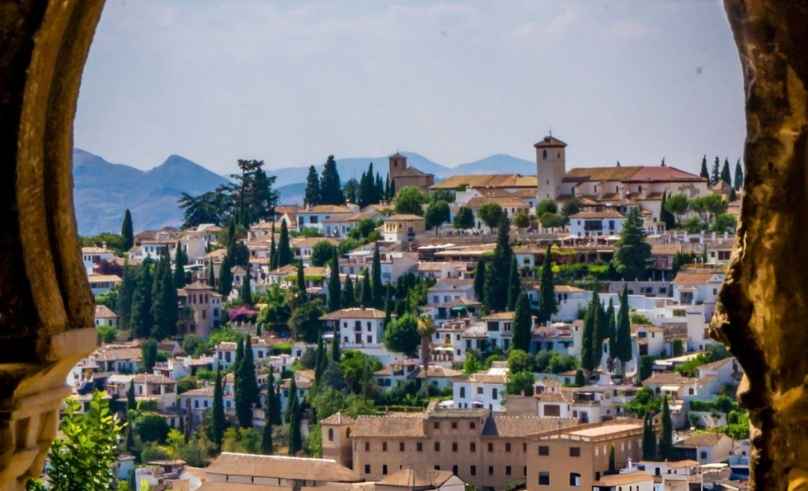
Andalusia was ruled from North Africa and the Islamic world for close to 800 years. Granada fell in 1492, and with it, centuries of Islamic rule ended, but its architectural history continued when the region became Christian Spain. Moorish arches, courtyards, and towers were never torn down, only added to, repurposed, and copied by architects with no connection to the empire that originally built them.
The era's most influential structures were born from four dynasties, the Umayyad caliphate that founded the Great Mosque of Córdoba in 785 through to the Nasrid kingdom that built the Alhambra as its last stand. Typical historical framing treats it as a chapter closed, a set of monuments from a period that ended. Yet, the same techniques that built these monuments are still relevant today, turning up in patterns and buildings produced now.
 Al-Andalus in Phases
Islamic rule in the Iberian Peninsula lasted from 711 to 1492. Its architecture moved through distinct phases and kingdoms, each leaving its own stylistic footprint.
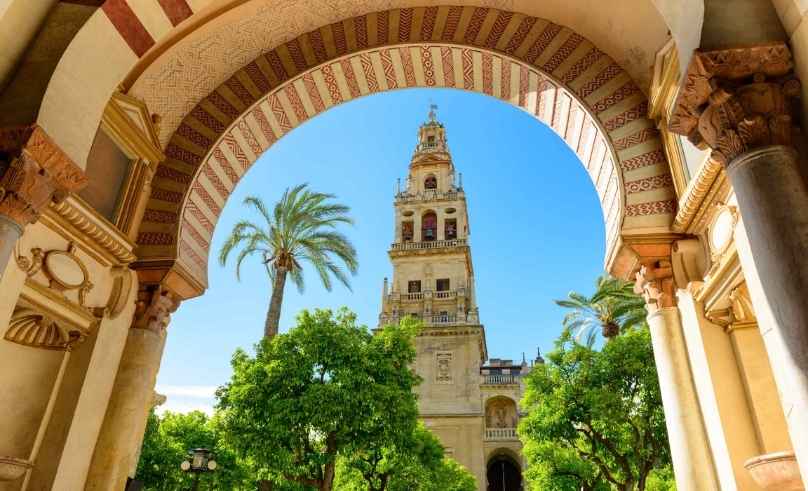
The Umayyad Caliphate ruled al-Andalus from 756 to 1031, founded when Abd al-Rahman I fled the Abbasid overthrow of his family and rebuilt Umayyad power from Córdoba. He began on the construction of the Great Mosque in 785, using salvaged Roman and Visigothic columns too short for the roof he wanted. Builders stacked a horseshoe arch under a semi-circular one, a fix that became the style's defining form. The mosque grew for two centuries after, layers added by successive rulers who built the minaret, the mihrab, and ribbed domes finished by imported Byzantine mosaicists.
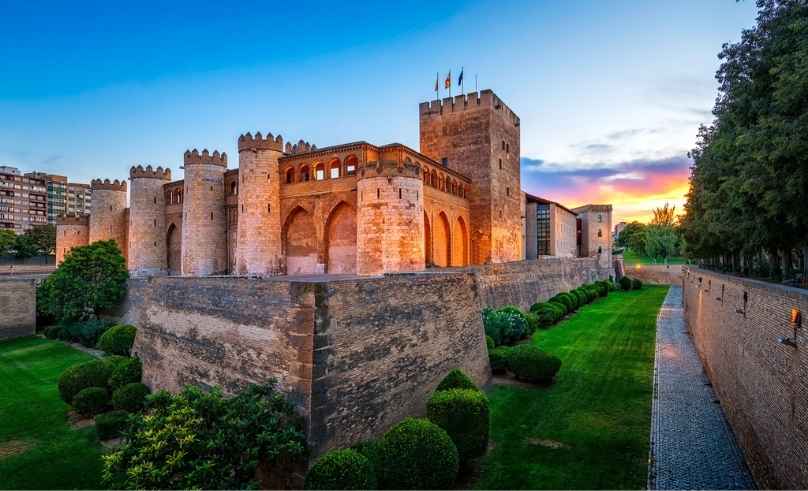
When the Caliphate collapsed in 1031, al-Andalus split into competing city-states, the Taifa kingdoms. Zaragoza’s ruler, Al-Muqtadir, built the Aljafería as a pleasure palace outside the city walls, calling it Qasr al-Surur, Palace of Joy. Its exterior is fortress-like and gives nothing away. Inside, a courtyard rings with cusped arches, leading to a Throne Room with a panelled ceiling carved into star shapes, the only large Taifa-era building to survive intact.
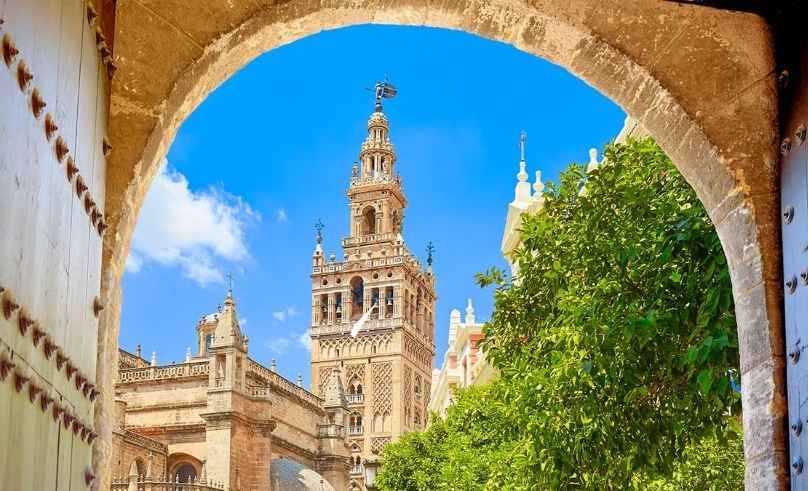
 The Almoravid and Almohad dynasties ruled from 1091 to 1238, governing from North Africa first and al-Andalus second, and their architecture shows it, heavier and more restrained than the Umayyads. Seville's Giralda, begun in 1184 as the city's minaret, descends directly from the Almohads' own minarets in Marrakech. It's built almost entirely from brick, patterned with geometric sebka relief instead of carved stucco, with interior ramps rather than stairs so the muezzin could ride a horse to the top.
Muhammad I founded Granada's Nasrid dynasty in 1238 as a tributary vassal state to the Christian kingdom of Castile, the last Muslim kingdom left on the peninsula. Within the constraints of its status, the Nasrids spent two and a half centuries building the Alhambra, each addition adding more, muqarnas ceilings, carved stucco running wall to wall, courtyards built around reflecting water.
 Two Buildings, Two Arguments
The Mezquita and the Alhambra make opposite arguments about how ornament and structure relate to each other, and the gap between them is the point.
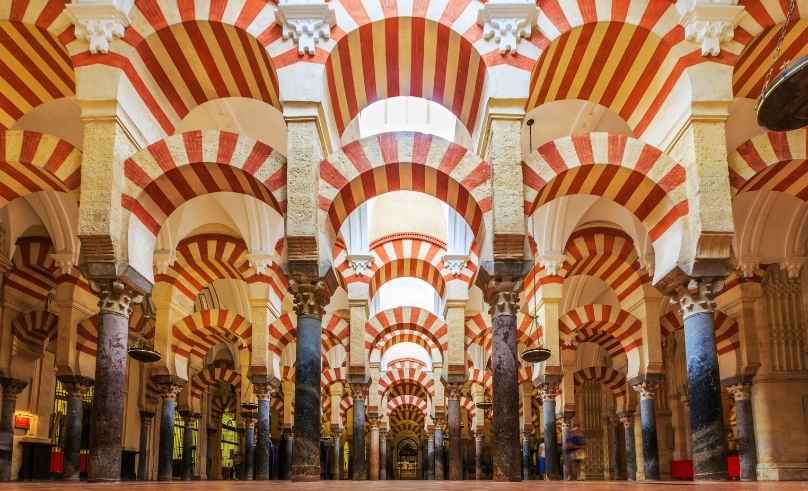
The Mezquita is Umayyad, built and expanded between 785 and 987. Its case is that scale and repetition can do the work ornament usually does. Rows of columns, salvaged from Roman and Visigothic ruins, carry stacked horseshoe and semi-circular arches, striped in alternating red brick and white stone. Its design is not particularly elaborate, focusing on repetition as an effect. The same column, arch, and stripe repeat hundreds of times across the hall.
The Alhambra is Nasrid, built across two and a half centuries between 1238 and 1492. It argues the opposite. Rather than repeat a simple form at scale, it stacks different techniques into the same small rooms, muqarnas ceilings over carved stucco over tile mosaics over courtyards built around still reflecting water.
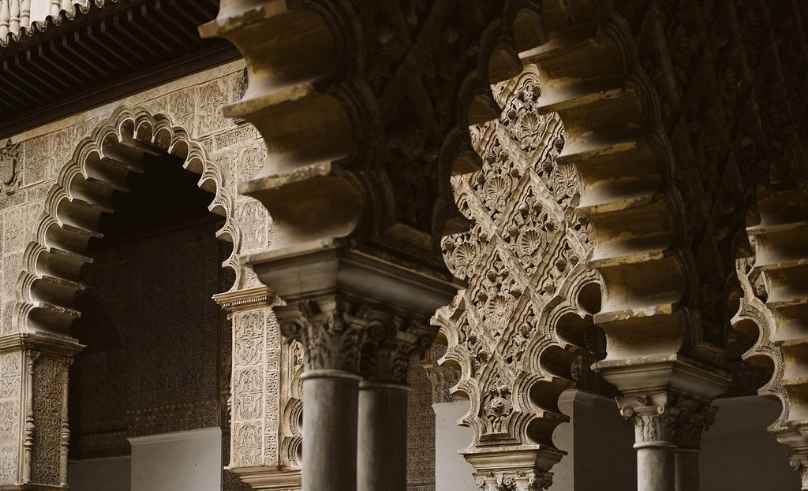
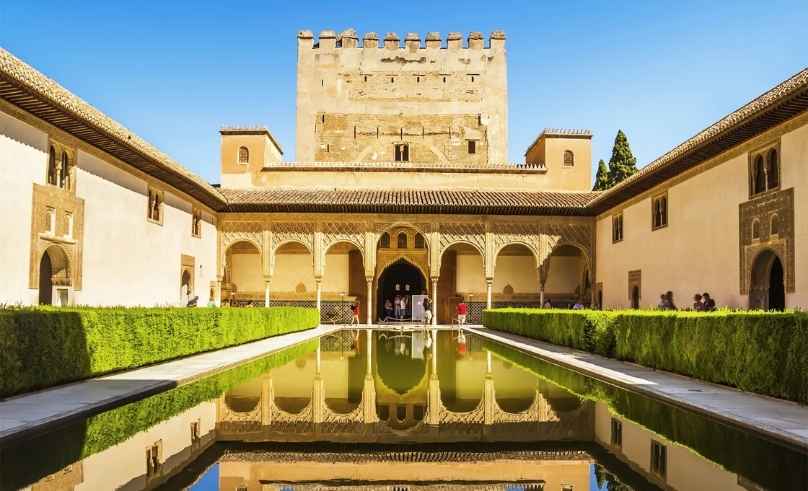 Seville's Real Alcázar sits between the two, in both technique and time, though its foundation is neither Umayyad nor Nasrid. Pedro I of Castile built the current palace in the 1360s, after the Reconquista, using craftsmen brought in from Granada, some of whom had worked on the Alhambra.
The result reads as Nasrid design under Christian patronage. Its domed hall springs from muqarnas in gold rather than the Alhambra's carved stone, and the same cusped arches and stucco work run throughout, built a century after Islamic rule in Seville had already ended.
 What Survived 1492
What followed is called Mudéjar, work by Muslim craftsmen who stayed in Christian territory after conquest and kept building in the style they knew. Christian rulers in Seville had Gothic building traditions readily available and used them elsewhere in the same complex. Choosing Mudéjar for the Alcázar's royal apartments was deliberate, a decision to keep building in a regional idiom that had become as much Iberian as Islamic.
The style outlasted the empire that produced it by centuries. It shows up in Aragón's brick belfries, recognized today for distinctly blending Islamic tradition with Gothic technique. It resurfaces again in the 19th century, when revival movements built Neo-Mudéjar structures, and again when Barcelona's Modernista architects, Antoni Gaudí among them, worked horseshoe arches and glazed tilework into Art Nouveau buildings inspired by Islamic architectural techniques.
 The habit is to treat Moorish architecture as something Andalusia contains, sites to visit after a period ends. A more accurate description is a way of building that keeps moving through hands. Horseshoe arches show up in buildings built for Catholic monarchs. Muqarnas-adjacent vaulting shows up in 19th-century revival work done by architects with no connection to the Nasrid court. The tilework survives in patterns still produced today, largely unchanged in geometry even as the religious and political context around them have completely shifted.
- Previous Article Behind the Making of 'Comfortably Numb, Reimagined'
- Next Article Photo of the Week: Malek Al Dayni