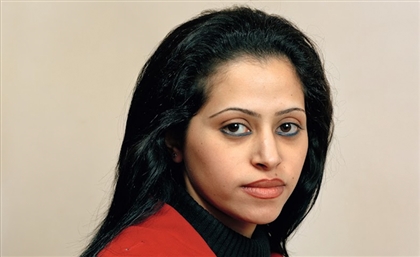






Sandy Chamoun's 'Sawt El Doumouh' Turns Sorrow Into Something Stranger
Lebanese artist Sandy Chamoun's second album is a stunning refusal to grieve quietly. Mournful, defiant, and stranger than you'd expect.
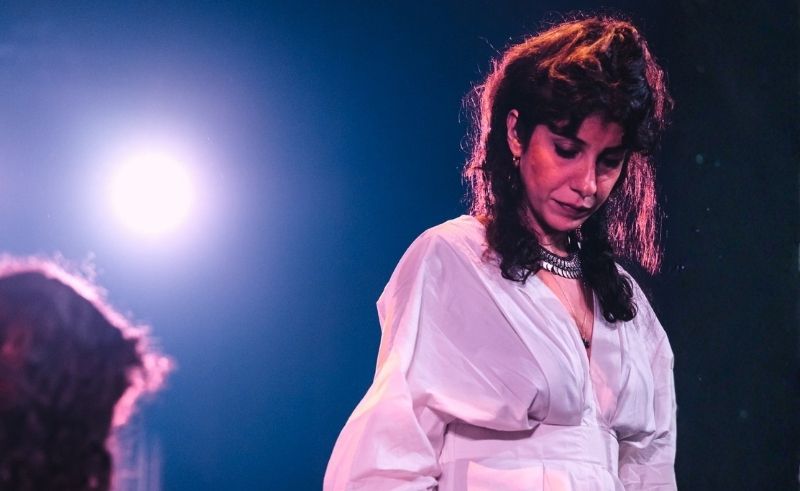
There's a dark story from childhood that Lebanese artist Sandy Chamoun channels on this album. A teacher screamed at a crying boy: "Cry, but don't make any sound." Chamoun wrote 'Sawt El Doumouh' in the shadow of that logic: witnessing a genocide in Gaza and living through a war at home in Lebanon, she woke up morning after morning, crying silently.
'Sawt El Doumouh' tries to express that silence and bring it to life: through grief, through exaltation, through defiance. But the sound of the album is not what you might expect. It doesn't announce itself with slogans or rage. Instead, across seven tracks drawing from Tarab, Cantu, Arabic classical poetry, southern Lebanese folklore and contemporary electronics, Chamoun builds something stranger and more durable: an aesthetic of sorrow that keeps finding light in itself, that mourns and then lifts, that confronts death but insists on beauty.
The album was supposed to be something else entirely. Inspired by Cantu, the polyphonic Sardinian ritual tradition celebrating humanity's victory over nature, Chamoun had planned to travel across Lebanon and write a song for each place. That ethos is still evident in places, though broken down, torn apart, and viewed through a lens of despair the album took on after October 2023.
It opens with ‘Khafy', where horns and bass establish the frame, almost bell-like in their resonance. Slamming 808s carry a low, insistent, singular pulse that doesn't move from its note for the duration of the track. What feels at first like restraint reveals itself as strategy. The instrumental locks to one chord, one harmonic centre, while textures accumulate around it. Bowed strings, wind chimes, overtones blooming from the sustained horns into something lush and almost overwhelming. Over all of this, Chamoun's voice meanders, searching and uneasy. The contrast is productive. The instrumental world is vast but static; the voice is the only thing that moves.
‘Wa' is sparser but more rhythmic. Chamoun's autotuned voice doesn't smooth or prettify so much as estrange, making the classical Arabic it carries sound like it's arriving from somewhere else, a choice that shows up across the record and earns its keep. The track opens gradually: percussion sets the scene with layered autotuned vocals building on top, then trilling plucks, engulfing bass and sweeping arpeggios arrive, before the whole thing accelerates into an evolving, abstract crescendo that doesn't resolve so much as disperse.
Metallic percussion and finger drums in 3/4 walk us into ‘Shahed', which maintains an eerie feel underneath a major key and an optimistic melody. Ghostly vocal echoes creep up from below while Chamoun's singing cuts through like rays of light through the smokey atmosphere. Then, midway, the arrangement deteriorates. Gritty claps and competing melodies push the track into more aharmonic territory, before the percussion returns at double speed, tightening everything into racing tension. A more conventional arrangement closes it out, where bass and synth mirror one another with urgency. Chamoun wrote the track after seeing a photograph of a boy on a horse on a beach in Gaza. The witness, she says, lives far from the shore in the water, watching the fire and trying to help. The duality is audible: the percussion is desert-dry, the synths and vocals evoke something aqueous and floating. It's one of the most fully realised tracks on the record.
The title track, 'Sawt El Doumouh’, opens with autotuned harmonised vocals before a massive bass and spaced-out handclaps arrive, lifting the performance into something between a chant and a lament. Lyrically it's among the most directly affecting moments on the album; instrumentally, it's the most restrained. Perhaps too much so. There's a sense of something held back that the arrangement never quite releases.
'Ward W Shok' is the closest the album gets to a familiar arrangement. A mellow synth melody with tabla percussion fades in, autotune back on Chamoun's vocals, which slide smoothly over an instrumental that feels more characteristically Arabic and nostalgic in its tonal colouring than anything else on the record. The vocal melody choices are particularly strong here, the phrasing complementing the synth line in a way that feels both natural and considered. Then a righteous organ interlude upends the track. A moment of uplift that's as unexpected as it is satisfying.
Built around a string arrangement and bowed buzuq by Abed Kobeissy, 'Ataba' is the outlier, leaning into a more acoustic sensibility. The classical influence is explicit, the string textures gritty and eerie, Chamoun's vocals less processed than elsewhere. But the strings aren't straightforwardly traditional; Oriental phrasing erupts in the spaces between the established motif, and effects are deployed in places to modernise them, mostly as a source of tension. In the second half, things begin to stutter until the whole thing becomes overwhelming with textures.
The album closes with 'Latife', a voice note from Latife Chamoun Atoui, delivering an intimately sung hand-off that ends the record on its quietest, most personal note.
Throughout 'Sawt El Doumouh', Chamoun is doing something that resists easy summary. This is a mournful record and a defiant one, artful and adventurous, rooted in multiple traditions without feeling like an exercise in any of them. The production by Chamoun and Anthony Sahyoun (who also plays synths and handles electronics) and Ali Hout's live percussion give the album a physical, tactile quality; Heba Kadry's mastering from New York gives it weight without clarity.
The connections Chamoun makes between Tarab's emotional directness, Cantu's polyphonic ritual structure and the granular possibilities of electronics feel genuinely synthesised rather than assembled. And the songs themselves, whether they soar or sigh, capture a reality of mixed hope and despair that's more nuanced than what the gravity of the subject matter typically inspires. That's not a small thing to manage when the material is this heavy, and the times are what they are.
Related Articles
Trending This Week
-
-
 Oct 15, 2026
 -

-