






In Egypt’s Nile Delta, Wheat Harvesting is a Question of Machinery
An EU-KAFI Programme in Damanhur is expanding access to mechanised farming tools as Egypt pushes to reduce wheat losses and strengthen domestic production.

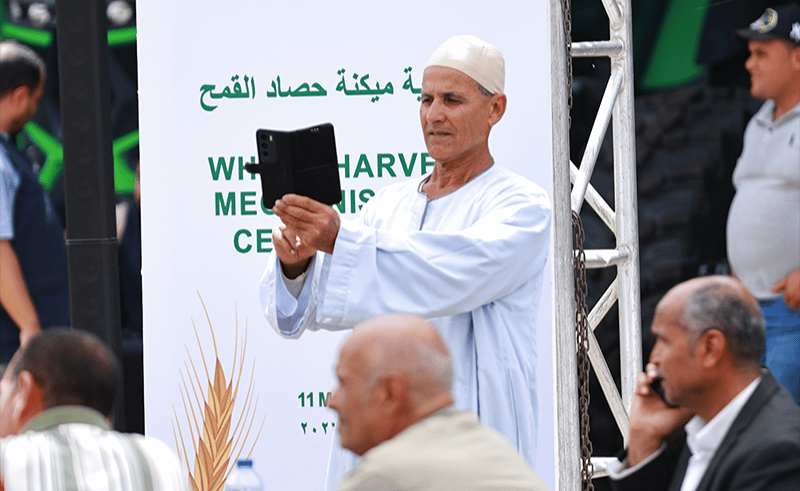
In a wheat field on the outskirts of Damanhur, the harvesters moved in straight, deliberate lines through the late spring crop, flattening golden stalks into neat tracks behind them. Farmers stood along the edge of the field watching the machines work, some filming on their phones, others shading their eyes from the midday sun as clouds of dust lifted briefly into the air before settling back over the Delta.
Nearby, rows of newly delivered agricultural machinery had been lined up outside the Agriculture Research Center’s Hiring Service Station, where Egyptian officials, European diplomats and local farmers gathered on Monday for the latest phase of the EU-KAFI programme, an initiative aimed at expanding mechanised farming access across Egypt’s wheat-producing regions.
The programme, funded by the European Union and implemented by the Italian Agency for Development Cooperation in Cairo, will support an estimated 31,000 small and medium-scale farmers through access to mechanised harvesting equipment, according to organisers.
For Egypt, wheat is not simply another crop. Bread subsidies remain woven into the country’s economic and political fabric, and the question of how wheat is grown, stored and transported has taken on renewed urgency in recent years as global grain markets have become increasingly volatile. Much of that pressure eventually lands in places like the Nile Delta, where small and medium-scale farmers continue to form the backbone of domestic production.
On Monday May 11th, the conversation centred more on policy than on logistics: how quickly wheat can be harvested, how much is lost before reaching storage facilities and how many farmers can realistically afford modern equipment on their own.
“Today the European Union stands with Egypt, demonstrating its long-term commitment to support the strengthening of domestic wheat production and reducing vulnerability to global shocks,” said Angelina Eichhorst, the European Union Ambassador to Egypt said during the event.
The demonstrations in Damanhur offered a practical illustration of the programme’s focus. One section of the field showed harvesting carried out through more traditional methods; another showed mechanised equipment moving through crops in a fraction of the time. Officials described the difference not only in speed, but in crop preservation. Delayed harvesting, particularly during hotter months, can increase post-harvest losses and reduce the amount of usable grain reaching storage sites.-3c46d5fb-fa96-455e-a9ff-3fb031ad9fde.png) The machinery itself will operate through a Hiring Service Station model, allowing farmers to rent mechanised services at subsidised rates rather than purchase expensive equipment outright. Organisers said the services would be offered at a 10% discount, lowering one of the primary barriers facing smaller landholders.
The machinery itself will operate through a Hiring Service Station model, allowing farmers to rent mechanised services at subsidised rates rather than purchase expensive equipment outright. Organisers said the services would be offered at a 10% discount, lowering one of the primary barriers facing smaller landholders.
The event brought together representatives from Egypt’s Ministry of Agriculture and Land Reclamation, the European Union, AICS Cairo and Agriculture research center, alongside farmers exhibiting wheat crops and discussing this season’s production challenges under shaded tents set up beside the machinery displays.
“Italy and Egypt share a deep commitment to food security, and today’s handover is a testament to what partnership can achieve,” said Tiberio Chiari, Head of AICS Office in Cairo. “When small and medium-scale farmers have access to modern tools and the knowledge to use them, the entire food system becomes stronger.”
The broader EU-KAFI programme includes plans for four seed processing plants, five silos with a combined 50,000-ton storage capacity, real-time tracking systems across 133 storage sites and training programmes expected to reach 400,000 farmers.
But the scale of those ambitions felt distant compared with the immediate rhythm of the harvest itself. Throughout the afternoon, the machinery continued moving through the wheat fields while farmers gathered around the equipment, inspecting controls, asking questions and measuring what modernisation looks like not in theory, but in acres harvested before the heat intensifies and grain is lost.
- Previous Article SceneNoise x Amsterdam Dance Event Present CROSSFADE: Egypt
- Next Article The Abandoned Architecture of Villa Badran by Gamal Bakry
Related Articles

Trending This Week
-

-
 Oct 15, 2026
 -
-