




Nourhan Maayouf Reimagines Happy Land as a City in Motion
Cairo-based artist Nourhan Maayouf returns to Happy Land in her debut book 'I Was Going to Work', reimagining it as a city of proto-cyborgs set against idle construction pillars.
Happy Land is a real place. Or it used to be. Happy Land was a chain of amusement parks that Cairo's children of a certain generation will remember, with the name having the peculiar flavour of commercial optimism: simple, cheerful English words stacked next to each other.
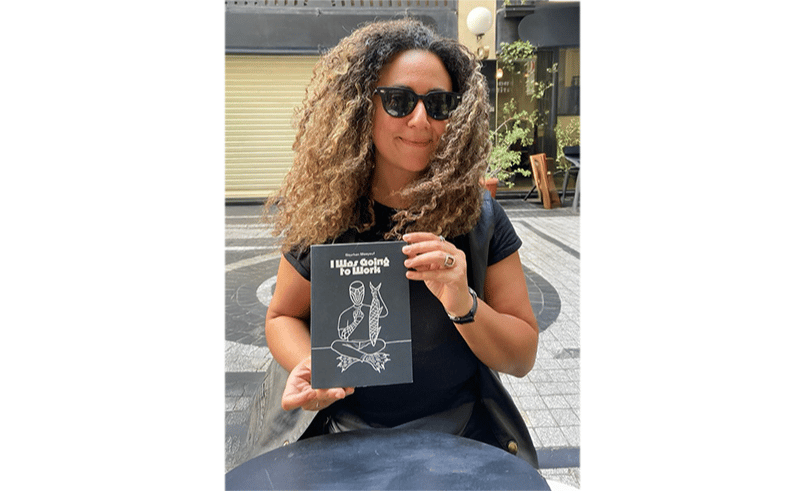
Cairo-based artist Nourhan Maayouf grew up frequenting it, and now Happy Land Nation is the setting of her debut art book, 'I Was Going to Work', a city of hybrid creatures, with a persistent background of idle construction pillars and billboards as press releases from a reality that no longer bothers with the pretence of catered advertising.
The drawings are black and white throughout; hybrid figures with robotic heads, human torsos, and animal limbs moving through solid black space, each accompanied by a short impassive sentence. The logic is procedural, almost funny, and the figures are not in crisis - they are simply continuing with their lives, which is its own kind of crisis.
Satire runs through Maayouf’s work: the “real” amusement park, the promise built into its name, and the children who believed it - all are taken, and turned to strain their own logic.
Maayouf works across photography, video and installation. Art books came to her sideways, during a period when she was in Switzerland finishing a master's degree in Arts in Public Spheres. "It was the pandemic, a time that had already made sitting with yourself obligatory," Maayouf tells CairoScene. She started drawing, and the work that accumulated during this period was different from her standard photography practice. When she came back to Cairo in 2022, she found herself scribbling hybrid figures against backgrounds populated with objects from somewhere memory meets an afternoon nap. "I listened to indie electronic or game soundtrack-inspired music while I drew these. It was my way of putting myself in the mood."
"I imagined a futuristic world," Maayouf explains, "where the background is always black and the fantasy is white. The creatures moved through this world doing things. After I finish one drawing, I add a small sentence."
Maayouf started posting the results to Instagram without a clear intention for what they were or where they were going. The sentences run deadpan, slightly clinical, occasionally very funny.
'Your loneliness is now cured.'
'This device will prevent both sleep paralysis and night terrors.'
'I miss non-organic food.'
'I wake up psyched to work until 11 PM.'
Stefan Lorenzutti, co-founder of Bored Wolves, a Poland-based independent publisher who had been following Maayouf on Instagram, decided the drawings should become a book. From that conversation to the finished object, it took four years. Maayouf sent drawings in stages, a PDF here, a batch there, the work growing and editing itself.
'I Was Going to Work' appeared in 2025 as an edition of 500, ninety-two pages, black and white, sewn and glued. "An experimental book with non-linear narrative," Maayouf says.
A construction pillar recurs throughout Happy Land Nation. "I imagined a high-speed rail as the main artery. The purpose in the city is movement and speed, and even when its citizens woke up warped, they still had to keep moving," Maayouf explains.
In 'The Metamorphosis', Kafka's disruption is singular and bodily. It’s one man, one morning, one transformation that breaks the machinery of a life built on his productivity. In Happy Land Nation, the disruption is total and collective, which paradoxically makes it harder to see. Maayouf draws the comparison herself: "Gregor Samsa became an insect, His identity, his role, and his physical form all break at once. But in my book the body hasn't collapsed into one thing - it has adjusted. The creatures are hybrid, and still enough to keep moving, or at least to keep the idea of movement intact."
'I Was Going to Work', in the past continuous, is the act interrupted before it could complete itself. "I imagined what would happen if people got interrupted. Speed governs everything at Happy Land Nation, the high-speed rail was built for it. The creatures were optimised for it. Then something happened, and they became something else, and now the city moves around them."
Maayouf resists fixing the work's meaning too firmly. “The creatures doing things,” she says, “are not allegorical placeholders for anything I can confirm.”
Her earlier zine, 'Homemade: Tales from Egyptian Youth During Confinement', dealt with intimacy at the scale of relationships, food, interiority - what people do in private during lockdown. Happy Land Nation scales that concern to a whole city without abandoning it. The creatures are public figures in a public space, the book is preoccupied with what it costs to continue, and what it means to keep doing things.
In the end, what the book leaves you with is that hybrid bodies are still dreaming, still craving, and still, occasionally, funny.
- Previous Article SceneNoise x Amsterdam Dance Event Present CROSSFADE: Egypt
- Next Article NYC’s First Onigiri Truck Just Pulled Up to New Cairo