





Lebanon's Roanne El-Alaili on Pre-Loved Fashion in the Middle East
Roanne El-Alaili hasn't shopped the high street since 2019. The &Again founder on dopamine dressing, vintage Fendi, and why the fast fashion bubble has to burst

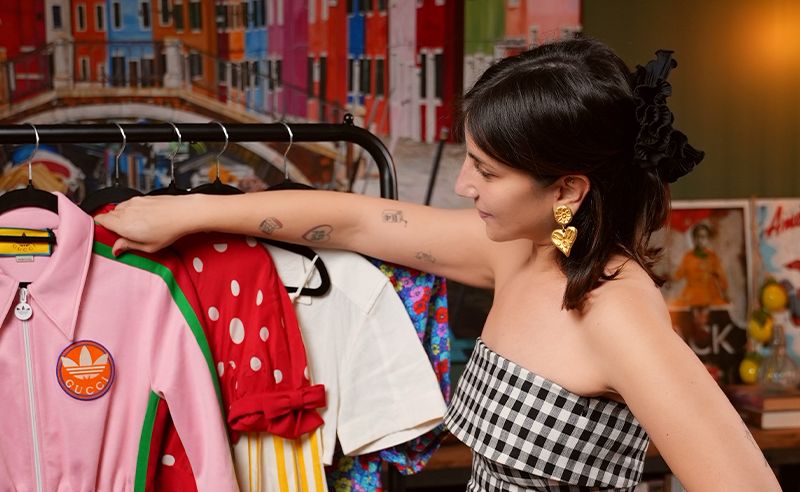
Everyone needs a Substack now, a pre-loved piece. Everyone needs to telegraph the correct sensibility.
We are living through an era of algorithmic convergence, where faces begin to resemble one another, interiors flatten into identical palettes, and taste itself starts to be machine-generated. So we reach for other forms of distinction: what we read, what we consume, what we reject, the ethics we perform, the references we understand.
Fashion, perhaps more than anything else, has become a language of moral and cultural positioning. A pre-loved jacket says something, and refusing fast fashion says something. The question is whether this signals a genuine cultural shift toward intentionality and sustainability, or whether individuality itself has morphed into another mass-produced aspiration.
It is within this tension that pre-loved fashion now exists, suspended somewhere between defiance and trend, personal philosophy and social currency.
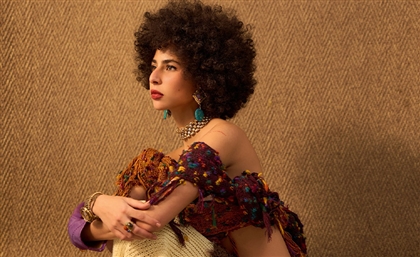
To unpack that contradiction, we sat down with Roanne El-Alaili, Lebanese creative director and founder of &Again, a UAE-based pre-loved marketplace built around extending fashion's lifespan. Few people have thought more carefully about what clothing means in this particular cultural moment, where taste, identity, sustainability and performance have become almost impossible to separate.
-530bf303-0ea5-4aae-8f03-847c61c5df00.png)
Your relationship with clothes goes back a long way. Where does it start?
Every little girl, everything starts with your mother: the fascination of seeing her get dressed, her closet, the trunk she keeps there. I was definitely one of those girls who'd go into her mom's closet the moment she left, try everything on, look in the mirror, and fantasize about wearing it all when I grew up.
What was the first piece you were emotionally attached to?
It wasn't something I bought. My mother had jewelry - very, very gold, very '80s and '90s. When I was small, she let me have one piece: a little choker with a gold pendant. Way too heavy for a kid. But I think that's what built the love for treasures, for things that endure, for objects that carry stories. It all started with that choker.
Has your style always been maximalist?
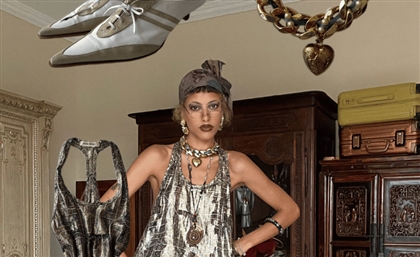
I've always been quite theatrical. I always felt that dressing up was like bringing a character to life - every day I could be a different character. The only consistent thread is that every outfit has to tell a story, or embody the persona I feel like that day. Fashion is emotional, and I think more people should bring emotion into it because that's what makes it fun. You want to be playful, you want to express yourself in different ways. It's fashion at the end of the day.
Does it shift depending on your mood?
There's never a plan. Some days I'm very preppy. Today I'm summery and frivolous; I feel like twirling. Other days I can be very dark, a bit rock and roll. It all starts with one piece I fixate on, and then I build the whole outfit around that.
There's an anti-perfection thread running through your outfits. They're maximalist, but they also resist polish.
My mother's dream was for me to be polished. But you know that Coco Chanel thing: the last thing you put on, take it off? For me, it's the opposite. The last thing you put on, put one more thing and see how far the outfit can go. More is more. There's never going to be a version of me in one basic top and jeans. There always needs to be that one thing that's a bit too much, and works.
Has running a pre-loved platform changed how you personally consume?
I shifted a long time ago. The last time I really went high street shopping was 2019. I worked for a competitor in the luxury pre-loved space, and that pushed me further and I was disappointed that it wasn't enough, that it wasn't how I imagined the world to be. Now that I have &Again, I shop purely from there, or slow fashion brands, or other thrift shops. A hundred percent of what I wear is preloved.
When did buying secondhand stop being something people were embarrassed about, especially in the Arab world, where our mothers would never have dreamed of buying a secondhand bag?
Our parents, Gen X, Boomers, grew up in a world where they bought fewer things of quality, and those things lasted years. There wasn't the thought of, oh, I need to buy secondhand. But with overconsumption growing and growing, something reversed. We developed more awareness about what we put on our bodies, and we started to admire the quality of before. That's why the Fendi baguette is back - it was great, it was fun, it was playful, and it was more unique. For Millennials, Gen Z, Gen Alpha, it's cool to be conscious now. And that's only going to grow.
But are people dressing more personally now, or just following the algorithm?
It's a mix. You're always going to have the group who want to follow trends and belong to that. But the savvier ones are finding trends at their origin. Capri pants are back, so you hunt for one from the actual '90s. If you can build a platform with enough diversity to even try to convert the trend girls to buy more sustainably, that's the hard one, and that's worth doing. My personal mission: all my friends around me who would never have shopped pre-loved are now open to it, they shop, they buy, they sell.
What's the thin line between resale culture making fashion more democratic and just creating new hierarchies of taste?
The categories are dissolving. Before, it was very clear, thrifters here, vintage crowd there, luxury resale somewhere else entirely. Now those walls are coming down and the same shopper exists across all of them. The question isn't democratic versus exclusive anymore, it's about building spaces big enough to hold all of them.
What do you think of trend culture?
I think it's valid. As we're younger, we don't necessarily know how to express ourselves, so it's helpful to have guides. As we grow, as women especially, we group together, then slowly find our individual threads. Some people get there earlier, some later. That's not a bad thing, the bad thing is how fast it's going. The cycle is so fast now with cruise collections then drops in between and neither the planet nor the consumer can keep up. At some point that has to slow down. Before, we had spring, summer, fall, and winter. Nothing continues at that pace forever.
When do you think it starts to slow?
Governments will have to look at regulatory systems. If you look at France, they're putting higher taxes on fast fashion, and retailers like Vinted are now the number one retailer in the entire country. When the rules force you to rethink how you consume, that's when the huge shift happens.
Every single year, 92 million tons of textile waste end up in landfills. The most polluting industry is methane from the meat industry. Fashion is second. It's in our waters, it's shedding microplastics, it's being dumped in Africa, in India. It's not physically possible to continue like this.
But people aren't getting richer. They're relying on SHEIN more, not less.
This is where government policy and taxation has to come in. If you look at France again - higher taxes on fast fashion to slow it down and show people there are alternatives. And even a group like SHEIN will eventually run out of resources. How much textile can you keep producing? Nothing is infinite. The bubble will burst.
What does a truly stylish person buy less of?
That's a difficult one to ask a maximalist. I think it's less about buying less and more about buying consciously, buying intentionally. You don't buy out of need, it's an emotional thing. You buy out of desire and dopamine, you imagine yourself in the outfit. So organise your closet well. Understand your style. And ask yourself: if I get this, how am I going to wear it? Can I style it five different ways?
What I do, if something gets me excited, I let it sit for twenty-four, forty-eight hours. If I'm still thinking about it a week later, I'll consider it again, go try it on again. If I really, truly want it and I've thought it through, then I buy it. I don't impulse buy anymore. And it's very hard, because there are so many cute things.
Why are younger people simultaneously anti-capitalist and hyper-consumerist in the way they dress?
I don't think it's anti-capitalist, I think it's anti-establishment, anti-corporate. Young people are smarter about making money without sacrificing their sanity, but they're not against desire or consumption itself. They've reframed what they buy, not how much. And social media makes that so much harder to resist - we're fed dopamine content all day, and it's only getting more addictive. So the question isn't really whether they'll consume less. It's whether you can redirect that impulse somewhere that doesn't cost the planet.
What makes a piece survive in someone's wardrobe for ten years instead of one season?
Really understanding your personal style. I keep things fifteen, twenty years, and slowly filter out what no longer matches my energy. You need your staple pieces: a good pair of jeans, good basic tops, and then the funky, cool pieces build around those. Understand your style. Curate according to it.
Who is still excluded from the pre-loved conversation in our region?
It's not so much about exclusion as it is about being scattered. The luxury side is quite exclusive and a bit snobby. If you look at Dubai alone, you have the British girls who love renting; you have Filipino culture with its own kilo stores; you have traditional charity shops like Thrift for Good. All of these exist in a scattered way. What matters is creating an ecosystem where they all know about each other, can shop from each other, and contribute to building the infrastructure for our region.
Do curated vintage spaces sometimes recreate the same exclusivity as traditional luxury?
For sure. A lot of spaces use inaccessibility as a strategy. But the more education you have around pieces, the more you know what's overpriced and what isn't, what's worth it and what's not. Not everything needs to be expensive just because it has a brand name. There's Dior on our app right now for 400 dirhams. It's about passing down a garment that no longer serves you so that someone else can be happy with it. We want to make it super cute, super fun. We don't want anyone landing on the app and feeling like they can't afford to be there. That's the opposite of everything we're building.
Walk me through how &Again actually works. How do you source what's on the platform?
It's several tiers. The first is general sellers: you download the app, create a profile, upload your items. Completely marketplace. Then one of our big USPs is influencer closets. We collaborate with influencers, help them declutter, take their items and manage the whole selling process on their behalf. That does really well because influencers are genuinely overwhelmed: the gifting, the brand sends, it never stops. So that's been working.
The third tier, which we're still building out, is businesses: the small thrift store that exists in real life but has no online presence. We help them set up their page, their little shop-within-a-shop. That's really where the ecosystem comes together. We even encourage bigger brands to come on and sell through us, because we want to consolidate everything in one place. The only thing we personally source is the influencer closets and the business partnerships. Everything else is free-flowing; you do whatever you want.
Does fashion now commercialise its own resistance to consumerism?
You're talking about greenwashing. Some groups are very transparent. I'd prefer an H&M to a Zara because they're genuinely working toward doing better, you can see it in their sustainability reports year on year. Others are just using the language without the commitment.
But what's more interesting is luxury groups, LVMH, Chanel, creating their own initiatives. Chanel launched something called Nevold, making pieces from their own deadstock fabrics. And you're seeing more people on red carpets pulling archive pieces. There is a cultural shift and it's only going to grow. The big groups know where the money is. The ones that don't get behind it are the ones that stand to lose the most. And if you look at the pre-loved market year on year, regionally and globally, it's only going upwards.
- Previous Article South Sinai Receives 826 Solar Streetlights Under China Grant
- Next Article The Intricate Beauty of Ben Youssef Madrasa