





AlUla's Rawi Storytellers Get a UNESCO Paris Show Until Aug 31
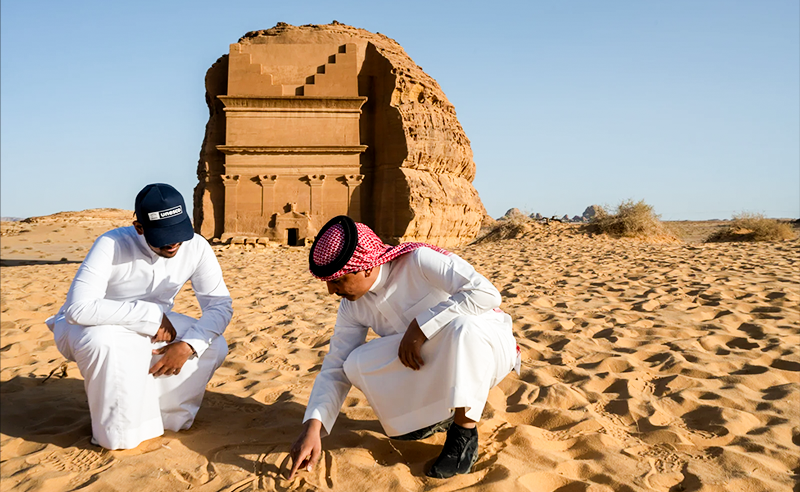
Twenty-one photographs of AlUla's Rawis at Hegra, Dadan and Jabal Ikmah are on view at UNESCO's Paris headquarters until the end of August, shot by Nick Jackson.
A rawi is a carrier. In classical Arabic literary tradition, the poet composed and the rawi memorised, which is how most of that poetry survived to be read at all. In AlUla the word now belongs to the guides who walk visitors through the heritage sites, and 21 photographs of them are hanging in Paris until the end of the month.
'I Am a Rawi: Sharing Stories of AlUla', an exhibition presented by UNESCO in collaboration with the Royal Commission for AlUla (RCU), honours the significance of AlUla's traditional storytellers. On display at UNESCO’s headquarters in Paris until 31 August 2026, the exhibition follows the Rawis’ evolving role from heritage storytellers to facilitators of intercultural conversation.
In classical Arabic literary tradition, the role of the Rawi centred on the memorisation of poetry. Over time, this oral tradition evolved into a holistic practice, extending beyond poetry to preserve and share the archived memories of past civilisations. Through them, archaeological heritage is imbued with a lived history, preserved in the mind and passed on through the voice, as they guide visitors through AlUla’s heritage sites, carrying the memory of the land with them. The exhibition is one of the milestones of UNESCO’s “Fostering Positive Social Transformations in AlUla” project, developed through its partnership with RCU.
The collaboration began in February 2025, when six Rawi leaders travelled to UNESCO Headquarters for the first-ever Intercultural Training Week for museum and heritage professionals. The Rawis helped co-design the first prototypes of UNESCO’s Live Museum model, “The Live Museum model has been developed as a flexible, adaptable and replicable tool for promoting intercultural dialogue and learning at museums and heritage sites,” says Olga Dobryanskaya, UNESCO’s Programme Specialist for Sciences.
The Rawis were among those who became the first certified Live Museum facilitators and the project eventually took on a local form: Qissa bi Qissa, ‘Swap a Story ', AlUla's own adaptation of the Live Museum model. The exhibition itself was shaped by the Rawis, from its conception to the selection of the stories featured.
During its opening week, two Rawi leaders, Adel Alanazi and Amal Aljohani, travelled to Paris for a ‘Rawi- in-Residence’ programme, facilitating Qissa bi Qissa sessions and leading tours for more than 100 people. “What struck the curatorial team most was how much living, personal memory surfaced alongside historical, cultural and archaeological landscape,” Dobryanskaya says.
One example is Rawi Wedad Yaseen’s recollections of her family’s life in AlUla Old Town until the 1980s, “it served as a reminder that this heritage is still within living memory, not confined to the historical record.” The exhibition features 21 photographs documenting the Rawis’ professional and personal journeys as custodians of AlUla’s heritage. The images show them at some of the region’s most significant sites, including Hegra, Saudi Arabia’s first UNESCO World Heritage site; AlUla Old Town; Dadan, the ancient capital of two kingdoms; and Jabal Ikmah, known for its concentration of Dadanitic inscriptions and recognised on UNESCO’s Memory of the World International Register.
At each location, the Rawis are shown not simply presenting historical information, but sharing their own stories and memories. Other photographs document Qissa bi Qissa sessions, while images of the Rawis at the future Museum of the Incense Road point towards the next chapter of the project. UNESCO’s Live Museum model has already attracted interest from other museums, and UNESCO plans to publish a guide for museum and heritage professionals worldwide, drawing on AlUla’s experience, “The goal is to foster the potential of museums as spaces for face-to-face human encounter, where people can learn about different cultures not only through objects, collections and institutional narratives, but also first-hand from each other,” Dobryanskaya says.
For visitors to I Am a Rawi, particularly those encountering AlUla for the first time, Dobryanskaya hopes that the exhibition leaves them with something beyond a collection of historical facts, “We hope visitors come away seeing the Rawis as cultural intermediaries whose own personal stories are inseparable from the history they share.”
- Previous Article El Gouna Film Festival Reveals First 10 Films for 2026 Edition
- Next Article Ten Insights From My First Year in Cairo
Related Articles
Trending This Week
-
-
 Oct 15, 2026
 -
-