




Hannah Khalil Premieres LOVE OMAR at London’s Theatro Technis
There are no black-and-white interpretations in Love Omar.

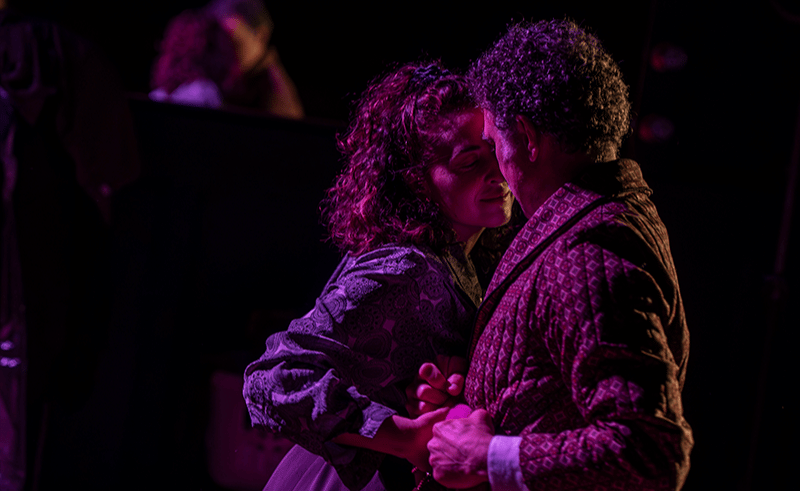
Egypt’s iconic actor Omar Sharif is in his backstage dressing room warming up for his role in Terence Rattigan’s play The Sleeping Prince. There, the “world’s most famous Arab” comes face to face with Mag, the assistant director of the play, who we later learn is half Arab, and a slow simmering tension ensues. It is a tension that steadily tightens, as the pair’s exchange touches upon themes of identity, nationalism and celebrity culture.
This is the story of Love Omar, the latest work from Palestinian-Irish playwright Hannah Khalil.
The comedy-drama premiered at London’s Theatro Technis between May 7th and June 6th and was directed by Chris White with powerful performances by British actor and director Al Nedjari as Omar Sharif, British actress Ishia Bennison as Sharif’s dresser Daphne, and British-Jordanian actress Lara Sawalha as assistant director Mag.
Love Omar immerses the audience in the world behind the curtain of Terence Rattigan’s play The Sleeping Prince at the 1983 Chichester Festival Theatre, the only time Sharif has performed before a UK audience. It is a dramatised portrayal of this real-life event, which saw the actor perform alongside co-stars Debbie Arnold and Jason Carter.
As curtain up approaches, we are invited into Sharif’s dressing room as he gears up for his role. A costume rack is lined with Sharif’s attire, hats hanging on the wall next to a bulb lined mirror and there is a wood dressing table as well as an elegant chaise longue. Set and costume designer Pip Terry vividly recreates the chaos, charm and private world of a real dressing room, giving the audience a real backstage view of the action behind the curtain.
We meet an aging Sharif fixated on his looks and trying to hold on to whatever remains from his once budding allure. After all, Sharif is now in his fifties and age is really starting to catch up with him. He is waltzing through the chaos of backstage life: he trips over some skates, keeps asking for underclothes, and at some point, his dresser, Daphne comes in to let him know that his co-star dislikes his moustache (Sharif had started dying his greying moustache and kissing his co-star left a mark on her face!).
Daphne’s intermittent appearances inject some much-needed humour into the drama, although Sharif’s condescending treatment of her (which is often brushed aside by her humour) is particularly aggravating at times.
But the stakes go far beyond just managing backstage chaos, for what is about to unfold is a verbal duel that Sharif is wholly unprepared for.
Interrupting Sharif’s bout of self-obsession is Mag, who has allegedly come in to run through parts of the script. Sharif asks for her honest opinion on his performance on the play “because no one tells you the truth when you’re Omar Sharif.”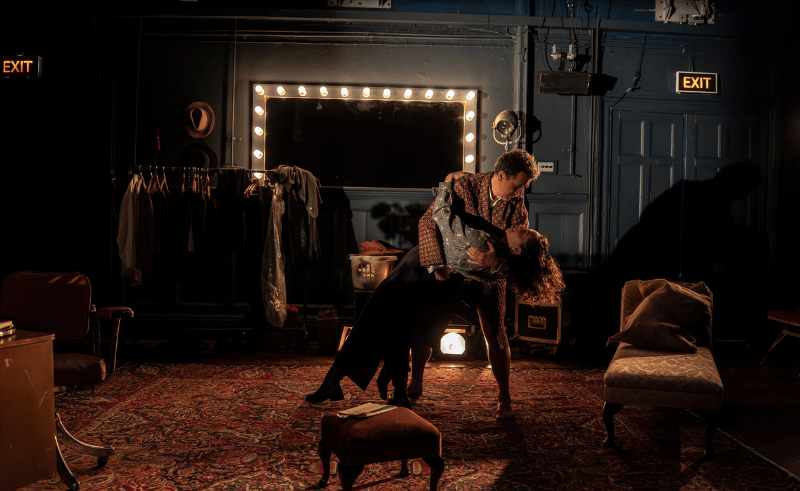 But as the exchange lingers on, we learn that another motive lurks beneath Mag’s stated intentions. Triggered by Sharif’s commanding presence, his celebration as the ‘Arab’ who made it, and his flaunting of a stack of fan mail (mostly from women who are seduced by his charisma), Mag ignites a heated confrontation with Sharif.
She questions the motives behind some of his choices (why did you change your name from Michel to Omar?), as seen by someone navigating multiple cultural identities. Initially, a flirtatious Sharif is unaware that Mag is half Arab, but when she eventually reveals that part of her identity, something shifts, and his playful attitude takes the back seat.
If Sharif is hailed as the ‘Arab’ who made it to Hollywood, what does that mean for a mixed heritage woman like Mag who is wrestling with questions of identity and rarely ever ‘seen’, let alone celebrated, for her inbetweeness? Sawalha deftly captures this conflicted sense of self.
In fact, many of the themes in Love Omar illustrate Hannah Khalil’s own experience as a Palestinian-Irish playwright. There is also a personal link to Sharif in Khalil’s story as she revealed in a post show Q&A that took place on June 3rd. The story extends back to the 60s when Khalil’s mother –a 16-year-old Irish trainee nurse at the time--came to London where she watched David Lean’s film adaptation of Doctor Zhivago (1965) and was enthralled by Sharif. She later met Khalil’s father, who looked like Sharif, at a party, and they got married.
For all these reasons, when Khalil came across a photo of Sharif in the foyer at Chichester Festival Theatre, she promptly embarked on her research. “I had to find out what the world’s most famous Arab actor was doing in West Sussex in 1983!” she says in Love Omar’s press release. Her in-depth archival research included interviewing Sharif’s co-stars on the play as well as the staff working at the theatre at the time. She also drew on Omar’s autobiographical book.
But rather than merely recreating Sharif’s almost mythic charisma, Khalil unmasked the many contradictions that define his character. We see the charming, fun and overly generous Sharif. But there is also his ego and explosive anger and excessively flirtatious behaviour as a manifestation of the gendered power imbalance embedded within the entertainment industry during the 80s.
There are no black-and-white interpretations in Love Omar. Just a highly sensitive and nuanced unpacking of the mythic status afforded to celebrities, the confusing questions of identity, and perhaps most beautifully, a sincere ode to theatre and backstage life.
Review by London-based culture consultant Nourhan Tewfik.