





Hany Rashed Paints With & Against the Cinematic Image
Hany Rashed’s practice is rooted in a kind of stubborn refusal.
.jpeg)
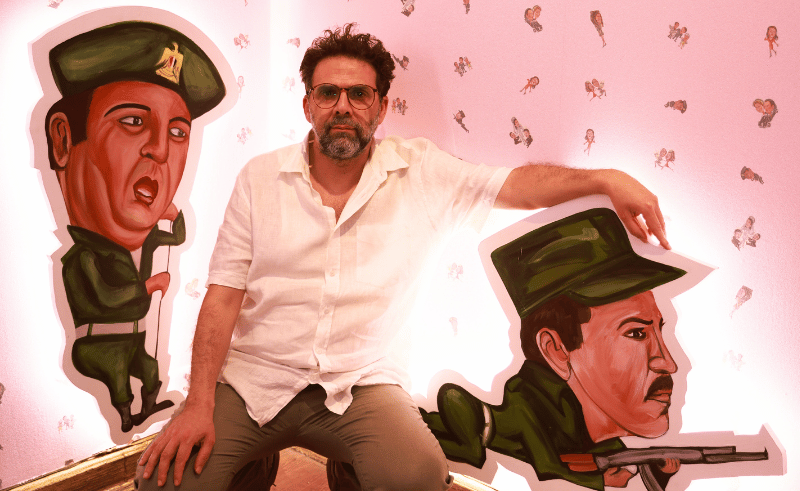
According to Hany Rashed, there are singers and there are performers, and in the realm of contemporary art, he places himself among the latter.
Loud, offbeat and edged with rage, Rashed’s practice is rooted in a kind of stubborn refusal. Self-taught and restless across mediums and materials, his work often begins with a provocation: why not? That curiosity, paired with a willingness to experiment, runs through a pioneering contemporary oeuvre now spanning three decades.
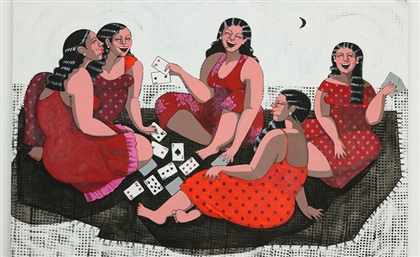
His latest exhibition, ‘Cima Cima 6’ at Ubuntu Art Gallery, works against the very premise of the image. An experiment against context and nostalgia. Rashed archives, codes and decodes, altering it, at times satirising it, at others documenting it.
It is this resistance to the image, its authority, its context, and the notion of contemporary art as something sacred above it, that anchors the show.
At moments the gesture is subtle; at others, it lands with blunt clarity, as in a visual equation drawn between patriarchal power and divinity.
There is a surface-level nostalgia at play, but it quickly unravels. The longer you look, the less sentimental it becomes.
In ‘Al Ard’, meaning is destabilised entirely, each frame carrying a different subtitle. In his works on weddings and funerals, Rashed traces the shared visual language that binds both rituals. In ‘Al Lemby’, he abandons the symmetry of equal rectangles altogether, less a conceptual shift than a refusal to repeat a method he had grown bored of. The piece ended up stealing the show.
Rashed shows little reverence for the personal archive as inherently relevant or inspiring. Instead, he works with it and against it, bending it, misreading it, at times even lying through it, to produce new meaning. Sometimes, that meaning exists simply for the sake of making something new. “That’s the main point of art, to create something different and new, the archive in and of itself means nothing, we’re not documentarians,” Rashed tells CairoScene.
Throughout, he remains in dialogue with cinema: as a timeline of shifting meanings, a montage of images, a source of visual language, and, at one point, a refuge to times when the screen offered his primary way of encountering the world.
- Previous Article SceneNoise x Amsterdam Dance Event Present CROSSFADE: Egypt
- Next Article MENA’s Weirdest, Wildest, Wackiest Museums