


Lara Baladi Finishes Her Seven-Year Alphabet of Revolt at Gypsum
Z for Zarafa at Gypsum closes Baladi's Anatomy of Revolution, an online abecedary of protest she began in 2019 and has now finished across all 28 Arabic letters. The show runs until September 23.
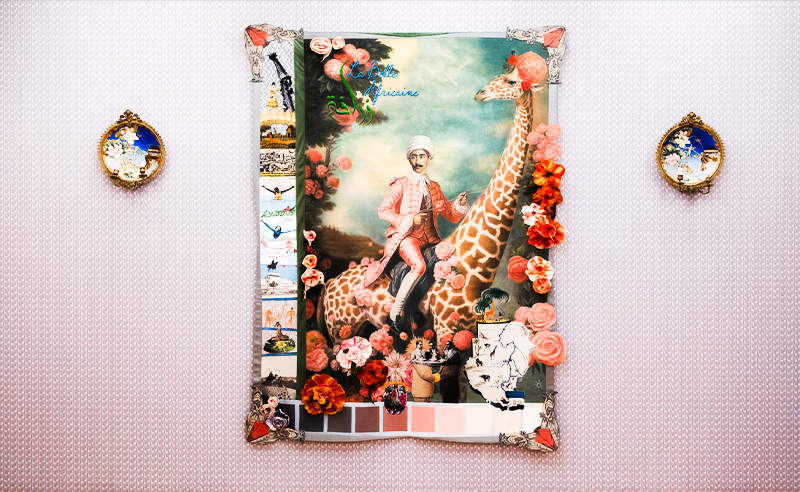
In 1827, a giraffe left Sudan for Paris as a diplomatic gift from Muhammad Ali to King Charles X of France, one of three sent to European rulers that year. Zarafa lived twenty-two years in the Jardin des Plantes and became, in her own time, the most talked-about creature on the continent.
Two centuries on, she has become the closing letter of an alphabet.
Lara Baladi has spent seven years building Anatomy of Revolution, a web-based abecedary of global uprisings that runs through all 28 letters of the Arabic alphabet. All 28 are now finished and published at anatomyofrevolution.com. Zarafa is zain, and Z for Zarafa, at Gypsum gallery in Cairo until September 23, is the exhibition built around her.
The show turns the giraffe's migration into an entry point for questions of power, diplomacy and displacement that have occupied Baladi for over a decade, and that speak as directly to Sudanese migration into Egypt today as they do to the nineteenth century.
It is her first solo with the gallery, and draws on work made during a residency at Civitella Ranieri. A monumental tapestry traces the giraffe's route. A cabinet of curiosities is built around the era's museum culture. Ceramic flies reference pharaonic medallions.
An embroidery piece was made with Threads of Hope, an organisation founded by a friend of Baladi's that supports Sudanese refugee and migrant women in Egypt. Around 20 women took part in the workshops, a few of them working on the embroidery itself, all paid according to the time and work they gave.
The gallery is staged like a classroom, modelled loosely on the propaganda schoolbooks of the 1950s, desks and alphabet posters included. Gypsum and Baladi are working on plans to travel the show after its Cairo run.
Anatomy of Revolution grew out of Tahrir Archives, the online archive Baladi began building in 2011 in the immediate aftermath of the Egyptian revolution, and is built to be entered at any letter rather than read start to finish.
The exhibition arrived alongside The Anatomist, a publication Baladi conceived as an artwork in its own right rather than a catalogue, the first in what she hopes will be a series. It carries essays and testimonies, including from two of the women who worked on the embroidery.
Born in Beirut in 1969 to a family of Lebanese émigrés long settled in Egypt, Baladi left Lebanon as a child during the civil war and grew up largely in Paris, where she discovered photography in college, a subject she never formally studied.
She resettled in Cairo in her twenties, and found that the technical limits of working there pushed her practice outward from photography into installation, sculpture, tapestry and, at one point, perfume. She won the Cairo Biennale's Grand Nile Award in 2008 for her sound installation Borg El Amal, has sat on the boards of the Arab Image Foundation and Cairo's Townhouse Gallery, and taught at MIT for six years and, until last June, at the American University in Cairo.
She spoke about the giraffe, the classroom and the archive.
For readers encountering your work for the first time, could you introduce yourself and your practice?
I'm Egyptian-Lebanese. My family comes from a community of Lebanese émigrés to Egypt in the nineteenth century, but my sister and I were born in Lebanon. When the war started, my parents brought us to Egypt, though we didn't stay long. I moved to Paris, grew up there, and in college discovered photography. I never studied art. I'm self-taught.
I rediscovered Cairo around the same time, coming back every year, and eventually the love of the camera and the city merged. But I quickly became frustrated with photography alone, because the technologies available in Egypt were limited. I developed ways of working around what was lacking, and that's how my practice expanded into installation and multiple mediums. I'm a visual artist, multidisciplinary, multimedia.
With so many mediums available to you, how do you decide which one fits a particular idea?
Early on, I'd have an idea and then think about how best to manifest it, what experience I wanted the audience to have. Other times a project arrives more like an object, because I'm inspired by something existing, by a history, and I don't question the medium at that point. But the medium you choose communicates an idea. As McLuhan put it, the medium is the message. It's never neutral, and it matters as much as the content itself.
Memory, history, archives and political events feel very tangible in your work. Where does that come from?
Since the beginning I was concerned with sociopolitical and personal narratives. When I reestablished myself in Egypt, I started analysing where I was and who I was in that context: religion, class, how society divides itself.
Then came the 2011 revolution, and that was a radical shift. Because I was already collecting archives, I started pulling material from the internet, which became the Tahrir Archives, the platform that precedes Anatomy of Revolution. I was trying to understand a visual language that emerged overnight and realised it was borrowed from earlier revolts, radically different in time and place.
I still don't think of myself as a political artist in the narrow sense. But 2011 was an unprecedented documentary moment: everyone had a phone and a camera, plus social media, this multiplication of the democratic image. I started archiving the visual language of revolt itself, how images already in our collective memory get borrowed and reshape themselves, the way a meme does.
What was it about Zarafa's journey, from Sudan to Egypt to France, that first captured your attention?
In 2019, at the very start of the ABC project, I was collecting words for each letter of the Arabic alphabet. Zain had almost nothing, and what it had was strange: Zuzu, Zenga Zenga, Zigzag, Zenzana, and of course, Zarafa.
A friend suggested Zarafa. I looked into it and found this entire world of giraffomania, museum ephemera and paraphernalia surrounding her arrival in Paris. She was a diplomatic gift, which meant I could talk about diplomacy without using the word.
The more I read, the more her story grew into something else. Around that time, people were dying in the Mediterranean trying to cross from Africa to Europe, and Zarafa took on the weight of a migrant, this idea that some make it and some don't. She actually had a sister; two giraffes were brought from Sudan, and it isn't clear whether the other one died en route or survived only a year in Europe.
What does that absurdity let you say about power and migration, specifically in an Egyptian context?
Researching the giraffes led me into the history of diplomatic gifts, which turns out to be a colonial-era practice and a way of feeding curiosity while demonstrating territorial power: if you can lose Sudan and gain a giraffe, you've shown you have authority over that territory.
In the tapestry, there are two men shaking hands, except instead of heads they have trays, and three figures are eating off them. Diplomacy is the language we use before we say the word conflict.
The exhibition splits along those lines. On one side, a cabinet of curiosity, a little museum of diplomacy. On the other, migration, specifically from Sudan, and how badly Sudanese refugees are still treated in Egypt today, a crisis the war there has made worse and that goes underdiscussed.
The space at Gypsum feels almost pedagogical. What do you want visitors to feel before looking closely at individual works?
You move from the cabinet of curiosity, through diplomacy and migration, into a corridor, which is a passage but also a spiritual one, about our own migratory nature.
The language of Anatomy of Revolution came from a question I kept returning to: when a revolution fails as a revolution. who tells its story? Usually the victors, so I looked at indoctrinating schoolbooks from the Nasser-era period and borrowed that visual language to turn it on its head.
The project became not just an artwork but an archive and a teaching tool.
Anatomy of Revolution doesn't ask viewers to follow a chronological narrative. What does that nonlinearity let you say?
That's the difference between being an artist and a historian. I'm not trying to write the history of Tahrir or build an encyclopedia of revolutions. I'm interested in the visual language, in collective memory, how ideas travel between cultures and periods, sometimes strangely, sometimes obviously, but always circling one common quest.
The volume of material is overwhelming, and yet the similarities across places and people are striking. What I think I do well is make that overwhelming amount of data feel simple and accessible at whatever depth someone wants to engage with it. I wanted a new generation to have a sense of what revolutions do, what they cost, so we're not walking into the next one blind.
The Anatomist launched alongside Z for Zarafa. What can it explore that the exhibition can't?
The Anatomist was born from the image of the ephemeral journals published around the time of the real Zarafa. Working on it with Farida Youssef, it grew organically into something bigger than we first planned, and I wanted it to be a work of art in its own right, not a catalogue or an explanation of the show.
It's issue one of, hopefully, a series. It carries the actual story of Zarafa in full, essays on diplomacy and the Statue of Liberty, and testimonies from two of the refugee women who worked on the embroidery piece, about leaving Sudan and building a life in Egypt. None of that is present in the show unless you read it, but reading it changes how you see the work.
Between Anatomy of Revolution, The Anatomist and Z for Zarafa, there's a recurring idea of dissection. What do you hope to discover by the end?
I think that's really a question about the creative process, about why anyone becomes an artist at all. What's beautiful about creating is that you're responding to something close to your heart, disturbing, painful, part of your environment, and you want to transform it. There's a process of taking something in, digesting it, and manifesting it at a different level.
What's fascinating is that the process changes you as you go. It pushes the horizon of what you thought you were capable of or interested in. So the practice becomes about growth, not in a self-absorbed way, but as a deepening of your relationship to the world, and hopefully something you can share with others.
- Previous Article AlUla Wins Gold at 2026 ICRT Responsible Tourism Awards
- Next Article US-Based Replit Acquires Egypt'sAtta to Add AI Business Analysis