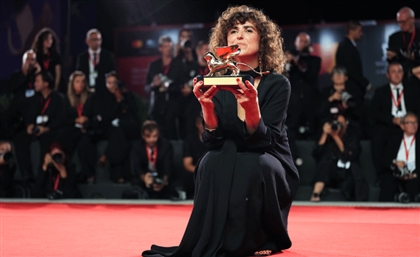






Mariam Ashraf's 'Made of Wood' Documents Damietta's Vanishing Trade
"Damietta is dying," the craftsmen keep telling her. In 'Made of Wood', photographer Mariam Ashraf documents the collapse of the furniture industry that shaped her city.

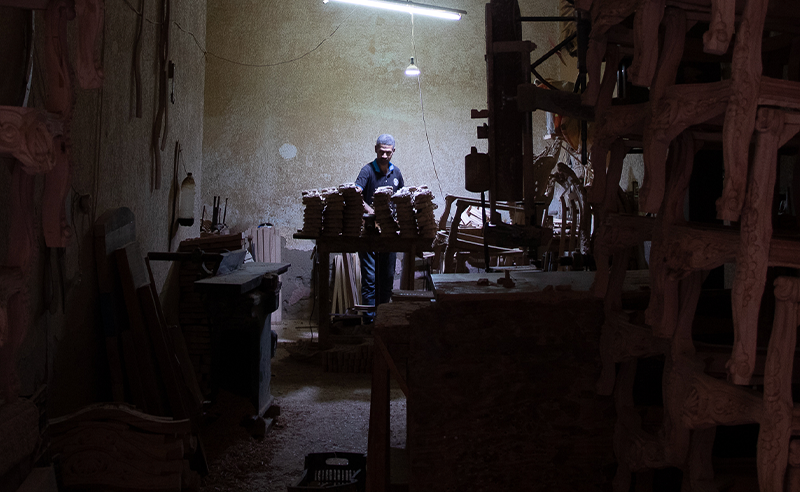
Egyptian photographer Mariam Ashraf has been walking through the old furniture quarter of Damietta since she was a little girl, through the dense warren of lanes where the workshops sit directly beneath the apartments of their owners. She learned early what a furniture workshop sounds like with the flat cough of a table saw, the whine of a lathe, the percussion of a hammer meeting a loose joint.
"The first workshop I ever documented, I went into it because of the sound. A strange mixture, unlike any of the other workshops," she tells CairoScene. "I looked, and I found the owner was keeping pigeons inside."
The man inside goes by the name of Am Salama. "He never finished school, he writes poetry. He is one of the most interesting people I have ever met. There were two worlds in there," she recalls. "A world of pigeons, and the world of the daily craft. That was when I felt this project wasn't going to be about the furniture industry at all. It was going to be about the craftsmen, and about the life around them."
Ashraf is from Damietta and trained as an interior designer before coming to photography in 2018, drifting into documentary and street work, drawn to what she calls the visual memory of cities. The project that has consumed her for the past several years, now titled 'Made of Wood', began as an assignment from VII Academy in France in 2022.
"The project didn't begin because at some particular moment I felt the industry was disappearing," she says. "It began completely differently. I was required to produce a project, an idea I could work on. At the time, my relationship with the city was weak. I belonged to it by upbringing, but my relationship with it wasn't as deep as it is now. The deeper the project went, the deeper that relationship became."
What she found, after months of long hours in the workshops, was that the assignment had a floor beneath its floor. "I began to feel that this wasn't going to be a project documenting an industry. It was going to be about a whole city whose identity was formed by that industry, and about a collective memory that is disappearing, gradually, with the disappearance of the craft."
In April, the project was awarded a grant by the Arab Fund for Arts and Culture, under the Arab Documentary Photography Program, which AFAC runs with the Prince Claus Fund and the Magnum Foundation. Ashraf is one of 10 photographers in the 2026 cycle, and the only Egyptian among them.
Roughly 350,000 people in a governorate of some 1.6 million work in furniture or in the trades that feed it, according to the local Chamber of Commerce, which counts around 13,000 registered establishments. The last serious count of the workshops themselves dates to 2010, and everything since is estimated, because most of the workshops were never registered in the first place. The city is a factory without walls.
Ashraf has run into the same wall. "What I arrived at was something like 40,000 workshops in Damietta, but all of it is approximate. I couldn't get to anything official," she says.
"But when you're in the city, everything is clear. There are entire streets that have shut down. There's a whole street where not a single workshop is left open. Certain areas were always known for this, always full of workshops. You'd only have to walk into them and the sounds would be unmistakable. So many things have changed and so many sounds have disappeared."
Damietta's beech and pine are imported from Romania, Russia and northern Europe, landing at the city's port, and the furniture they become is sold to Egyptians. After the successive devaluations of the pound, that arrangement became a vice. Timber rose by around 60% in a single year, according to traders in the city, and small workshops, which depend entirely on imported material and have no reserves, began cutting production or stopping altogether.
"On top of that, with the Chinese machines and the CNC, they began letting go of huge numbers of workers, replacing them with machines," Ashraf says. "That's one of the reasons so many workshops closed. The largest number of workshops that shut were the carving workshops, the ones working the wood by hand."
Ashraf talks about the oyma, the deep hand-carving that gives the gilded Damietta salon its reputation, furniture that Italian buyers used to come for and that Egyptian families once drove all the way to the city to purchase before a wedding.
"They're the last generation who will master this," she says. "To become good at something like that takes you 30 years. And the men doing it now aren't teaching it to their sons, because they can see it doesn't earn, it doesn't put bread on the table."
Ashraf's father's family all worked in the furniture industry, every one of them. "And now, unfortunately, some of them have left it to look for something else, because there's no living in it anymore. Some of them travelled to other governorates just to find any source of income at all."
'Made of Wood' came to Ashraf through the ear rather than the eye. "My relationship with the city is built on sound more than anything else," she says. "When I'm in another city and I simply hear the sound of a wood machine, or a saw, I feel Damietta, or I remember it. And not only sound. Smell too. If I'm walking somewhere and there's the smell of wood, just the smell of wood, my mind goes straight there."
Wood itself, she insists, has been a witness to the full sweep of the industry's history, from the gilded furniture crafted in the 1980s to the IKEA pieces produced today.
"At first, wood was just a material to me. But over time I came to see it as something alive, carrying memory and witnessing history. In the end, 'Made of Wood' isn't about wood at all. It's about the people who give it meaning."
"It's a sad thing, honestly. What we had was art. One of the craftsmen once told me, 'When a man makes a mistake in his work, he feels he has made a mistake in his honour.'"
Ashraf had been circling the question of why a trade should matter this much, why a city's sense of itself should be so thoroughly welded to a commodity. "They are genuinely part of it," she says. "The craft is part of who they are. It's even in how they introduce themselves. This is bigger than a job, it's bigger than a profession. They inherit it across generations. A boy goes down to the workshop at seven years old, and he grows up feeling this is an inheritance."
"There's one sentence that repeats itself with everyone, in the strangest way," she says. "Damietta is dying."
"They see no future in it. There's frustration, there's despair."
In her written statement for the AFAC grant, Ashraf records that the losses have been severe enough to drive some craftsmen to take their own lives. "The stories became so heavy that they began to affect me psychologically. I had to remind myself that my role isn't to steer the story or give my opinion, but simply to document what's happening."
She eventually stepped away from the project for a year, and the distance, she says, changed her perspective. "It made me see things I hadn't been seeing. When you're too far inside, sometimes you need to zoom out to notice what you'd stopped seeing."
The same refusal governs how she photographs the men. She will not take the picture that grieves on their behalf. "I don't want to take a photograph with drama in it, or pity," she says. "That isn't what I'm after. Reality is more than enough to show it."
Her method in this project doesn't involve waiting for one element to happen, because everything in the room is already bound to everything else. "I remember watching a lathe turner shaping a piece of wood, the sawdust settling on his forearm until it became indistinguishable from the hair on his skin. The man and his craft become one. It's a relationship I find assembling itself in front of me."
There is one photograph Ashraf feels so strongly about, though it didn't make the main selection of the project. "It was a workshop cut in half. One side had been turned into a supermarket. On the other, a man sat alone at his table, still making his pieces."
- Previous Article SceneNoise x Amsterdam Dance Event Present CROSSFADE: Egypt
- Next Article The Intricate Beauty of Ben Youssef Madrasa
Related Articles
Trending This Week
-
-
 Sep 10, 2026
 -
 Sep 10, 2026
 -