





Photographer Nick Brandt’s Dubai Exhibit Faces Syrian Displacement
“As the world gets darker, I seek to both channel my outrage and find some solace through the work I create.”
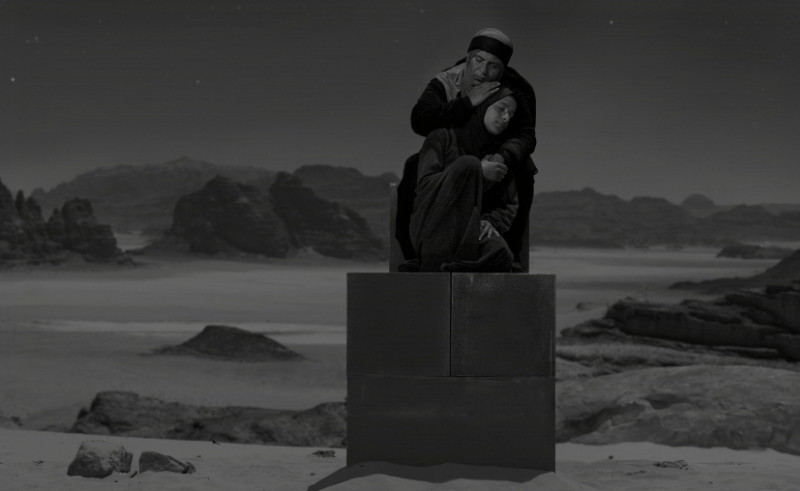
Cover: Maisa and Ola in Moonlight, Jordan, 2024. From The Day May Break, Chapter Four. © Nick Brandt.
How does one look at suffering without turning away, but also without turning it into spectacle? On the surface, it appears to be a simple ethical concern. Yet within photography, especially documentary and environmental practice, it remains a tension that has rarely been directly confronted.
Images of loss, displacement, and ecological collapse now circulate so relentlessly that they risk dissolving into visual noise. We speak easily of documentation, awareness, or impact, yet far less of dignity, or the people who must continue living long after the image has been made.
This tension sits at the heart of ‘The Day May Break, Chapter Four | The Echo of Our Voices,’ English photographer Nick Brandt’s latest solo exhibition, currently on view at Waddington Custot in Dubai. The photographs are large-scale, black-and-white, and carefully staged: families standing together atop towering stacks of boxes, elevated against vast, unforgiving landscapes. The images resist urgency. They refuse pity. Instead, they insist on presence.
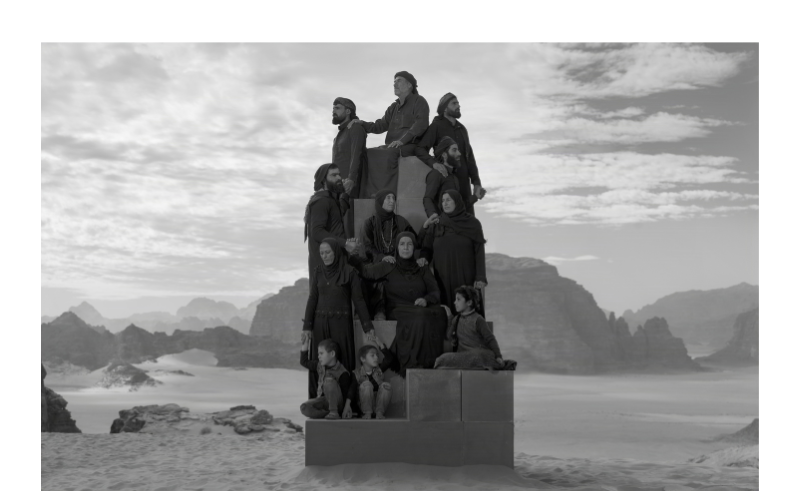 Shaila and Families, Jordan 2024. From The Day May Break, Chapter Four. © Nick Brandt
Shown in a city shaped by migration and sharp contrasts between visibility and invisibility, the exhibition asks a deeper question: when did devastation become familiar, and what responsibility does the photographer carry once suffering is rendered visible? “As the world gets darker,” Brandt tells SceneNowUAE, “I seek to both channel my outrage and find some solace through the work I create.”
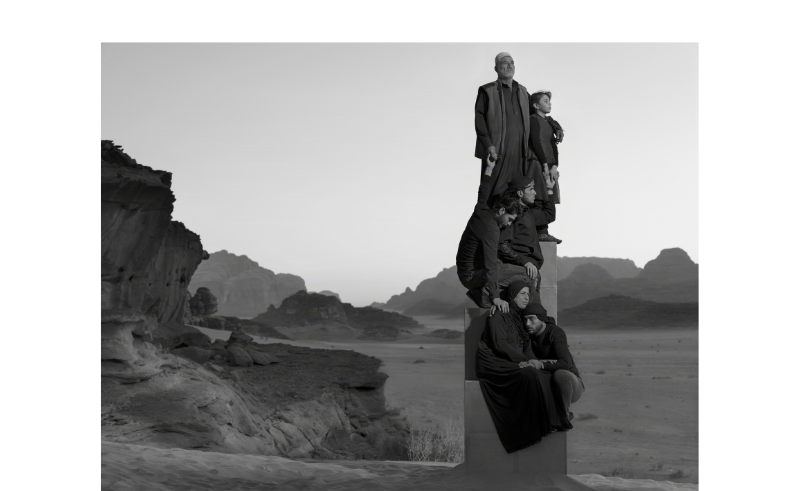 Kamal Family, Jordan, 2024. From The Day May Break, Chapter Four. © Nick Brandt
As a 61-year-old British photographer, Brandt has spent over a decade documenting the rapidly disappearing natural world - and, increasingly, humans and animals living through displacement and ecological collapse. His practice is driven by two compulsions: “Thematically, the need to express my feelings about the destruction of the natural world… and, physically, the compulsive desire to make prints.”
That insistence on print is not incidental. In an era dominated by screens, Brandt refuses to fully trust an image until it exists physically. “I can never tell whether anything has subjective merit until I see the images printed,” he explains. The print slows the image down. It demands attention. It resists the disposability that defines so much contemporary visual culture.
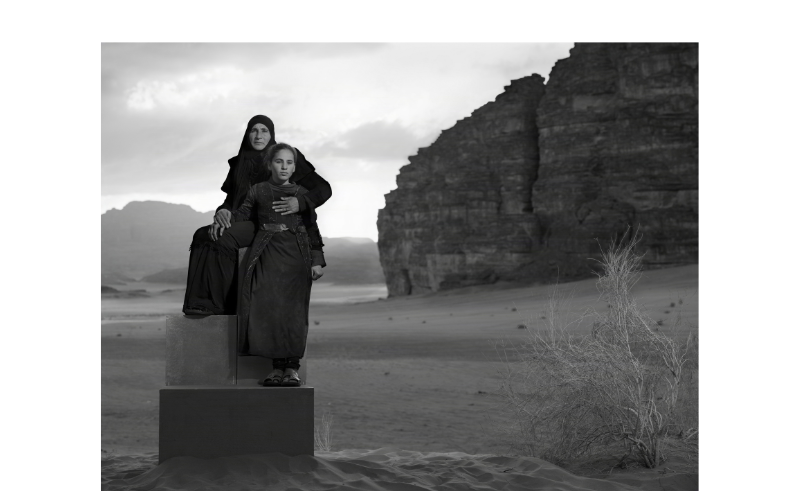 Fasel and Inas, Jordan 2024. From The Day May Break, Chapter Four. © Nick Brandt
The photographs in the recent exhibit belong to ‘The Day May Break,’ an ongoing multi-chapter series that evolves alongside the crises it observes. Earlier chapters often isolated subjects - human and animal figures suspended in stark environments, a study in separation and desolation. But by the time Brandt began this chapter, something had shifted.
“I, like so many of us, have become more and more worn down by the events we see all around us in recent years,” he says.
Photographed in Jordan, ‘The Echo of Our Voices’ focuses largely on Syrian refugee families living with perpetual displacement. Brandt did not set out to document refugees, but the thematic alignment was unavoidable. “These are people who lost their homes, their way of life, their communities, their land - everything. Now all they have is each other.”
-be9b4e65-ac5f-449e-b7ce-37387ceda068.png) Maisa and Boshra in Moonlight, Jordan, 2024. From The Day May Break, Chapter Four. © Nick Brandt
Maisa and Boshra in Moonlight, Jordan, 2024. From The Day May Break, Chapter Four. © Nick Brandt
His guiding principle is clear: the people being photographed are the most important audience. Across the series, Brandt prioritises consent, collaboration, and comfort. In earlier chapters, subjects were largely free to pose as they wished. After each shoot, participants were interviewed. “What we have always heard,” he says, “is ‘thank you for seeing us. Thank you for hearing us.’”
For the families being photographed for this chapter, the experience carried that same emotional weight. One elder, Shaila, said standing atop the boxes made her feel her story needed to be told. Another, Kamal, said it made them “feel like we are truly human…we feel that we have worth.” In a context where displacement strips people of agency and visibility, that sense of worth is radical.
-b0d23b9f-d248-4712-943c-240449cdd385.png) Women with Sleeping Children, Jordan 2024. From The Day May Break, Chapter Four. © Nick Brandt
Women with Sleeping Children, Jordan 2024. From The Day May Break, Chapter Four. © Nick Brandt
Throughout it all, Brandt is conscious of his position as an outsider. “Obviously I am European,” he says, “so I want to make sure that I am not misrepresenting the subjects.” During the project, a small group of Middle Eastern confidants and key crew members reviewed the work, flagging anything that felt imposed or inaccurate. Their role was not symbolic; it was essential.
It is this careful attention to ethics, presence, and accountability that underpins Brandt’s practice. “Everything I do,” he says, “is ultimately motivated by my outrage at injustice.” His outrage is measured, patient, and directed not toward spectacle, but toward honouring the humanity of those he photographs.
And so, in a world saturated with images of crisis, Nick Brandt’s photographs - now gathered as ‘The Echo of Our Voices’ - refuse the comfort of distance. They ask us not just to look, but to stay - with the people in the frame, with the weight of their stories, and with the uneasy recognition that their vulnerability is not separate from our own.