





There’s an Underground City in Cappadocia Where People Lived in Secret
Beneath a quiet Cappadocian town lies a network of corridors, stone doors, and vaulted chambers that once held entire communities out of sight.

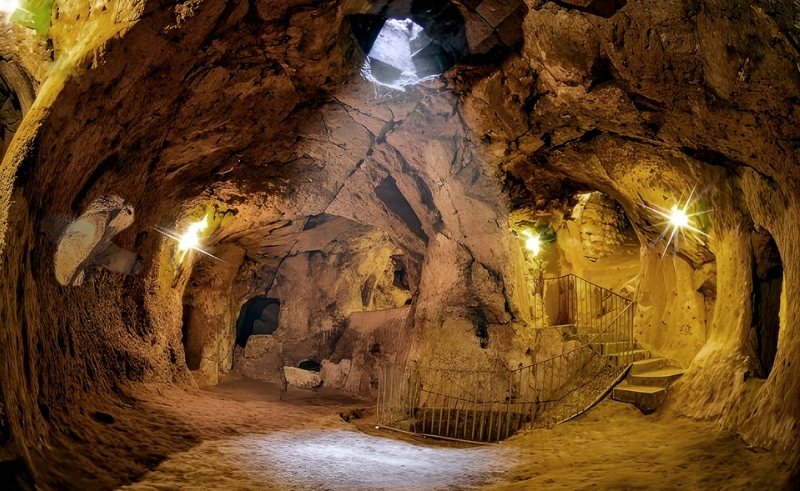
In 1963, an ordinary villager in Cappadocia began renovating his home and chiseled through a wall—that wall gave way to darkness. One step became two, two became a stairway, and that stairway unfolded into corridors, rooms, wells, a rolling stone the size of a dining table. Soon, the man had unearthed an entire underground city: Derinkuyu, a subterranean world where generations lived hidden from the surface.
Dust, echo, and the practical inconveniences of discovery accompanied this accidental confrontation with a civilization beneath his feet—centuries of subterranean history revealed not as spectacle, but as survival.
Derinkuyu sits beneath the dry high plains of Nevşehir, where the landscape is already sculpted into fairy chimneys, carved churches, and cave hotels. Here, volcanic tuff soft enough to carve yet firm enough to last has been hollowed into a multi-storey refuge. Passages plunge roughly eighty metres down, opening onto rooms, wells, and rolling stone doors the size of dining tables. Scholars estimate tens of thousands may have once taken shelter here, though those numbers measure human intent as much as population—how far people will go when withdrawing from the surface becomes necessary.
-4c8822d9-1b3d-492d-b469-f60924a17162.jpg) The architecture is austere and precise. Circular stone doors roll into niches to isolate levels; vertical shafts channel air and water; and rooms bear traces of daily life—blackened stones where cooking fires burned, ledges for tethering animals, cisterns for drinking water. Barrel-vaulted halls hint at chapels or schools; storage niches and presses for wine or oil speak to a people balancing the mundane and the vital beneath the earth.
Yet Derinkuyu is not only a record of ingenuity—it is a record of repeated choice. These spaces were never dug for display. They were excavated over centuries, deepened as needed, used episodically whenever the world above turned hostile: during raids, invasions, or epidemics. Ventilation shafts move air efficiently, gradients prevent flooding, interlocking rooms allow communities to fragment and regroup. The tuff preserves, making the past legible, even as it shelters.
The architecture is austere and precise. Circular stone doors roll into niches to isolate levels; vertical shafts channel air and water; and rooms bear traces of daily life—blackened stones where cooking fires burned, ledges for tethering animals, cisterns for drinking water. Barrel-vaulted halls hint at chapels or schools; storage niches and presses for wine or oil speak to a people balancing the mundane and the vital beneath the earth.
Yet Derinkuyu is not only a record of ingenuity—it is a record of repeated choice. These spaces were never dug for display. They were excavated over centuries, deepened as needed, used episodically whenever the world above turned hostile: during raids, invasions, or epidemics. Ventilation shafts move air efficiently, gradients prevent flooding, interlocking rooms allow communities to fragment and regroup. The tuff preserves, making the past legible, even as it shelters.
-ad85f01b-6814-4ce7-a58f-3dfa45fe46d4.jpg) Visiting Derinkuyu demands attention to scale and detail. The upper, public levels reveal domestic arrangements in striking immediacy. Ceilings dip, passages narrow to shoulder-width, and artificial light falls discreetly. The soundscape is muted—footsteps, whispers, and occasional guides’ directions. Objects become the dramatis personae: a wheel door, a winepress, a soot-streaked lintel. For the writer, metaphor tempts: a city as unconscious, as hidden history. But the site resists symbolic overreach. It insists on practicality. People extinguished light to survive.
Visiting Derinkuyu demands attention to scale and detail. The upper, public levels reveal domestic arrangements in striking immediacy. Ceilings dip, passages narrow to shoulder-width, and artificial light falls discreetly. The soundscape is muted—footsteps, whispers, and occasional guides’ directions. Objects become the dramatis personae: a wheel door, a winepress, a soot-streaked lintel. For the writer, metaphor tempts: a city as unconscious, as hidden history. But the site resists symbolic overreach. It insists on practicality. People extinguished light to survive.
-39923f11-7a8d-4863-b2e3-cd76e1442a75.jpg) Derinkuyu will not forgive a casual glance. It rewards curiosity and patience, and in that silence, the past and present meet. Every carved niche, every narrow corridor, every stone door speaks of a community’s ingenuity, endurance, and quiet courage. Here, underground life is not a relic—it is a testament to the human capacity to adapt, endure, and keep hidden histories alive beneath the sunlit world above.
Derinkuyu will not forgive a casual glance. It rewards curiosity and patience, and in that silence, the past and present meet. Every carved niche, every narrow corridor, every stone door speaks of a community’s ingenuity, endurance, and quiet courage. Here, underground life is not a relic—it is a testament to the human capacity to adapt, endure, and keep hidden histories alive beneath the sunlit world above.