






Review: ‘La Cazadora’ Is a Masterful Portrait of Disappearance
La Cazadora’, competing at this year’s Sundance Film Festival, is the kind of film that feels unmistakably authored.

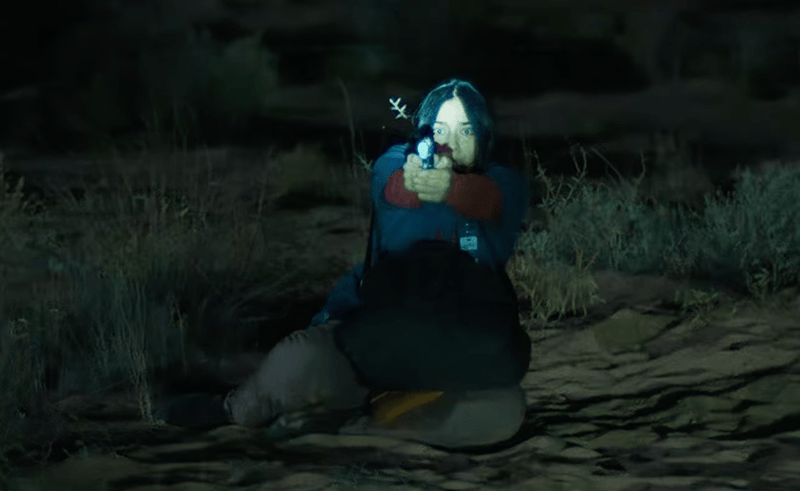
The screen is black. Headlights cut through the darkness. The light briefly illuminates a face as a car passes by. Another vehicle follows, and more faces surface, then recede back into the dark. A bus arrives. The people have been standing in the middle of nowhere, waiting in the dark. One by one, they board. When the bus reaches its destination, passengers begin to exit, while others step inside to replace them. The last to board is a woman. She locks eyes with the bus driver, her stare filled with hatred. He looks back, confused. We hear a sudden bang. She fires and misses. Another shot. This time, she hits him in the chest before running off into the distance.
Writer-director Suzanne Andrews Correa, an award-winning Sundance Film Festival shorts alum, returns to the festival with a true story about an infamous bus driver killer who took the city by storm. The film is set in the border city of Juárez, Mexico, where violence against women unfolds with near-total impunity. But from this climate of fear, an unlikely vigilante emerges. Adriana Paz (“Emilia Pérez”) delivers a staggering performance as Luz, a woman haunted by the harm inflicted on herself, her co-workers, and her family. She is driven by an urgent need to protect her teenage daughter. In fact, she will do anything to avenge the victims of sexual abuse, rape, murder, and systemic neglect.
Set across two tense nights in the aftermath of the bus driver’s assassination, the film builds with mounting dread. I was completely immersed in a city where the ghosts of missing women roam the streets. Drawing on elements of magical realism, the film allows memory, trauma, and the spiritual world to bleed seamlessly into everyday life. Correa transforms Juárez into a liminal space where the past refuses to stay buried.
It is the second film I’ve seen at Sundance this year to confront women fighting back against men in societies that endanger them. The other being Olive Nwosu’s impressive debut, ‘Lady’. But of the two, this is definitely the more confident and haunting work. It’s a film that sustains its atmosphere with extraordinary control. There are scenes that left me completely on the edge. I was genuinely fearful for what might happen to those onscreen. This was particularly the case in moments involving young women navigating the streets alone. For them, the threat of sexual violence is always a few feet away.
‘La Cazadora’ (The Huntress) is the kind of film that feels unmistakably authored. It could only be made with such devastating power by a filmmaker attuned to the daily calculations women make to simply get by. It fills me with anger, while also underscoring the strength it takes to endure this kind of psychological violence daily. There’s a scene in a bus ride filled with the ghosts of women who disappeared that still haunts my thoughts. I was completely caught off guard by the film’s power.
It brings to mind Patricio Guzmán’s ‘Nostalgia for the Light’, the extraordinary documentary that juxtaposes two parallel searches unfolding in Chile’s Atacama Desert. Astronomers gaze upward, tracing the birth of the cosmos, and women kneeling in the dust look beneath the ground searching for the bones of those erased by Pinochet’s regime. As in Guzmán’s film, the earth becomes an archive of absence. The parents of missing children comb the ground for the dead. Meanwhile, those still alive struggle to navigate a dangerous world. They try their best not to become the next names added to the ever-growing list of the disappeared.
At its core, ‘La Cazadora’ operates as a work of forensic memory. This concept understands cinema as a tool for recovering what has been systematically erased rather than merely representing the past. In this sense, the film aligns with theories of counter-archival cinema, where memory emerges not through official records but through embodied experience. By allowing ghosts to coexist with the living, the past remains insistently present.
With this exceptionally thrilling work, Suzanne Andrews Correa contributes to a growing body of feminist cinema. It’s a film that resists both victimhood narratives and heroic revenge frameworks. Here, the vigilante figure is not a symbol of restored justice, but a symptom of societal failure to grant basic protection to those who need it most.
When the film was over, I found myself thinking back to that opening scene. Faces emerge only long enough to be seen before slipping back into darkness. People appear, then vanish. In retrospect, the sequence tells us everything we need to know about “La Cazadora”. As the story unfolds, that initial image begins to reverberate everywhere. Women move through the city knowing how quickly they can be swallowed by it. Mothers search for what the ground has hidden. Ghosts ride buses alongside the living as reminders of those who never made it home. This is the mark of a great filmmaker. Correa does not explain her ideas; she embeds them in images.
‘La Cazadora’ (The Huntress) competes at the World Cinema Dramatic Competition at this year’s Sundance Film Festival.
Related Articles

Trending This Week
-
 Oct 06, 2026
 -

-
-