



Saudi Artist Faisal Samra’s Search for Art’s 'Other Body'
The pioneering Saudi artist’s latest exhibition returns to when he left behind his Parisian art training for Gulf beginnings.
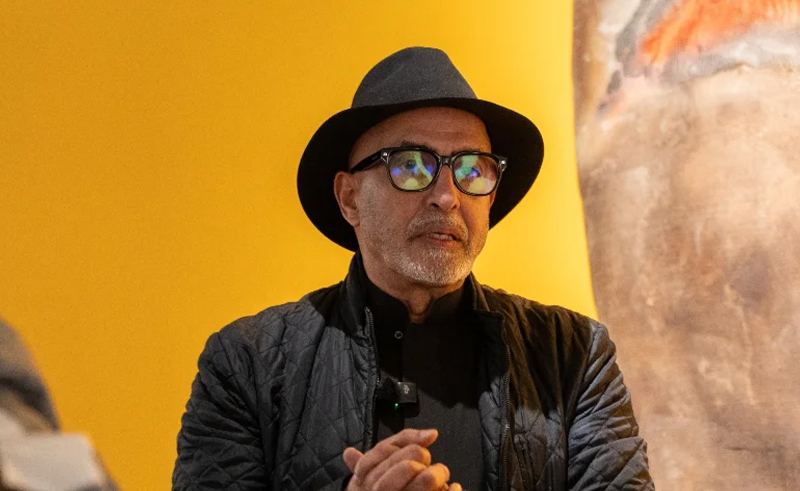
Creatures hang from the walls of Faisal Samra’s latest exhibition, creatures that have been asleep for twenty years. He speaks of them lovingly, like a parent. After all, it was he who birthed them, and he who woke them from their long slumber.
In the world of this Saudi pioneer of conceptual art, there is a new vocabulary one must familiarise oneself with. When he speaks of art, he speaks of research. When he speaks of creation, he speaks of intervention and dialogue. Artworks become creatures, and the traditions and conventions of art’s long history become bodies.
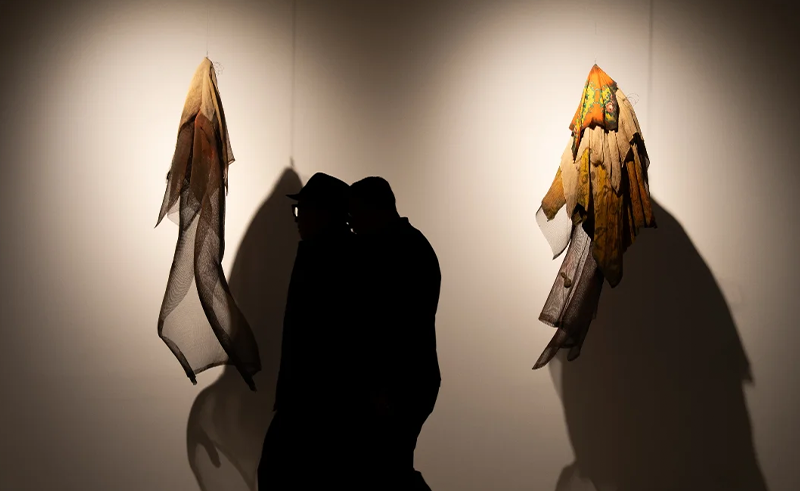
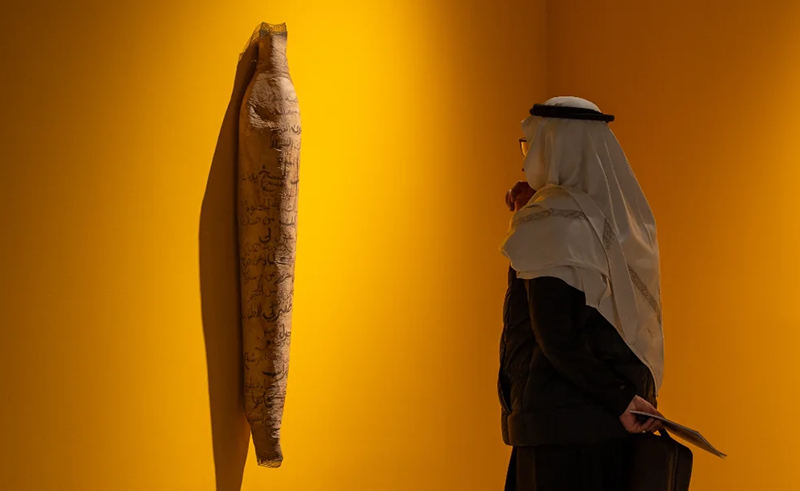
The creatures currently on display in Samra’s Other Body exhibition at Hafez Gallery in Riyadh are Mo’alakat, a term which, like the rest of Samra’s dictionary, carries overlapping meanings. In a literal sense, the term can be translated as something which is ‘suspended’ or ‘hanging’, as in an art installation that hangs from the ceiling, a key feature of Samra’s ongoing exhibition. But the word itself is borrowed from an ancient term for the poetry of pre-Islamic Arabia that was chosen to be hung on the walls of the Kaaba, and thus revered. For Samra, they marked a pivotal point in a career that began with charcoal drawings on the walls of his family home, became formalised at École Nationale Supérieure des Beaux-Arts of Paris, and decades later, continues to reinvent itself.
With his ongoing project, Immortal Moment III, at the Diriyah Contemporary Art Biennale, we sat down with Samra to explore an earlier moment in his career and learn about his Mo’alakat, what they represent, and why he has brought them back to life now for Other Body.
Q: These artworks were created between 1997-2004. Can you tell me about this period in your life as an artist?
The project is an extension of a previous project I began in Paris in 1987, from which arose my first solo exhibition in 1989. At the time, seven years after my graduation, I was working at the Institut du Monde Arabe (Arab World Institute). In that period, I was still working within the framework of Renaissance painting and Western painting, but this kind of painting cannot accommodate Arab figures or ideas, no matter how much we try to incorporate ourselves into it. Its essential foundations were laid in Italy during the Renaissance. So I was asking where the body of work is, that was of our own heritage, particularly in the Arabian Peninsula. We needed another body.
Q: What does this body look like?
In Egypt, there is the culture and artistic traditions of the ancient Egyptians, as is the case in Iraq and Syria. But in the Arabian Peninsula, if you’re searching for a body of art, well, our art relied upon poetry. Our poetry was transmitted orally before it was ever written. When the Arabs began writing, they transcribed the poetry onto animal skins and other materials, and these skins were then hung on the walls of the Kaaba. They called them Mo’alakat. During annual gatherings in Mecca, the poets would compete and the best poet would be bestowed a title. So it was sort of like the first art exhibition in our context, and the first time a work of art was hung on a wall. These Mo’alakat, which are a body of art with roots in the Arabian Peninsula, also became the root of my work. I added other elements as well, but this is the key essence of it.
Q: I've seen your work described as ‘freeing the canvas’, but physically, how does this happen?
I began taking canvases and cutting them in ways that are different from the usual square-type frame, leaving one of the ends hanging freely, and then colouring them. When I hung them on the wall, I realized that the artwork began a dialogue with the space around it. It was the complete opposite of a painting. It had a direct relationship with the walls and empty space. A painting is as though it’s a portal into another world. Through the Mo’alakat, the canvas is more like a sculpture, taking on the role of three-dimensional art. What led to Other Body, which I began in 1997, is that I began incorporating wire, mesh, and cotton fabrics. It became like a prison of different materials, and the work became a spontaneous dialogue between myself and these materials.
Q: You use the word, ‘dialogue’. What does it mean to have a dialogue with the artwork?
When you stand in front of a canvas, you’ll see that the artist has either copied something from the real world, or copied something from inside his own mind or imagination. Or, thirdly, the artist practises a sort of intervention. It’s not open-ended; it’s very controlled. The artist introduces certain elements, the artwork reacts, and a dialogue happens. When I started this project, I didn't put colour on the brush in the conventional sense. The colour went onto the canvas, and then I enacted upon it a certain action, which created a reaction, or shock, and left behind a certain effect. In this way, there is a dialogue between me and the work, and from that I create a kind of creature. The final outcome creates its own self though the dialogue. But, of course, it’s me who decides when to end the conversation.
Q: Why did you decide to bring these Mo’alakat back, and why now?
I wanted to give them a new life, as you might say. I was sitting in the studio, and I saw these artworks, and when you see works in the studio or in storage, it’s as if they’ve gone to sleep. When you display an artwork it comes back to life. So I wanted to bring it back to life. The other reason is that now, other artists are also arriving at the idea of Mo’alakat as if it’s a new thing. So I thought, ‘No, I’ve been doing this since 1997.’ I had to defend myself. Now, I’m seeing many artists, including here in Saudi, recognize and appreciate my work with Mo’alakat, acknowledging that it’s my primary work. Mo’alakat, and breaking the Western painting.
Q: The process is clearly borne of political intent, but is there also a political message within the works themselves?
I noticed in several of the Mo’alakat there is a parachute, or a paratrooper. The parachute is from a group of works I did in 2004, and it’s a metaphor for the invasion of Iraq. The parachute means people coming upon you from above, colonizing you. But these kinds of details, and the finer details in my work in general, are hard for me to talk about. In the early 2000s, I was despaired by the political situation, and reached a point where I had to make something about it, but that really started in 2005 when I began experimenting with digital mediums and stopped drawing.
Q: And in your current project? Is there a throughline there?
My current project is called Immortal Moment. The title of the first exhibition was ‘Thriving Emotions’, and the second, which was after Covid, was called ‘Coping with the Shock’. The third is titled ‘Post Shock Creatures’. After experiencing the shocks of the pandemic and of wars, we become different creatures, psychologically and physiologically. For example, the war in Gaza. People, especially those who lived through the shock, but also us who lived it from afar, changed a lot in the aftermath of it. It changed in us how we perceive the world. The primary victims of this war, who dealt with it upfront, became different creatures. I was also imagining, as I worked on this project, that if humanity experienced a large enough shock and went extinct, new creatures would emerge after us. What would those creatures be like?
Q: Are you concerned that the kind of artworks you create, particularly conceptual art and installation art, are not usually the kinds of things bought by collectors and other art buyers?
Of course it is a type of art that is less commonly acquired by collectors, but after I graduated from university and began working on my art, I have always remained on the same path, the same artistic research, without changing my focus in order to sell. There were artists who were doing their own art alongside a different, more commercial kind of art, in order to sell, which is very wrong. Thankfully, I continued along my same path. I did other things in life, like interior design and graphic design, that gave me income, and kept my artistic work pure. So, bit by bit, collectors saw that I am dedicated to this path, loyal to it, and I began to sell. Not much at first, but still the work imposes itself once it becomes clear that you are insistent upon it. If you do this and then that in order to sell, you won’t be taken seriously.
Other Body is on view until March 21st at Hafez Gallery in Riyadh.