





REVIEW: 'Ta fille' Is a Fearless Triumph of Confrontation & Compassion
Turning the camera on her own mother, the renowned director and producer Marianne Khoury, Sara Shazli demands answers for her absence throughout much of her childhood.

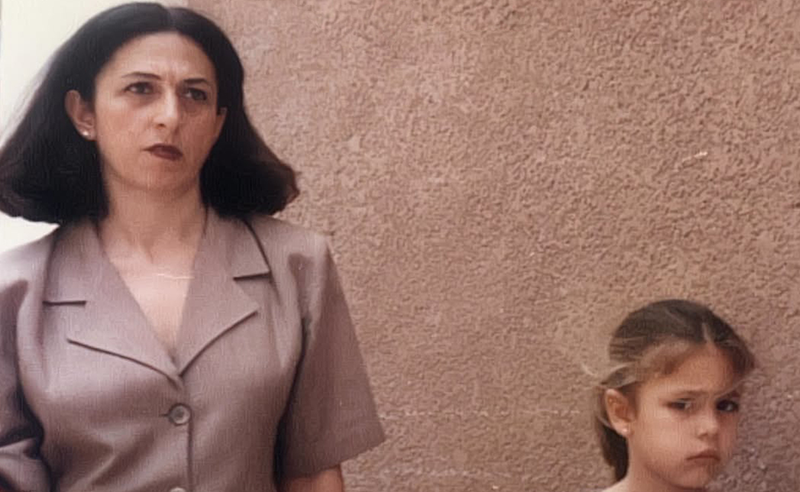
In recent years, Egyptian independent cinema has witnessed a surge in personal documentaries in which filmmakers turn to family archives and home videos to unearth their pasts and make sense of their relationships with those closest to them. Among these works is Sara Shazli’s Ta fille (Your Daughter), which explores motherhood through the eyes of a daughter on the verge of becoming a mother herself. Turning the camera on her own mother, the renowned director and producer Marianne Khoury, Shazli demands answers for her absence throughout much of her childhood. What elevates Shazli’s film above this emerging wave of autobiographical filmmaking is its remarkably confrontational nature. In fact, “Ta fille” is perhaps the most unflinchingly confrontational Egyptian documentary of its kind in recent memory.
Some of the greatest documentaries ever made use the camera as an instrument of confrontation, forcing people to reckon with truths they would rather leave buried. Kazuo Hara’s “The Emperor’s Naked Army Marches On”, my favourite documentary of all time, is perhaps the most extraordinary example of this approach. Joshua Oppenheimer’s “The Act of Killing” and “The Look of Silence” similarly use confrontation to expose uncomfortable truths, compelling perpetrators to confront their actions and the histories they have sought to suppress. Yet these films are concerned with collective trauma, historical atrocities, and the enduring consequences of political violence. What I find so remarkable about Shazli’s film is that it takes this approach and turns it inward, bringing it into an intensely personal and intimate setting. I can’t recall seeing the camera used quite this way to confront the people closest to the filmmaker. The pursuit of truth becomes inseparable from the emotional vulnerability of those involved.
-6c978643-eee0-4be5-999f-a83b53606d20.png) There is an equally beautiful irony in the fact that Sara was making this documentary while navigating motherhood herself, giving birth and raising a child while attempting to come to terms with the sacrifices her own mother made in pursuit of her career. In many ways, she finds herself occupying the very position she has spent much of the film questioning. Motherhood allows Sara to see life from a perspective that was previously inaccessible to her. What begins as a daughter's attempt to hold her mother accountable gradually becomes an act of understanding, culminating in a deeply moving reconciliation. The film's circularity is therefore not merely structural but also emotional. The daughter becomes a mother, the mother becomes a grandmother, and somewhere in that transition, the distance between them begins to close.
Throughout the film, we also catch nuanced glimpses of the men who inhabit the periphery of this mother-daughter relationship. There is Sara’s brother, Youssef Shazli, whom we see as a young toddler playing a toy piano, long before he would grow up to become one of the most prominent DJs in Egypt’s underground music scene and a co-founder of Cairo’s arthouse cinema, Zawya. There is their loving father, whose presence adds warmth to this intimate family portrait. Sara’s husband also provides a welcome moment of comic relief in an amusing domestic disagreement over how eggs should be cooked. Even Youssef Chahine, arguably Egypt’s greatest filmmaker, makes an appearance as the affectionately nicknamed Uncle Joe, bringing moments of light-heartedness to an otherwise emotionally demanding film. Yet for all his towering stature in Egyptian cinema, Chahine remains a supporting figure here, occupying the margins of a film far more concerned with the complexities of the mother-daughter relationship. And rightly so. This film belongs to the women. It belongs to the complicated bonds between mothers and daughters. To the ways love, regret, and longing are passed down through generations, and to how art allows us to confront old wounds and allow them to heal.
-a6cd0bba-52b1-495a-b3a1-6ed06eca333c.png) What makes “Ta fille” such an extraordinary achievement is ultimately not the confrontation itself, but what Shazli chooses to see beyond it. There is something profoundly moving about the way her gaze evolves over the course of the film. What begins as the accusatory gaze of a daughter seeking answers gradually gives way to something far more compassionate. It allows her mother to emerge as a person whose identity extends beyond motherhood and the expectations that come with it. Marianne Khoury is no longer simply the absent mother of Sara’s childhood, but a woman shaped by her own experiences, regrets, ambitions, and sacrifices. The camera, initially an instrument of confrontation, becomes one of empathy and understanding. In allowing us to witness this transformation, Shazli demonstrates remarkable sensitivity and maturity as a filmmaker. It establishes her as one of the most exciting emerging voices in Egyptian documentary cinema.
“Ta fille” is a fearless portrait of a mother and a profound examination of the distance that can exist between those who love each other most. It exposes the painful realisation that the people who raised us had lives and dreams long before we came into theirs. It made me reflect on my own family, on the things left unsaid, the questions I never thought to ask, and the countless ways in which we take the presence of those we love for granted. And perhaps that is the greatest gift a work of art can offer us. Its ability to reach beyond the confines of the screen and into our own lives, giving us the courage to ask difficult questions and have conversations we might otherwise spend a lifetime avoiding. The film may belong to Sara and Marianne, but the emotions it leaves behind belong to all of us.
- Previous Article Yazeed Fahad Makes His COLORS Debut with New Single 'Um Alayal'
Related Articles
Trending This Week
-
 Nov 22, 2026
-

-

-