


Dana Awartani Brings Lost Histories to La Biennale di Venezia
Saudi-Palestinian artist Dana Awartani brings 29,221 sunbaked clay bricks to the 61st edition of La Biennale di Venezia, exploring heritage, loss and what remains.
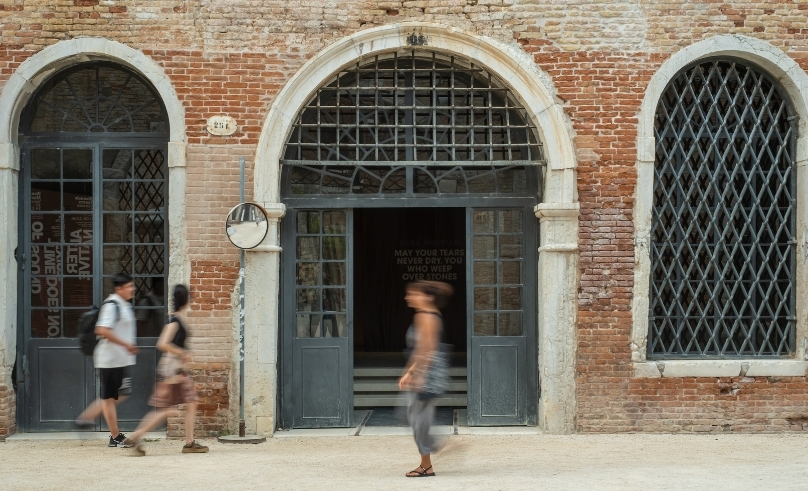
For the 61st edition of La Biennale di Venezia, the National Pavilion of Saudi Arabia opened its exhibition with Saudi-Palestinian artist Dana Awartani’s May your tears never dry, you who weep over stones. Commissioned by the Visual Arts Commission at Saudi Arabia’s Ministry of Culture, the installation was curated by Saudi-based British curator and Director of Art Jameel Antonia Carver, alongside assistant curator Hafsa Alkhudairi.
Realised through more than 30,000 hours of collaborative labour, the floor-based installation draws on ancient mosaic traditions that originated in Mesopotamia and continued through Greek, Roman and Byzantine cultures, before making their way into places including Venice itself.
For Awartani, the choice of mosaic is deliberate. Trained in Islamic geometric design, the artist has long worked with historical techniques and locally sourced materials, bringing them into conversation with contemporary questions around cultural heritage, craft and its preservation. Sunbaked clay earth bricks become the material through which she reconstructs fragments of histories that are increasingly difficult to access.
The choice of mosaic also carries its own reminders. “Our histories are much more interconnected than many appreciate,” Awartani says. The installation draws on sites across Syria, Lebanon and Palestine, bringing together motifs from places that have existed across shifting borders, cultures and faiths for some three millennia.
There is an urgency to the work, with Carver describing it as building “significantly on Dana’s practice, steeped in both artisanship and conceptual art,” while addressing “a live situation and one that affects humanity as a whole.” It also sits between two worlds that are often kept apart, bringing the collaborative, hands-on traditions of craft into a contemporary art context that can often be more focused on the individual artist.
The installation draws on extensive research into 23 heritage sites, with their mosaics providing the geometric, floral and faunal motifs that make up the work. The sites themselves range from mosques, churches and synagogues to archaeological sites, domestic spaces and public places, bringing together different forms of cultural heritage that have long existed alongside one another.
Many have suffered devastating damage in recent years as a result of conflict and violence. Some are now severely damaged or destroyed, while others are being slowly restored by local archaeologists, artisans and conservationists, with the support of organisations including UNESCO, the World Monuments Fund and the ALIPH Foundation.
But these are not simply ruins or archaeological sites in the abstract. As Carver carefully points out, many are places where people have lived and gathered, “where families gather, eat, play tawla.” When they are attacked, she says, “these sites are doubly mourned.” Their destruction extends beyond the loss of a building or an object, taking with it the memories and connections people have formed with a place.
“In these situations, the loss of each human life is unfathomable and devastating,” she says. “This profound loss is compounded when future generations are denied their history.” She also points to the unevenness with which cultural loss is mourned, recalling the global shock that followed the fire at Notre-Dame in Paris. “We have many monuments, many ‘Notre-Dames,’ in the Arab world, and beyond, deserving of such collective outrage and action."
Rather than reproducing any one site, Awartani has composed a patchwork of geometric, floral and faunal motifs taken from across them, the inclusion of flora and fauna marking a first in her practice.
The design is rooted in geometry. Awartani mapped each mosaic in detail before isolating individual sections and motifs, using “geometric techniques using a compass and a ruler, and no digital software,” a method she learned at the King’s Foundation School of Traditional Arts. Every brick was then drawn and entered into a comprehensive coded index, which was used to create intricately shaped wooden moulds with master woodworkers in Riyadh. The margin for error was tiny: “One millimetre out, and the pieces wouldn’t fit together.”
Working with 32 Saudi-based artisans across woodwork, brickmaking and drafting, Awartani then began producing the bricks themselves. Four naturally hued clay earths were sourced from across Saudi Arabia, their colours reflecting different environments and geographies, from wadis and oases to mountain landscapes and desert farmland.
The moulds were taken to a production site on a farm in the arid mountains outside Riyadh, where thousands of bricks were produced by fourteen of the artisans. The Riyadh sun was not simply a backdrop to the process but part of the material itself. Without chemical or artificial processes, the bricks were left to bake naturally in the dry winter climate, hardening over the course of a day or two.
That same process also leaves them vulnerable. The bricks contain no binding agents, meaning that as they dry, they naturally begin to crack. The fractures are not repaired or hidden; they remain visible across the work, making fragility part of its physical language. A material that has been carefully shaped, dried and assembled can still split under the conditions that made it possible in the first place.
It is a material that mirrors the work’s concern with cultural loss. The cracking gives the installation a sense of impermanence, echoing the threatened sites it references and the histories that can fracture alongside them. The work does not attempt to make loss invisible or reconstruct an untouched version of the past. Instead, the cracks remain as evidence of vulnerability, while the act of making – repeated thousands of times, by many hands – becomes a way of tending to what is at risk of disappearing.
“The material and the work embrace fragility, but there’s resilience within the monumental,” Carver says.
Beyond the material itself, the work draws attention to the vulnerability of the traditions behind it. The knowledge held by Awartani’s collaborators is a form of living heritage, threatened by the displacement of communities. Awartani describes the artisans she works with as carrying deep, intergenerational knowledge “despite often being displaced from home and family.”
For Awartani, the process of making is as significant as what it produces. “The repetitive process of repair, remaking, reimagining material heritage, becomes devotional – a form of remembrance that is healing, deliberate, and cathartic,” she says.
The result was 29,221 handmade sunbaked clay earth bricks covering the pavilion’s entire floor, assembled into one unified mosaic of geometric, floral and faunal patterning. Intricate in design but fragile in material, it is the first time Awartani has made a work of such size, complexity and depth of concept.
The installation refuses to leave the visitor standing outside it. Earthen pathways cut through the mosaic, allowing visitors to enter and walk across the work before stopping at seating within the imagined archaeological site.
It is another first for Awartani, and a deliberate one. She describes the pathways as part of a critique of archaeology’s “bird’s-eye view” and its supposed neutrality, which can obscure the power dynamics behind how sites are studied, documented and understood. By stepping into the work, the visitor is no longer simply looking at a representation of cultural heritage from a distance.
“Whether we are makers, practitioners, or visitors experiencing a work, we are all complicit and have agency in how we think about cultural heritage, its destruction, and preservation,” she says.
“Stones are not merely stones – they are (or sometimes were) vessels that hold the stories of the people who built them,” Awartani explains. What appear to be ruins, she adds, “often carefully and against all odds cradle history and connection to land and place.”
The title itself comes with a history of its own. “It references the debate among ruin poets and others around them, about those who mourn buildings, relying on nostalgia rather than action,” says Awartani. The tradition she is referring to is the atlal motif, in which a poet pauses at the remains of an abandoned campsite before beginning an ode to lost love.
One of the best-known challenges to that convention came from Abu Nuwas, the eighth-century poet who delighted in mocking the conventions of earlier Arabic poetry. In 'The Wretched Paused', he writes: “May God never dry the tears of who cry over stones, / Nor ease the love-pangs of those who yearn for tent pegs.”
In Abu Nuwas’ hands, the tears are a jibe at the familiar act of mourning ruins. Awartani keeps the same image but turns it in another direction. Here, stopping before what has been lost is not an end in itself. It becomes an invitation to remember, investigate and care.
“The title is a plea,” she says.
And the installation asks visitors to do something with that plea. Rather than looking at ruins from a safe distance, they walk through an imagined archaeological site made up of fragile, painstakingly produced fragments. The act of pausing over stones, once mocked as a poetic cliché, becomes a way of confronting what remains, what has been lost and what might still be preserved.
For Alkhudairi, the project ultimately comes back to “the power of storytelling” – between the curators and artist, between Awartani and the artisans who brought the work to life, and “between the poets of the past and the audiences of the present.”
Carver hopes the installation similarly invites audiences to reflect on “our shared responsibility as custodians of material heritage.”
May your tears never dry, you who weep over stones located at the Arsenale, Sale d’Armi, marks Saudi Arabia’s fifth participation in La Biennale di Venezia. The Biennale Arte 2026 is open to the public until 22 November 2026.
Related Articles

Trending This Week
-
-
 Oct 15, 2026
-
-