





Dar El Makhzen Housed Every Power That Has Ruled Tangier's Kasbah
Built by sultans on the ruins of Portuguese and English forts, Dar El Makhzen sets atop Tangier's Kasbah as a museum of Roman, Berber and Moroccan artifacts overlooking the Strait of Gibraltar.
Inside Dar El Makhzen hangs a map of the known world, made in 1154. It's oriented upside down by modern convention, with south at the top. This was the standard in Islamic cartography of the era, which placed Makkah near the top of the frame.
Dar El Makhzen is the former sultan's palace at the centre of Tangier's Kasbah, the city's fortified citadel above the medina. It sits at the citadel's highest point, looking out over the Strait of Gibraltar.
This site is believed to have carried a fortress through the Portuguese occupation of the city, from 1471 to 1661. The English took the site after that and built an outpost called the Upper Castle. In 1684, Moulay Ismail, the Alaouite sultan who ruled Morocco until 1727 and rebuilt much of its central authority after decades of tribal fracture, retook Tangier and had the English fortifications torn down.
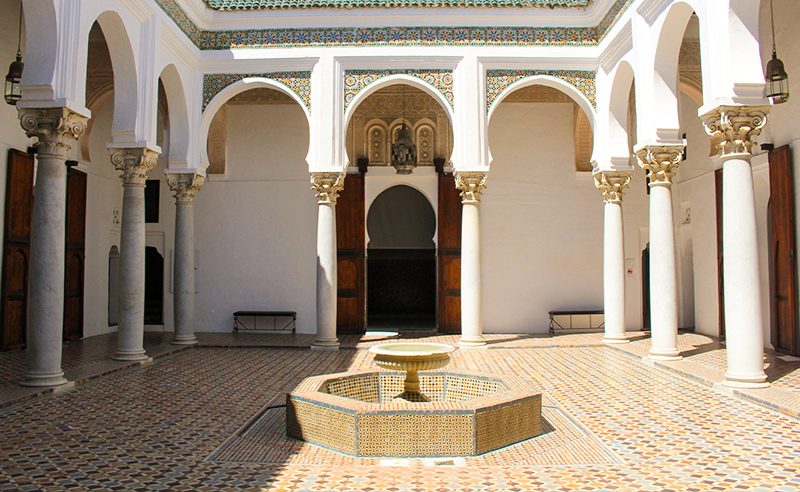
An inscription inside the building dates the current structure to 1151 in the Islamic calendar, 1737 by the Gregorian one, commissioned under Pasha Ahmed Ben Ali al-Rifi, the general who led the city's liberation. Each ruler who held this hill built over whoever came before.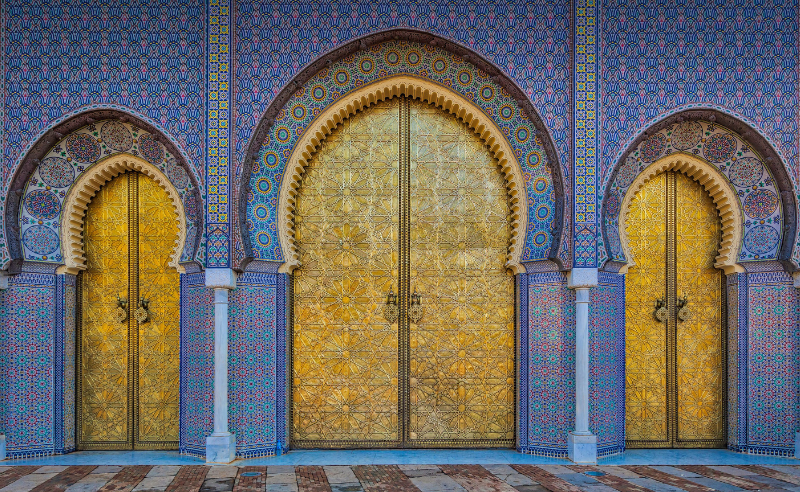 The palace is arranged around two courtyards, both centred on marble fountains. Its main courtyard keeps its original zellij flooring, framed by a covered walkway held up by a row of columns instead of solid walls. Carved and painted wooden ceilings run through the seven rooms of the main residence, with arabesque plasterwork between them.
Past the first courtyard is an Andalusian garden, laid out in the style Moorish craftsmen brought south across the strait after the fall of Granada. The sultans who built this palace were looking toward Fez and Marrakech, but also across the water at a peninsula their predecessors had once ruled.
The building itself is classified as Moroccan-Andalusian, a style that fuses Moroccan building craft with Mediterranean influence. Rather than sitting as a single flat plan, the structure extends across several levels.
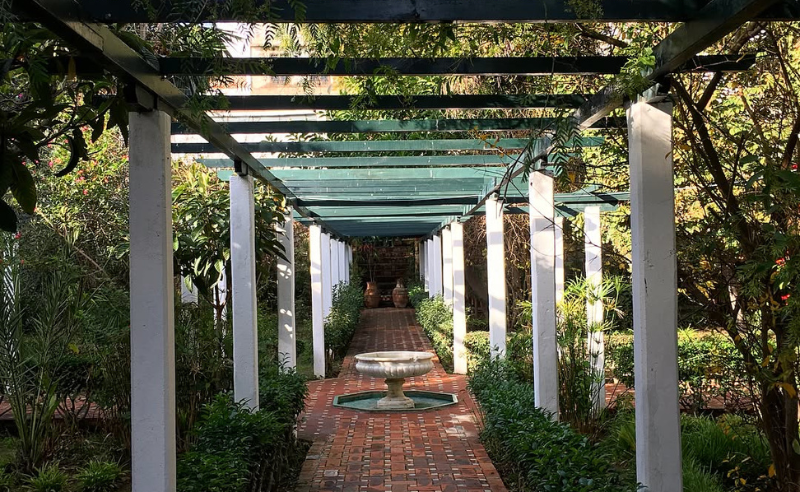 Beyond that, the palace's architectural character is carried by the same elements found throughout it: the colonnaded courtyards, the carved and painted wooden ceilings, the zellij tilework, and the marble fountains, rather than by a single defining feature unique to Dar El Makhzen among Moroccan-Andalusian buildings.
Further into the palace is the Treasury Room, where a hand-forged iron box still sits on display, hammered into shape rather than cast in a mould. Its lock takes several buttons pressed at once to open.
This was a working government building before it was anything else, built to hold taxes, arms, correspondence and the sultan's belongings whenever he was in residence. Beyond the Treasury Room, the wider complex includes a mosque, a prison and a number of residential structures.
The palace kept working long after the sultanate that built it changed shape around it. When Sultan Hassan I, whose Alaouite court moved constantly between Morocco's interior cities, visited Tangier in 1889, the city had just become Morocco's diplomatic capital, and Dar El Makhzen was restored to house the European diplomats who arrived after him.
By 1922 it had become a museum. A 2016 renovation renamed it the Kasbah Museum of Mediterranean Cultures, and a contemporary art space was added to the complex in 2021.
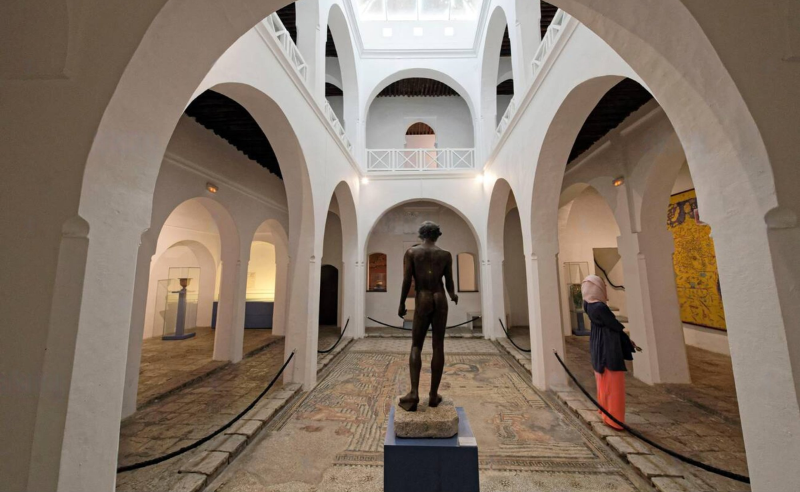 The collection inside now reaches well past the palace's own history. A mosaic of Venus, brought from the Roman city of Volubilis, sits near a set of replica maps tracing trade from Phoenician metalwork through to modern electronics.
Phoenician and Berber pottery share the space with Moroccan textiles, silk and carpets, none of which were originally made for this building. The craft collection extends further into jewellery, leather goods and manuscripts drawn from the cultures that passed through the city, with exhibits labelled in both French and Arabic.
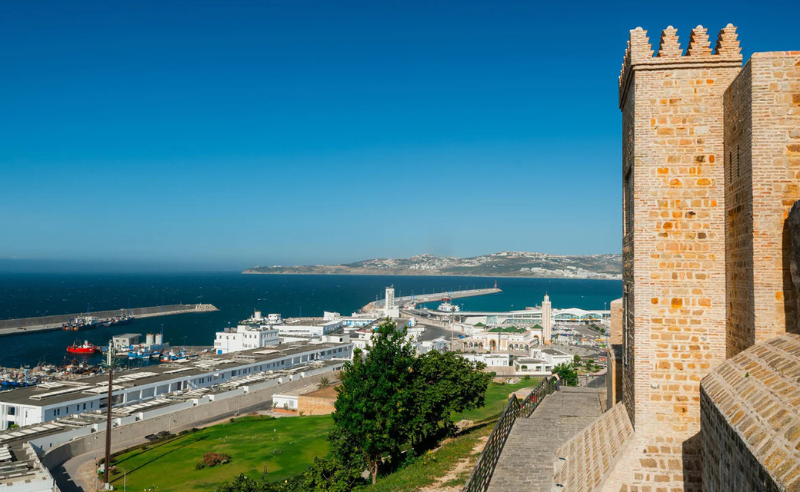
From the upper terrace, the medina drops away below and the strait opens out past the harbour. On a clear day, the coast of Spain is visible directly across the water.
Every ruler who held this hill chose it for the same view, close enough to see whoever was arriving before the rest of the city could.
Related Articles
Trending This Week
-
-
 Oct 15, 2026
 -

-