





Inside Mariolino: the most talked-about ‘house’ on Egypt’s North Coast
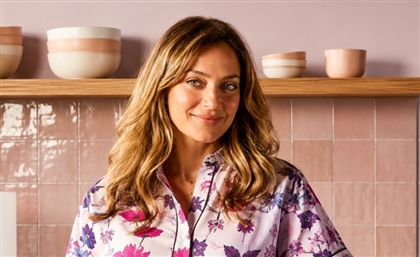
Mario Haddad Jr. wanted guests to arrive as strangers, gather over breakfast and leave as friends. Hala Saleh spent 18 months turning that idea into one of the North Coast’s most talked-about homes.
Ramla is Arabic for sand, an odd name to give ground you want people to fall for and never leave, since sand is famous for the one thing a home cannot survive being: unstable.
On this particular stretch of it, on Egypt’s North Coast, Mario Haddad Jr. and Hala Saleh have somehow pulled off the one trick sand isn’t supposed to allow. Permanence.
For this instalment of The SceneHome Tours, we’re stepping inside Mariolino Beach House, the Marakez-owned, 18-room guest house set within Ramla and designed by Hala Saleh of TDF.
Mariolino feels less like checking into a hotel and more like turning up at the summer house of your coolest friend. Except this friend has 18 bedrooms, a spectacular stretch of Mediterranean out front, and has somehow assembled exactly the people you didn’t know you wanted to spend the weekend with.
That particular magic is helped along by restaurateur and host Mario Haddad Jr., who can generally be found somewhere between the kitchen and the pool, cooking, introducing people and holding court.
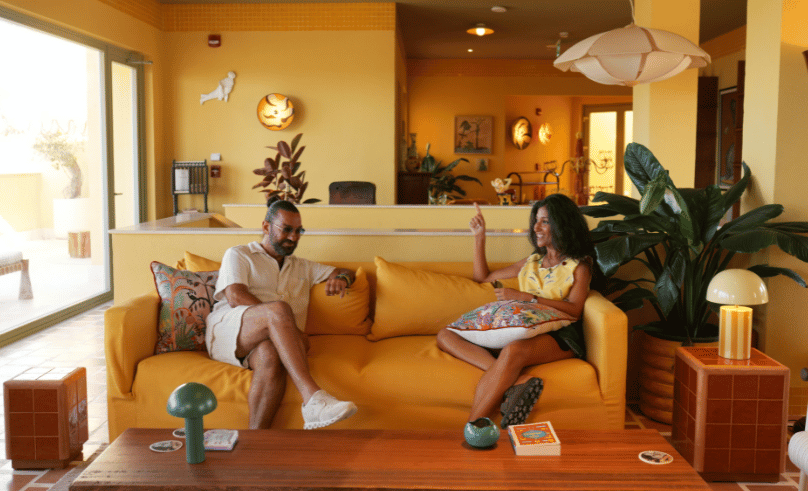
We find Haddad and Saleh curled up on a couch the colour of an egg yolk held a beat too long against the sun, each faintly unable to believe they’re allowed to be there.
“I can’t believe I’m actually sitting here,” Haddad says. “It feels like home. More than my home.”
Saleh allows herself exactly one told-you-so.
“In this butter-yellow room,” she reminds him, “that you hated.”
The yellow came considerably later.
At the beginning, Haddad handed Saleh something more difficult to draw.
“I don’t care what it looks like,” he remembers telling her. “I’m not here to tell you what colour, or what design, or what style I want. I’m here to tell you what I want people to feel.”
He didn’t want a boutique hotel. He wanted a guest house: somewhere he could live, host people, entertain and cook.
Saleh responded by imagining the people before the place was even built.
 Her original concept presentation mapped out different archetypes of future guests and how they might inhabit Mariolino: the Curated Crew, the Getaway Parents, the Voyager and Mariolino’s Friends.
Where might they sit? Which suites might they stay in? Would the after-party happen downstairs or in a room?
Haddad sat through Saleh’s early presentation almost entirely reactionless. Then he got up, walked around a huge boardroom table and hugged her.
Saleh left with one thought.
“Mariolino needs to feel like a hug. Can I design a hug?”
Eighteen months later, Saleh returned to Mariolino as a guest. She spent two days meeting people she had never met before, then reopened that original concept presentation.
Suddenly the hypothetical guests looked remarkably familiar.
“Oh my God, that was Jad. That was Lina,” she remembers thinking. “These people were there. They acted that way. They behaved that way.”
The archetypes had come to life.
That is perhaps the key to understanding Mariolino’s architecture. Saleh wasn’t simply designing what people would see. She was imagining how they would live inside it.
The ground floor is almost entirely open, because doors have an unfortunate habit of getting between you and the party.
The pool-level floor has no conventional windows separating its principal spaces from the outdoors, deliberately blurring the boundary between inside and out.
“Am I inside or am I outside?” Saleh asks.
The outdoor corridors leading to the rooms continue the idea. Rather than enclosed hotel passageways, they become breathable extensions of the suites: somewhere to sit, take a call, meet someone or simply wander barefoot beneath the sky.
In other words, the journey back to your room is another opportunity to get distracted.
And the Mediterranean refuses to leave you alone.
Just 50 metres away, the sea appears through the building again and again, with the architecture positioned to maximise views from rooms, shared spaces, corridors and terraces.
Haddad calls it the Mona Lisa effect: wherever you go, you see it.
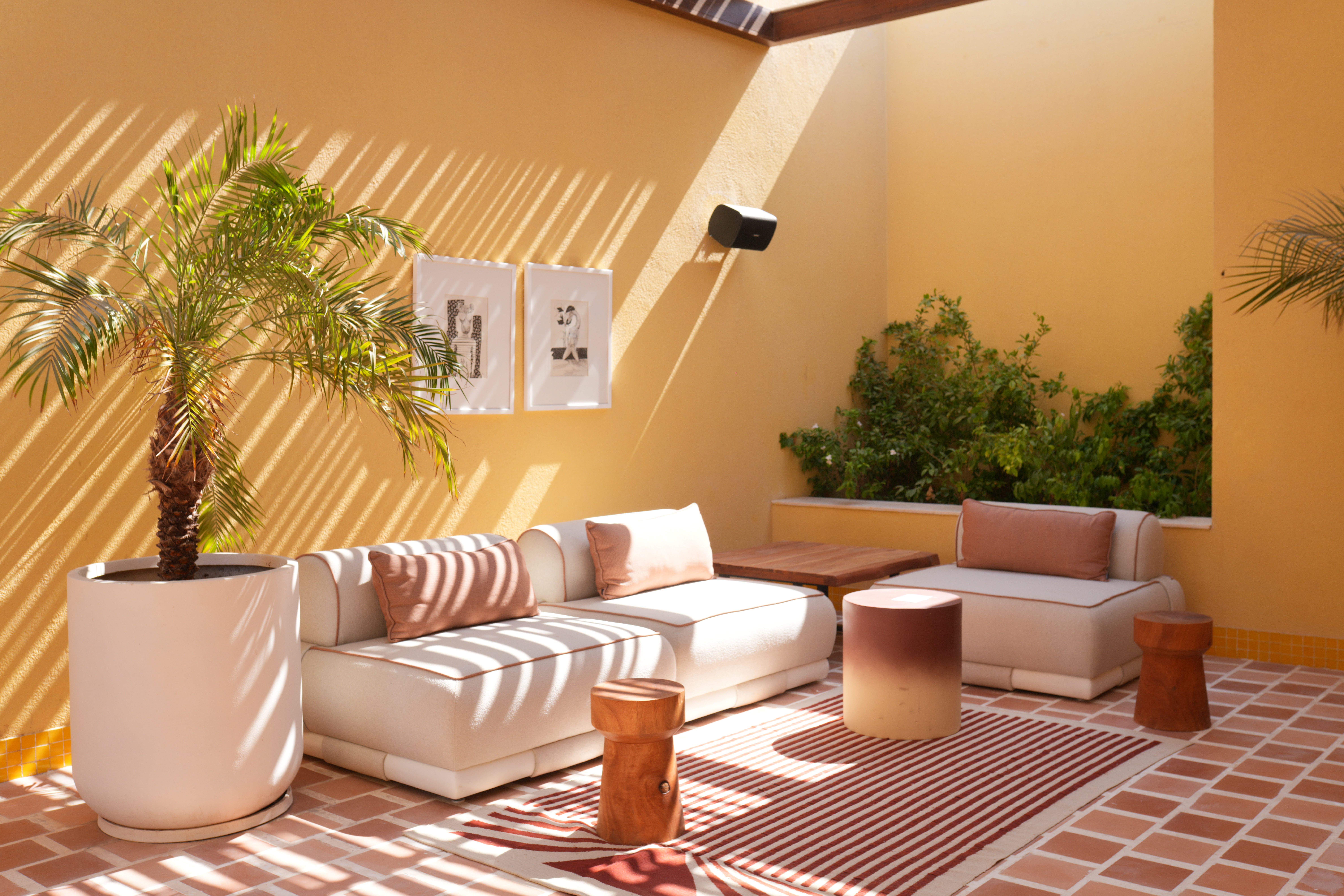
Then there is the butter yellow.
Saleh delivered it like a verdict, already bored by the idea of an appeal.
“We’re going to paint it all yellow,” she told Haddad.
“All yellow?”
“Butter yellow.”
“Still all yellow?”
He lobbied briefly for terracotta.
“Everybody’s done terracotta,” Saleh told him.
That ended that.
-e76826b7-8feb-417c-8529-451bd7532406.png) Haddad tells the story now like a man conceding a chess match he didn’t realise he’d been playing.
Haddad tells the story now like a man conceding a chess match he didn’t realise he’d been playing.
“I cannot see it in any other colour.”
Around it are greenery, books, vintage finds and retro pieces, all part of a deliberate attempt to make a newly built guest house feel as though somebody has already been living there.
“The challenge is how do you design a space that feels lived in way before it’s built?” Saleh says.
That meant imagining the small evidence of life before the life itself existed: books, newspapers, collectibles, vintage pieces, the things left around a home that make it feel accumulated rather than installed.
And then actual life started interfering with the styling.
Saleh recalls filling the home-library area with Arabic books, only to return as a guest and have another guest ask for a book to read, then point out that they were all in Arabic.
The books had been chosen to style a home. Now someone actually wanted to live in it.
At Mariolino, even the swimming pool is trying to introduce you to someone.
The 300-square-metre pool is divided between what Haddad calls the lap pool and the social pool.
The latter was designed around an unusually specific problem: how do you have a conversation when one person is swimming and another is sitting beside the water?
The answer was to sink the loungers and bar so people in the water, on the sunbeds and around the bar could meet at roughly the same eye level.
Because, apparently, architecture can engineer a meet-cute.
Saleh also describes a “sound thermometer” running across the pool. The music and social energy rise around the more active end before dissolving towards the quieter side, where guests might read, tan or simply do very little.
You can join the party. You can also hover just outside it.
The pool contains one of Saleh and Haddad’s favourite glitches too.
 The sunken bar didn’t land at quite the intended measurements, leaving them with furniture proportions that initially horrified Haddad.
“I’m not going to open a place with this,” he remembers thinking.
Then people arrived, sat there and loved it.
“People don’t see what we see,” Saleh says. “They just act and behave.”
For a place designed so carefully around how people might behave, there is something rather wonderful about the guests occasionally rewriting the plan.
The 18 rooms have names, personalities and their own particular relationships with the rest of the house.
The Barefoot has an outdoor shower surrounded by greenery. The Spiral has panoramic views and its own staircase directly to the pool. The Gathering connects around a shared living room. And The Spritz has an outdoor bar where guests can have a private bartender and DJ.
Quiet weekends were clearly not part of the brief.
The Spiral, in particular, captures Mariolino’s peculiar relationship between privacy and participation. Saleh stayed there herself and had already retreated to her room when the party downstairs fired up again.
She went straight back down in her pyjamas.
The staircase meant she could.
Haddad also admits to recommending rooms according to the person staying in them.
“I try to curate as much as possible,” he says.
When Saleh stayed, Haddad chose The Spiral for her.
She walked in and thought it was exactly her.
The designer imagined the archetypes. The host is now casting them.
-61a0892d-7358-454c-b415-53dee94b869a.png) Every morning, the communal kitchen island fills with breakfast and whoever happens to be awake.
Every morning, the communal kitchen island fills with breakfast and whoever happens to be awake.
This is where Mariolino’s home-not-hotel proposition becomes almost literal.
The kitchen was designed around the way breakfast might unfold when friends stay at somebody’s house rather than around a conventional hotel buffet. Guests can grab coffee, open the fridge, make something themselves or gather around while somebody else cooks.
“This is currently the hero of the project,” Haddad says.
Saleh describes the island as its pulse.
During her stay, one guest decided she wanted to make her own eggs despite apparently not knowing quite how. Saleh helped her. They started talking, then took the eggs and sat down together.
They had never met before.
“She just felt home,” Saleh says.
Technically, it was breakfast.
Architecturally, it was proof of concept.
Of course, architecture can only engineer so much.
Saleh can manipulate eye levels, sightlines, circulation and the distance between privacy and party. Somebody still has to bring the place to life.
This is where Haddad comes in.
Cooking, he says, is his love language. At Mariolino he cooks, entertains and hosts day in, day out, seemingly energised rather than exhausted by it.
Friends arrive with friends. Those friends meet other friends. People who arrived separately end up eating together, swimming together and exchanging numbers.
“You come as strangers and leave as friends,” Haddad says he has already heard repeatedly.
 The beach extends the same social logic towards the Mediterranean. Umbrellas sit metres from the water, while the pool and restaurant remain close enough that moving between them feels almost incidental.
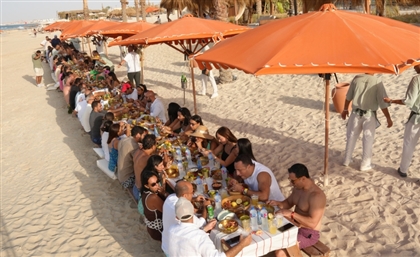
There are weekly Caboria seafood feasts on the sand. There is music. There are long meals. And there is very little incentive to consult a clock.
Saleh describes what happens here as a “stretch of time”.
It is a good description.
Breakfast becomes swimming. Swimming becomes lunch. Lunch acquires music. Someone you met yesterday is suddenly sitting beside you. Plans for leaving begin to feel unnecessarily ambitious.
Somewhere along the way, the hotel part of the equation becomes almost beside the point.
At the end of the tour, Haddad and Saleh are asked what home actually means.
For Haddad, it is “a feeling of warmth, of contentment, of peace of mind.”
Saleh reaches for Arabic.
Sakan, she explains, comes from sakina. Home is the place where you feel that peace.
Which brings us back to the boardroom hug, the butter-yellow room and a brief that began not with how Mariolino should look, but how it should feel.
Saleh designed the hug. Haddad supplies the mischief.
The architecture sets everyone up. Summer does the rest.
- Previous Article Amare at Solare Ras El Hekma Steps Down to the Mediterranean
- Next Article The Intricate Beauty of Ben Youssef Madrasa