





Nothing Makes Sense in Mohamed Ali's Playa Summer House
Design Avenue's Moe Ali gave his summer house in Playa four weeks, a crowd of artists, his mother's old stove, and a single house rule.

Moe Ali, of the Cairo studio Design Avenue, and his team design the way a good host seats a dinner party. He puts the guests least likely to meet side by side, then waits for the conversation to start.
In his rooms, an heirloom finds itself next to a newcomer, one artist's brushstroke leans into another's, and colour goes a shade past the point where good taste would usually clear its throat. With clients, that instinct shows up on its best behaviour. At his own summer house in Playa, on Egypt's North Coast, it kicked off its shoes and stayed up well past sunrise.
The chalet took four weeks, and almost none of it was drawn beforehand. Ali brought the studio with him: Nihal Lashin, Shahira Elmorshedy and Lina Yasser from Design Avenue, along with two of its own artists, Nadine El Kholy and Mostafa Kamel.
Then he widened the circle to painters, tilers and textile houses, handing each of them a wall, a table, a pot.
"It's all improvisation," he says. "Improvised art, on site."
The whole house is built on three words, nothing makes sense, a permission slip to have fun with the design. What followed was freestyled wall by wall, and never once asked to justify itself.
"Nothing has to make sense," he says. "Play freely, put down what you feel, and see what comes out. That's my headline."
"We wanted things that are light and lovely, good for everyone," Ali says, "bringing together artists and a lot of memories." Every object in the house carries one of those memories, and none of them comes with an explanation.
 Walking through it feels like being let into a cocoon that keeps unfolding. The house holds you close first, then opens, until there is nothing left between you and the sea.
The living room is where it holds tightest. The walls are a deep, unapologetic mustard yellow. Asked whether committing to that much yellow made him nervous, Ali answers with a question. "No. Why?"
There is no television. The seats face one another, built for long conversations, and overhead the Design Avenue team painted a sun straight onto the ceiling. Its ochre rays spill out from the rattan pendant, so the lamp sits at the centre of its own small sky.
Against the yellow hangs a portrait by Abdelwahab Hawwam: lilac curls, a green sweater, a cigarette held loosely between two fingers. Hawwam had been posting drawings like it on Instagram. Ali saw this one and told him he wanted it.
That the portrait's colours would settle so easily into a wall that hadn't been painted yet was, by Ali's account, pure chance. The house gets lucky like this often, and he has a gift for letting it.
A black-and-white striped sofa sits beneath it all, its back cushions a popping red. Nearby, a maroon velvet cloth carries an embroidered orange sun with a human face, rhyming with the sun on the ceiling and with the faces waiting outside on the terrace.
The indoor dining table repeats the one on the roof, down to that same red. The chairs around it refuse to cooperate. One is red, one is blue, one is bamboo. "What's the relation?" Ali asks. "Nothing. Nothing makes sense."
The kitchen is all stainless steel, and its reason is purely sentimental. "The stove was my mother's, from ten years ago," Ali says. "It was old, sitting in storage. I brought it, put it in, used it, and built the whole story of the kitchen around it. Stainless steel in Sahel, it's a bit crazy."
Everything else in the room, the steel counters, the black metal, the dramatic wall colour, keeps that old stove company. Behind it, the backsplash is tiled in the same electric blue as the six-metre dining table outside. One material, two lives: a table under the sky, a wall behind his mother's stove. "Same DNA," Ali says.
Point out that it all feels continuous even though nothing looks related, and he is delighted. "There, you said it," he says. "I got you to say it."
The plates on the shelves carry the same drawings as the tablecloth on the roof. The coasters are fabric, relaxed just like everything else about the house.
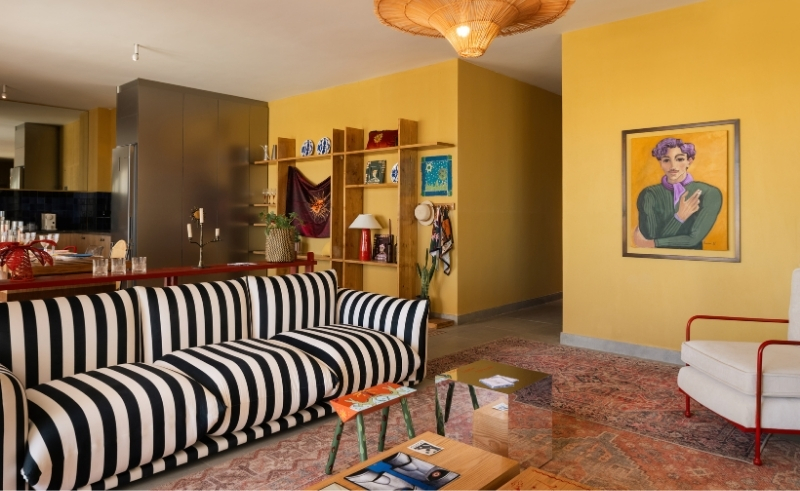 Near the sofa sits a small mirrored cube, and across its gold top, in red cursive, the house states its thesis outright: NOTHING MAKES SENSE. Walk around it and the sentence keeps going down the side: THIS TIME IT'S A BIT PERSONAL. Ali wrote on both faces on purpose, a hidden message for whoever bothers to circle the table. A smaller table built the same way keeps a Pink Floyd sleeve under its glass.
"This time it's personal," he says. "It revolves around me."
The cube sits beside a low oak coffee table, and there Ali put himself into the house quite literally. In red ink, straight onto the grain, he drew his own figure: a mop of curls, a hand raised to his lips, a cigarette between his fingers. Around him the wood turns into a small daydream of cherubs, one puffing out a wind, another plucking a lyre, all of it drifting among waves, stars and unfurling leaves.
That personal thread runs loudest above the doorways, where small frames climb the wall in clusters. There is Grendizer, the Japanese robot cartoon an entire Arab generation grew up on. "I used to love Grendizer," Ali says. "Its colours are beautiful."
There is Cheb Khaled over the bathroom door and a Lucha Libre cover across from him. There is an Amr Diab concert, and a photograph of people eating pasta by the sea. Ask about the arrangement and Ali sounds as amused as you are. "Amr Diab, and next to him a Japanese anime, and next to that a plate of spaghetti. What's the relation? There really is none." And then, glancing at Khaled: "What is this madness? What brought this next to that?"
The bedrooms are kept plain. "The rooms are very basic, honestly," Ali says. "There's no story behind them." The stories all live where people gather.
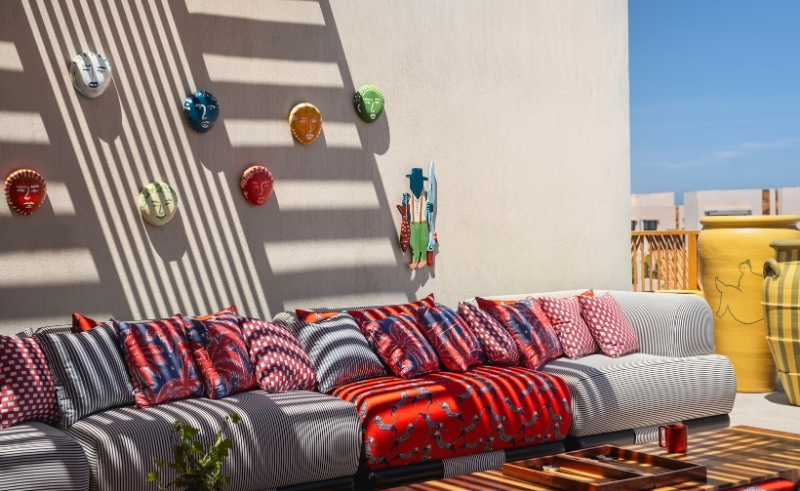
Which brings you, finally, to the terrace, where the cocoon splits open to the water. A wood pergola throws stripes of shadow across the wall, and set into those stripes are ceramic faces by Nadine El Kholy, white and cobalt and ochre and red, each caught mid-expression. Her fabric koi swim off a hook nearby.
The faces are a portrait of the house's social life. "They express the many different people who come to the house, who visit me, who know it," Ali says. "The many people. The commotion, dawsha, that happens in the house."
The curtain beside them began life as tableware fabric from Anut. The team hung it up and called it a curtain. Its moon has a face too, with "luna" curling beside her jaw, drawn with the looseness of a child who never stopped to ask whether it would fit.
"It has no meaning," Ali says, "but it's beautiful in the place." Its drawing, he points out, looks like the faces around it, like the noise around it, like everything.
Leaning against the same wall is his surfboard. He has been surfing for two or three years, and it landed here by chance. It shares the space with sofa fabrics in a red he describes as full of energy, "eager for life, as they say."
A plain white IKEA piece has been painted over by Nadine El Kholy in saffron and cobalt, two blue tigers chasing each other round its top, until it looks like an heirloom from a more interesting family. She signed it in the corner, like any good canvas. Underfoot, rugs are unmatching and overlapping.
The dining table stretches six metres in electric-blue tile from Tamia, modular but built long "to gather everyone." Red chairs circle it, dressed in fabric from The Monkey Business.
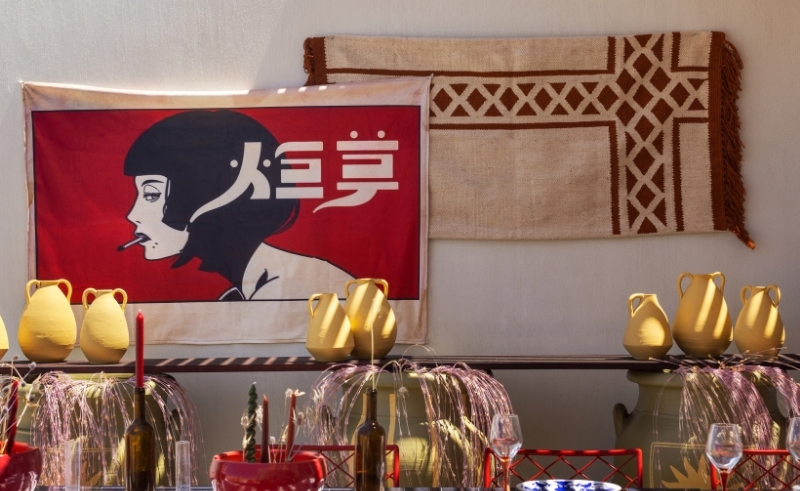
On the wall behind, a Japanese anime throw hangs beside an ordinary Egyptian kilim. Ali loves anime, found the throw, and liked it. The kilim is as local as they come. "Put them together," he says, "and see how it turns out."
By the railing stand Mostafa Kamel's urns, striped ochre and olive, one carrying a sketched crouching figure and the other a flight of yellow doves. The pots came from the pottery studios of Darb 1718 and were painted where they stand.
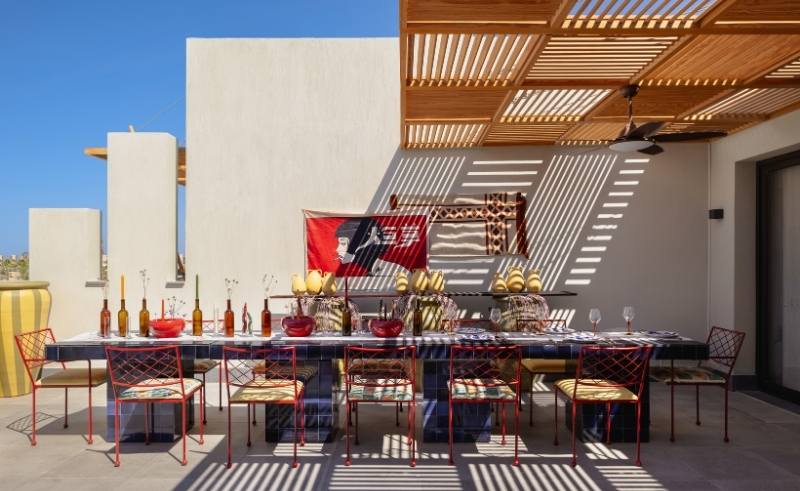 Down the table, empty bottles filled with sand hold candles, because the coast supplies its own. Suns cut from coloured paper sit over the glasses. "The glass is answering the picture," Ali says, meaning the sun on the ceiling inside.
The blue of the table is the wall behind his mother's stove. The sun on the ceiling is the paper on the glass. The faces on the wall are the face on the curtain, and all of them are the people who keep turning up.
Furniture and objects came from Caliber & Co, Cassa Designs, Image Home and Studio Ruut, textiles from Tanis Textiles, tiles from Tamia, cloth from Anut and prints from The Monkey Business. Most of their makers never met.
- Previous Article Egyptian Real Estate Tax App Registers 2.5 Million Properties
- Next Article Monochrome Monday: Espresso