





This Foundation is Leading the Fight Against Eating Disorders in Egypt
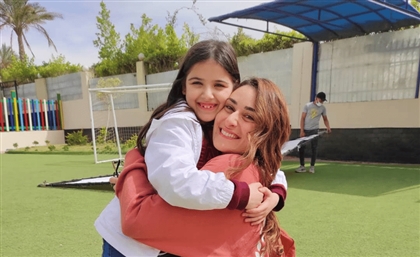
Neveen Radwan started the Ameera Foundation to provide eating disorder education and care in Egypt, and to prevent what happened to her daughter from happening to anyone else.
Originally published on March 4th, 2026
Six years ago, Neveen Radwan’s 15-year-old daughter nearly died.
When COVID hit in 2020, her daughter decided she would use quarantine to have a ‘glow up’—a strict exercise and diet regimen that quickly spiraled into anorexia. She spent the following year and a half in and out of hospitals. Soon after leaving inpatient treatment, Radwan and her daughter took a trip from their home in California to Egypt for Christmas to make up for the annual summer visit she missed that year. When they decided that being around family would be the best thing for her recovery, a three-week vacation turned into a two-year stay.
Radwan began her search for eating disorder treatment in Egypt. Before she arrived that winter, physicians and family members had told her, “We don’t really have this illness here.” But more and more conversations with parents struggling to find treatment for their daughters and sons opened her eyes to the prevalence—and stigma—of eating disorders in Egypt.
“I realised that we didn't just have eating disorders in Egypt,” she said. “We had them in excess. But, unfortunately, there's very little awareness. There's very little understanding.”
When Radwan returned to the US, she quit her 25-year corporate career and started the non-profit organisation Ameera Foundation, dedicated to raising awareness about eating disorders in Egypt.
She travels frequently to Cairo to train parents and school counsellors on how to detect eating disorders and intervene early. Radwan has also connected over a dozen families in Egypt with medical providers and educated them on what intervention looks like at home.
Radwan often grounds the conversation in her personal experience to prevent what happened to her daughter from happening to other children.
“I’m not a doctor,” Radwan clarified. “This is what I learned as a parent. And this is what I learned too late. And this is what I should have known in the beginning. Because if I had known in the beginning, then our recovery journey would have been very different.”
Early intervention is key, she emphasised, especially because of how difficult it is to find higher-level care in Egypt—such as dedicated eating disorder wards in hospitals. But early intervention does not only fall on the parents—it requires certified professionals and families to work hand in hand to avoid hospitalisation.
Radwan explained that eating disorder treatment requires a team of three: a therapist, a dietitian, and a psychiatrist who work together, and they must have eating disorder certification. Without it, they run the risk of hurting the patient more than helping. Dr. Mahmoud Zaki was one of the few doctors in Egypt dedicated to treating eating disorders whom Radwan could find. He runs the Self Centre Clinic in Sheikh Zayed and brings his expertise to multiple Ameera Foundation workshops, but his waiting list is often months long.
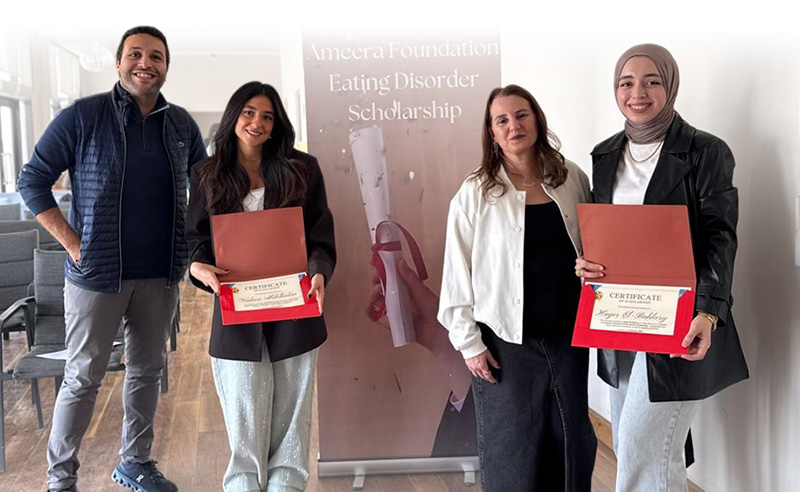
To address eating disorder care disparities, Radwan and Dr. Zaki hatched a plan to train more dietitians and therapists with the proper certification through the first Ameera Foundation Scholarship Program. In this year’s inaugural round, they raised enough money to cover the six-month program for three recipients ($2,000 each). They are currently seeking additional donors and sponsors to reach their goal of 10 scholarships per year for five dietitians and five therapists. Each caregiver will be supervised by Dr. Zaki’s clinic, and because cost should not be a barrier to care, the grant requires scholarship recipients to take on one pro bono patient and two sliding-scale patients per year.
As a parent, founder, and advocate, Radwan spoke with CairoScene about the misconceptions surrounding eating disorders and how to support the people we love to overcome this illness.
What do you think the difference is between an eating disorder and disordered eating?
I think probably 95% of the world has some sort of disordered eating. Often, families have some form of disordered eating, and then the children sometimes develop that into an eating disorder. Doing a ‘cleanse’ or intermittent fasting or a keto diet obsessively is actually becoming defined as an eating disorder called ‘orthorexia’ (defined as an obsession with ‘healthy eating’).
People who are on one of those constant fasts and then accidentally eat something out of their norm feel so guilty to the point of exercising manically afterwards because they feel like, “Oh my God, I had a piece of bread on my keto diet, so I’m gonna have to go to the gym for four hours to burn it off.” If this is happening to you, then you know that something’s not right. If it’s becoming so obsessive that you’re skipping events because you don’t want people to see you, or you don’t want to cheat on your diet, or if it’s affecting your lifestyle so much, then yes, something’s wrong.
Is losing weight always a sign of an eating disorder?
One of the very common misperceptions is that you can recognise an eating disorder because the person has lost a lot of weight, but actually, a lot of times you don’t recognise it. With my daughter, she had lost very little weight, even though she was already very thin. A lot of times people can’t recognise it at all. If you can tell they’ve lost too much weight, it’s usually too late. Very rarely can you tell that somebody has an eating disorder.
What are some of the early warning signs of an eating disorder?
There are internal and external warning signs. There are the signs that somebody can recognize from the outside—like me as a parent, for example, can recognize in my child or in my family member—like social isolation.
They stop wanting to see their friends and want to eat with their family. They start cutting their food into really small pieces. Or they start going to the bathroom right after they eat because they throw up. Or they start to exercise a lot.
For patients with anorexia, like my daughter, many start wearing really baggy clothes because they don't want people to notice that they've lost a lot of weight. Or they're always really cold because they lose a lot of weight, and so their heart rate drops. So they start getting really dizzy when they get up out of bed or when they sit down. Or their fingers start turning blue. But with my daughter, she was always cold, even in the summertime, and we didn’t think much of it.
But then internally, if somebody's struggling themselves, it's going to be things like their desire to compare themselves to other people. And the idea that they're always dissatisfied with their body. Now, of course, that one is actually very hard to discern because I think all of us have that built into us, right? And I think that's part of the society that we live in.
What should and shouldn’t we say to a loved one who may be struggling with an eating disorder? What is helpful, and what might push them away?
You can’t approach the conversation with any aggression. It’s such a misunderstood illness, so you have to be conscious of what’s happening to them and try to approach it in as loving a way as possible. It’s very important for you as a family member, or for anybody, to approach it knowing that this person might truly not have control of what they’re doing.
“I’m worried about you. I feel like something’s not right. Let’s maybe go to a doctor”—has to be done in a very loving and compassionate way, because any form of aggression or confrontation is going to backfire. The eating disorder is something they want to protect.
When my daughter was hospitalized for the first time, the doctor pulled us aside and said, “I want you to understand right now that starting today, your child is no longer your child. Your child’s brain has been hijacked by this eating disorder, and they’re no longer going to function like your child. They’re going to say things you don’t recognize or do things you don’t recognize. They might swear if they’ve never sworn. They might steal, they might lie, they may cheat, and every single thing that they’ve never done in the past, they will do in order to protect their eating disorder.”
My daughter was 15. She was an excellent student and athlete. She had never ever said or done anything wrong. She never lied to us. But it’s crazy because every single thing that the doctor told us happened. Eating disorders follow a playbook, and it’s insane the way that their brain truly does get hijacked by this disorder—the patient has zero control.
What is the first step to addressing a potential eating disorder?
If you truly believe that it's an eating disorder, there could be multiple things. A lot of adolescents and teenagers struggle with body image and comparing themselves to their friends and social media. It could just be body image struggles which are treatable in therapy.
But if it truly is an eating disorder, which a therapist can identify, then they need an actual eating disorder specialist, not somebody who just says they’re a specialist or a dietitian that specializes in eating disorders because they think they do. They have to truly be certified in treating eating disorders. They have to have the full team—the therapist, dietician and psychiatrist.
In my experience here in Egypt, the therapists, life coaches, nutritionists, dietitians, and even psychiatrists who claim that they deal with eating disorders are exponential, but the actual number who know what they’re talking about you can probably count on less than two hands.
How can families support the patient along with professional care?
There is a book I unfortunately didn’t find until it was too late for me, but I really recommend it, called Survive FBT: Skills Manual for Parents Undertaking Family Based Treatment (FBT) for Child and Adolescent Anorexia Nervosa by Maria Ganci. It’s a walking manual on how to go through the refeeding process and what to do when they’re angry, throwing food, yelling, screaming. It’s a manual for caretakers, primarily for parents. It’s primarily for anorexia, which is the most common and also the most deadly of the eating disorders.
Many people think recovery from an eating disorder ends when the patient leaves the hospital. Was this the experience you had with your daughter?
There’s no such thing as a quick fix. This is an illness that takes months to years to come back from, and even then you’re not really recovered. It’s kind of like an addiction. You’re recovering even after that. If you catch it early, you can recover quickly, but you’re always going to be living with it. We thought my daughter was fixed after a week in the hospital, so we made all of these mistakes we didn’t know we were making—pushing her right back into relapse.
What is your advice to parents who are trying to support their children through the recovery process?
They have to have a very strong support system for themselves. It is not for the weak. My daughter didn’t talk to me for three or four years. Your children will yell and scream and hate you and run away. This process is extremely difficult and honestly, the hardest thing anybody will ever do in their lives.
If there are two parents in the household, they need to be on the same page. If they’re not, it won’t work because the patient will use them against each other. You need to be committed because at the end of the day you are saving their life.
My daughter’s heart stopped three times throughout this process. There are things I saw in the hospital I wouldn’t wish upon my worst enemy. Every time I wanted to say, “Today I’ll just let her do this,” you have to know that every time you say that, you’re giving in to the illness and getting one step closer to not saving her life. As hard as it is, you have to always remember that. You can’t lose sight of the final goal, because the final goal is the only goal: recovery.
How is your daughter’s health and your relationship now?
Our relationship is much better, thank God. We’re in a much better place now. I don’t believe there’s anything called full recovery, but we are very blessed to have her with us and in a much better place. She’s in college and she’s thriving.
Is there really no such thing as ‘full recovery’?
Well, full recovery means you are fully aware that you are living with this illness for the rest of your life. Being fully recovered means you can eat whatever you want whenever you want, go wherever you want, but also knowing there might be a day when something triggers you. Something bad might happen—a divorce, a death, a trauma—and you might be triggered badly enough to go back to your eating disorder. So, being fully recovered means being fully aware of that, and not thinking you’re never going to see it again.
What was one of your biggest challenges in getting the message across to parents in Egypt?
Parents would say, “I can’t believe you’re talking about this in public. What if your daughter never gets married?” I’m very proud of my daughter and what she overcame. If somebody doesn’t want to marry her because of that, then that’s not somebody we would want in our life anyway.
The stigma is huge. The whole idea that it is a mental illness is a stigma. In Egypt, we’re starting to get past the stigma of some mental illnesses like depression and anxiety, but nobody wants to admit their child has a mental illness, especially something that might affect the way they look or the way they’re perceived.
Ameera Foundation also educates school-aged kids about the dangers of social media. What role did social media play in your daughter’s illness?
Social media was a huge factor in my daughter’s illness. I don’t say it caused it, but it was a trigger. She was an athlete, and when COVID hit, all of her training stopped. She wanted to stay in shape during COVID, so she started looking up workouts and healthy meals.
The way the algorithms work on social media is damaging. Especially with children, they tailor harmful content toward them. There are several lawsuits right now against social media companies because of this content. She would look up a regular workout, and because her account was flagged as a child account, they would send her posts with hashtags like #eatingdisorder and #anorexia. She would watch videos like “what I eat in a day,” “how to stay under 500 calories,” challenges to be skinny. It was an eating disorder black hole.
Skinniness is glorified online, unfortunately by influential people, models, actors, people young girls look up to. A lot of what’s posted online is fake. Kids only see manipulated, curated, filtered images. It used to be that only magazines were photoshopped. Now videos are filtered, pictures are filtered, there are AI accounts where the people aren’t even real. There’s no way to filter what’s real and what isn’t. It’s terrifying.
To support or learn from the Ameera Foundation, you can find them at ameerafoundation.org or on Instagram @anorexia_no_more.