





Two Early Dynastic Tombs Discovered at Minya Burial Site
The finds span the Predynastic period through to the Late Period.

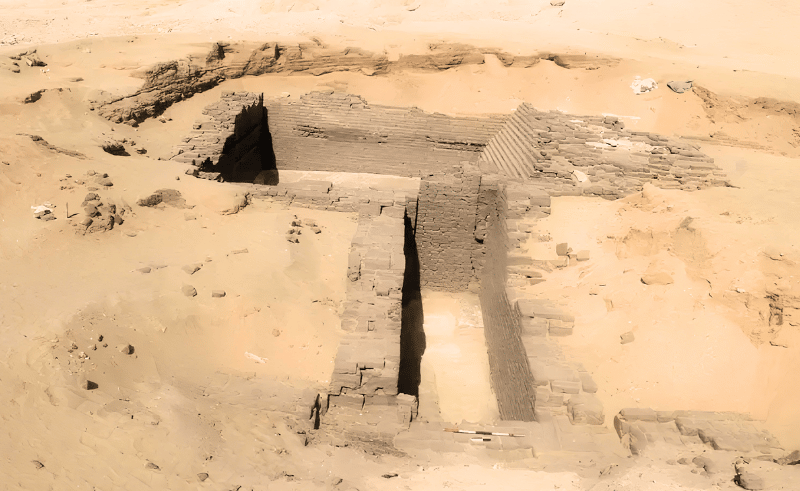
Archaeologists have uncovered two Early Dynastic tombs at Gabal El-Teir in Minya, alongside burials dating to the Predynastic and Late Periods, offering new evidence of how funerary architecture evolved over thousands of years.
According to the Ministry of Tourism and Antiquities, preliminary studies suggest the newly discovered tombs share similarities with the tomb of King Den at Abydos. Hisham El-Leithy, Secretary-General of the Supreme Council of Antiquities, said the first tomb features a rare geometric design, with walls that are thicker at the base and gradually narrow towards the top.
He noted that the structure could represent an early stage in architectural concepts that eventually led to the development of step pyramids and later true pyramids.
Although parts of the tomb were damaged by later quarrying activities, surviving sections preserve oxide lines indicating precise stone-cutting methods, as well as large wooden supports used to reinforce the walls.
A second tomb, located further south, follows a similar layout and is in a better state of preservation. The excavation also revealed part of a Predynastic cemetery. According to Mohamed Abdel Badei, Head of the Egyptian Antiquities Sector, several burials were found in a crouched position and wrapped in remnants of plant matting.
Some were accompanied by black-topped pottery vessels dating to the Naqada II and III periods. Archaeologists also identified individual and collective burials from the Late Period, some contained within deteriorated wooden coffins.
- Previous Article SceneNoise x Amsterdam Dance Event Present CROSSFADE: Egypt
- Next Article Egypt Adopts Global ISO 20022 Standard for Bank Transfers