





The Accidental Alchemy of Kiss Facility
In our latest cover story, we speak to Egyptian-Emirati singer Mayah Alkhateri and Irish-Chilean producer Salvador Navarrete to unpack the gensis story behind their musical project, Kiss Facility.
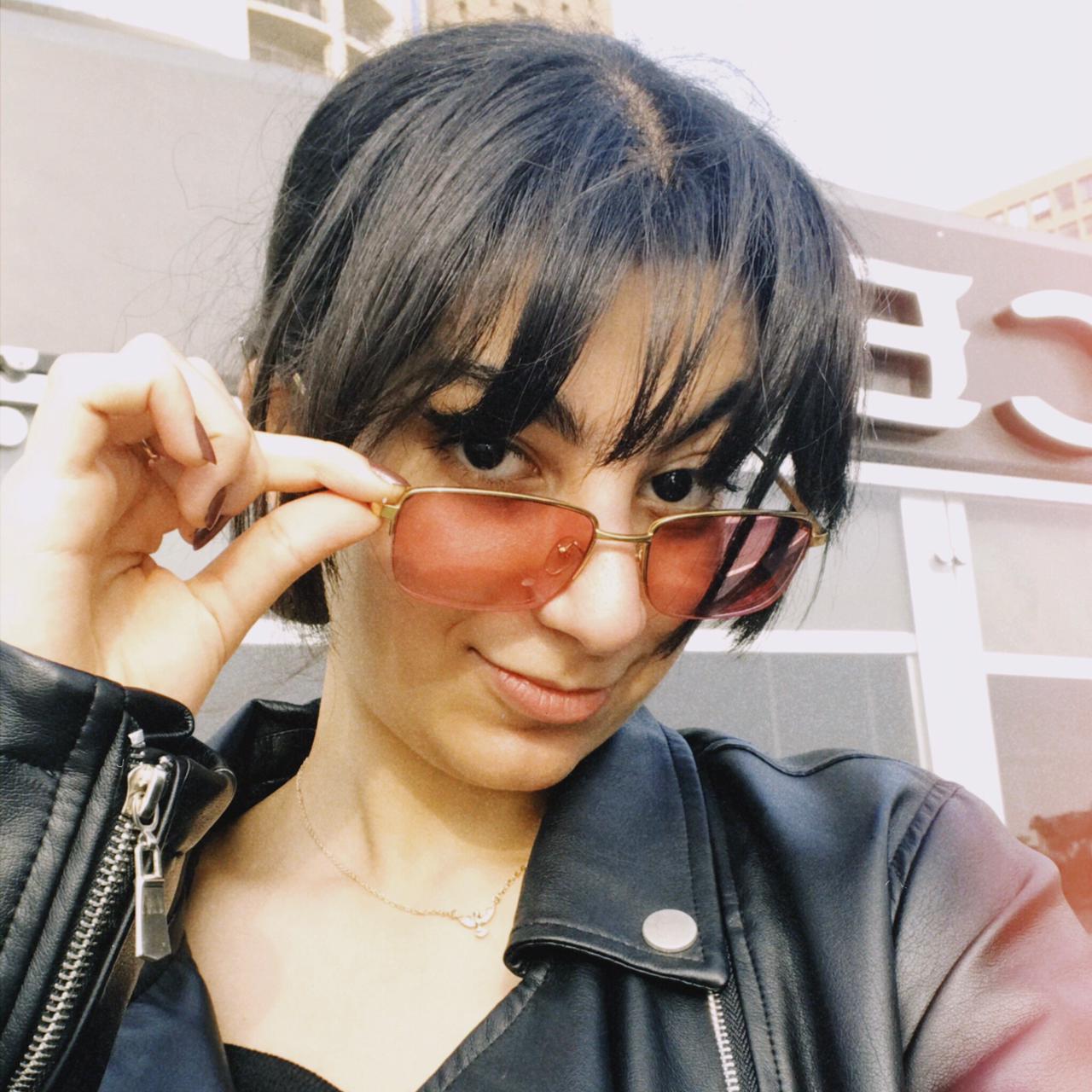
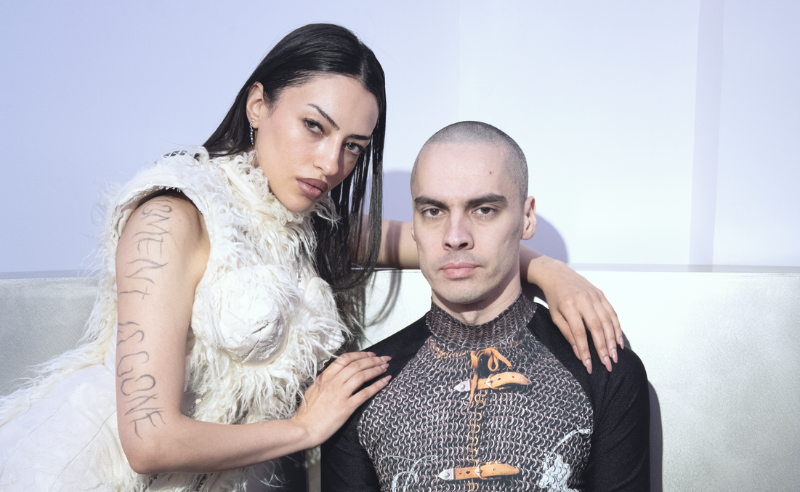
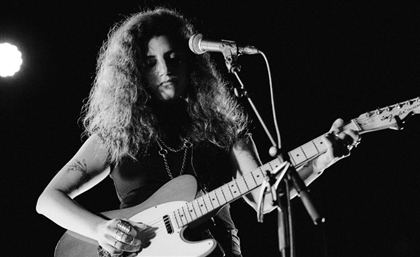
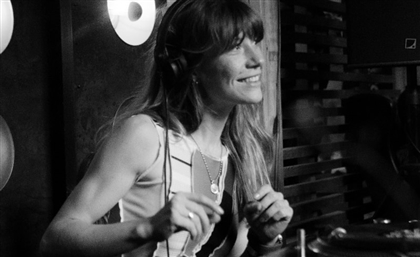
On a rainy afternoon in Downtown Paris, Egyptian-Emirati singer-songwriter Mayah Alkateri and Irish-Chilean producer Salvador Navarrete arrived at the FCC showroom dressed in couture that seems to echo their chemistry: distinct but somehow perfectly in sync. Mayah walks in smiling, a laugh trailing behind her, presumably from a joke Salvador has just told her. Within minutes of sitting down with them, it became clear that said ease between the two is far from being performative. They finish each other’s thoughts, pick up on references without explanation and seem to know where the other is going before the sentence gets there.
“I think he reads my mind,” Mayah tells SceneNoise. “Because we know each other so well, he knows what I want.”
It’s this instinctive connection that is at the heart of their musical project, Kiss Facility, the musicof which has spent the past three years moving through the edges of Europe’s alternative underground. Yet for all the intention that now surrounds the project, Kiss Facility was never meant to be a band.
It started with a DM.
Mayah had come across Salvador’s music, released under his internationally recognised alias Sega Bodega, online and reached out simply because she liked what she heard. There was no collaboration pitch, no grand plan and certainly no expectation that the exchange would eventually become a musical partnership. They continued talking on Instagram for nearly six months, getting to know each other from a distance - Mayah largely based in Dubai, Salvador in Paris - before eventually meeting in person.
Even then, music was not really the point.
By the time they began making music together around 2023, they already knew each other in a way most collaborators never get the opportunity to. The relationship came first; the music followed almost accidentally.
“We kind of accidentally just made a song during a jamming moment,” Salvador recalls.
That song was ‘My Room’, released in May 2023. Then came another, and another. They kept making things simply because they liked where they were going.
“I didn’t actually intend to work with Salv,” Mayah says. “In the past, when I used to try and reach out to people, they’d never take me seriously given that I don’t have anything out. They’d try to sexualise the whole thing and it pissed me off. So I stopped reaching out to work with people for a while.”
What eventually emerged between them was difficult to categorise, partly because neither seemed particularly interested in categorising it. Shoegaze, dream-pop, trip-hop, alternative rock and electronic music all surface in Kiss Facility’s work, but none stays long enough to become a fixed point of reference. Their songs feel less like exercises in genre than records of two people following an instinct together.
“Most of the time, songs will just come out and we really focus on finishing it,” Mayah says. “I think it’s important to really know the person so well before working together. Chemistry and natural connection are a main part of making something successful and different.”
For Salvador, that freedom was part of the appeal. After years of establishing himself within electronic music and collaborating with artists including Shygirl, Caroline Polachek and Eartheater, repeating himself had become less interesting than finding somewhere unfamiliar to go.
“I am always trying to make something I have never done,” he says. “It’s not fun for me to make the same kind of electronic sound for 10, 20, 30 years. I need to mix it up.”
Kiss Facility offered him exactly that. He had never made a rock or shoegaze project before, but had long wanted to make Arabic songs within an experimental indie-rock framework. With Mayah, he found a way into it that did not require either of them to force the music into an existing template. The sound developed through shared references, experimentation and, above all, instinct.
“Mayah had never released music before but when we started working on music together, suddenly, she’s writing like she’s done it for 20 years,” he exclaimed.
Mayah does not describe her process as particularly technical. She rarely starts with lyrics. Instead, melodies arrive first, often unexpectedly, before she knows what they will become. “I believe that songs have to have a feeling, and that feeling comes mostly from the melodies first. So I never write lyrics first,” she explains.
Her phone has become an archive of these often sudden flashes of inspiration.
“I always have voice notes in my phone ready, because it just comes to me sometimes, randomly, any time,” she says. “My melody comes out on my phone. And then when I have a problem, when we’re making music, I share those voice notes with Salv, and he knows what to do.”
Salvador then takes those fragments and starts pulling them apart. His approach in the studio is deliberately instinctive as well: keep singing, keeping changing things up, do not settle too quickly.
“Sometimes, you know, ‘Do something right now. Just do something,’” he says. “When I am working with anybody, and they do vocals, and they do the vocal line and I’m like, ‘Nah, that’s not it.’ Do something else. And then do something else.”
His method can sound almost demanding, almost punishing, but it's less about him being a perfectionist than about catching something spontaneous and unexpected in these small moments. He might ask a vocalist to sing for ten minutes, changing direction every few seconds, before returning to the recording to isolate the moments that feel more alive and organic.
“You can piece together these really small golden moments of melody that will then flow,” he says.
That refusal to settle has become one of the most defining characteristics of their debut album full-length album Khazna in March 2026. Across the twelve tracks, dream-pop sits alongside ambient passages, distorted guitars dissolve into synthetic textures, and moments of devotional stillness give way to widescreen electronic arrangements. Influences appear fleetingly before disappearing again.
What holds everything together is not genre, but emotional coherence, and the story they are trying to tell.
“We have a lot of feelings and desires that we don’t talk about, or feel ashamed to share with people. They are like in a vault within ourselves. It can be sexual desires or our spiritual side. Like how people perceive us in a certain way for having certain beliefs or ideologies. So Khazna is like that vault of all of these things we keep hidden within ourselves. But it is also an invite for people to embrace all of these sides and not to be ashamed.” Mayah explains.
The chorus of ‘Magenta’ came together this way: not from a neatly written vocal part, but from fragments discovered through experimentation. “That’s kind of my way of being like, I’m not going to make a song in a typical structure,” Salvador says. “The melody just has to hit.”.
For Mayah, she perceive music as something fundamentally emotional, something people turn to when they are happy, grieving, sleeping, remembering or simply trying to feel understood. That philosophy has shaped the way she approaches songwriting, where poetry, memory and fragments of different cultures can sit beside one another without requiring a neat explanation.
Her relationship to Arabic poetry, for instance, comes from much further back than Kiss Facility. At school, she encountered writers including Mahmoud Darwish and other poets whose work became part of her internal archive. Later, those references began resurfacing in her songwriting.
One piece she encountered was Darwish’s State of Siege, which centres on a dialogue between a mother and her lost child imagining the afterlife. Mayah reworked the idea into something more intimate.
“It’s like a lullaby to calm down someone,” she says, “and it’s like to make you feel the afterlife.”
On other tracks of the record, she drew directly from three lines by Egyptian poet Mohamed Shaker, while another song became an opportunity to write in Egyptian Arabic and reconnect with her mother’s side of her identity.
The use of Arabic, however, is never presented as a calculated artistic decision. “It just came naturally without having to force certain sound or certain feeling,” Mayah says.
Her songwriting draws instead from the accumulation of a life lived across places, languages and influences, Turkish music, Persian songs, Arabic poetry and everything else she absorbed along the way.
“I think listening to different languages and the way they pronounce things is very important as a songwriter to have different sources.” She explains.
As an artist living in the diaspora, Mayah is very wary of the pressure that comes when trying to represent her Arab culture. How often the industry is expecting artists to dress in a specific way, speak differently or reshape their identity to fit whatever room they happen to be in.
“I feel that the majority of artists in the diaspora feel scared that they have to act or dress a certain way to be accepted in society,” she says. “And I feel like we should be the same everywhere, no matter what.”
She hails regional artists like Yasmine Hamdan and Lella Fadda, for their unapologetic approach to music and expressing themselves, and for her, Kiss Facility is her way into pushing for of that artistic freedom for herself and the new generation of upcoming Arab artists navigating the scene abroad.
“I like pushing for that freedom of expression more,” she says. “And I think that’s really powerful.”
It is a philosophy that also extends to the project’s name. When they were trying to decide what to call themselves, Mayah had a list of possibilities saved on her phone. Salvador suggested “Kiss Facility”.
The name eventually stuck because, to them, it captured something about the project’s underlying philosophy: creating a space for people who might otherwise feel out of place.
Mayah references the work of Genesis P-Orridge and the culture around Psychic TV as an influence, particularly the idea of art as a means of empowering people who feel disconnected from the dominant narrative.
“It’s all about belief,” she says, “and also talks about spirituality, how you, in your work, push your mindset to be like, not taking the negativity basically from people.”
It’s perhaps that sense of refuge that makes the project feels unusually intimate. There is experimentation, but it is not experimentation for its own sake. There is a softness beneath the distortion, a sense that the music is being used as somewhere to put feelings that do not necessarily have another place to go.
“I think it’s very crucial at the moment to have songs that can make you feel things and make you feel hope as much as make you feel sorrow or pain or anything,” Mayah says. “It reminds us that we are human.”
For Salvador, meanwhile, the project remains valuable precisely because it refuses to become predictable. He is aware that audiences sometimes want artists to repeat whatever initially drew them in. Kiss Facility is unlikely to offer that comfort.
“I can’t hear the same thing,” he says.
Mayah agrees.
“It’s very nice to always experiment with different sounds and not limit or box yourself off in a specific sound that people come to know you as.”
Even their studio dynamic reflects that willingness to keep things loose. They argue, disagree and occasionally have to remind themselves that they are partners outside the studio as much as collaborators inside it. “When we’re working, we just really focus on songs,” Mayah says. “We forget that we’re a couple.”
The friction, when it happens, is creative rather than destructive. Salvador might dislike a vocal choice; Mayah might reject a production decision. They push back, listen again and keep going.
For all the talk of experimentation, that may be the most defining thing about Kiss Facility: the trust underneath it. The music works because neither artist seems afraid of the other’s instincts.
They met because Mayah liked a song. They kept talking because they liked each other. They found each other personally before finding each other creatively. Making music together became a natural extension of everything else.