






Elhamy Ezzat Restores Classic Cars to Their Former Glory
Elhamy Ezzat fell into classic car restoration almost by chance, starting with a Beetle he bought for EGP 5,500 and eventually turning that passion into a career.
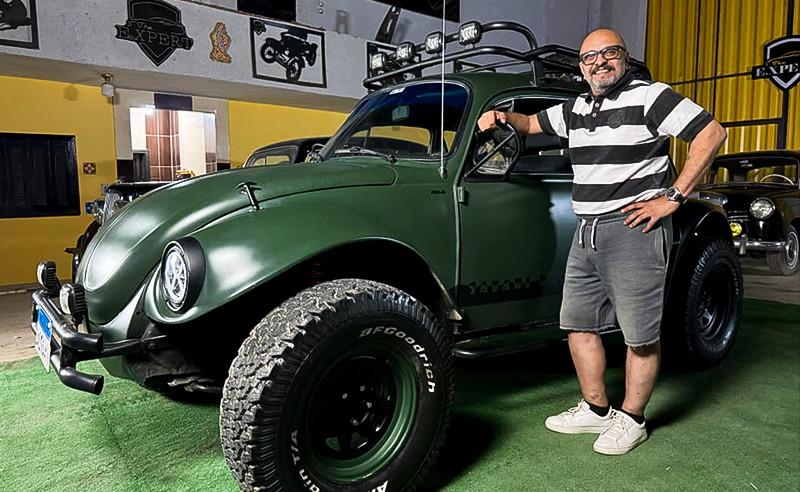
Elhamy Ezzat's journey into classic car restoration started by chance. No plan, no particular five-year vision of becoming one of Egypt's go-to names for reviving rare cars. Just a Volkswagen Beetle he bought because it was what he could afford, and a decision to fix it up once it started breaking down.
"The first car I restored, I didn't restore with the intention of being a collector or a restorer," he says. "I was still at the beginning of my life, I didn't have much money but I still bought a '61 Volkswagen Beetle model for EGP 5,500 and I used it in a very normal manner – I would take it to work, it would break down and then I decided to restore it. That was the beginning of my passion for classic cars."
He bought the Beetle in 1992 and began restoring it the following year. "I have always been into cars since childhood – it's always been in my blood," he says. "Men in general, I think, have a particular obsession with cars."
That interest followed him into his professional life, when he began working with multinational car companies, and eventually turned him into a collector - though restoration remained something he did for himself until 2008, when he started getting back into it more seriously. It wasn't until after he left the corporate world that the idea of turning it into a business took shape.
"My love for classic cars made me a collector – I initially started collecting just for myself," he says. "But after I stopped working in corporate, I thought: why not start a project where I practice my passion and hope to make a living out of it at the same time?"
That idea became The E.Xpert, the business he opened in November 2021. His first professional restoration for a client was a Rolls-Royce, which quickly turned into another, and then another - eventually around 13 Rolls-Royces, back to back.
Today, Ezzat is still selective about what comes through the workshop, whether it's his own car or a client's.
"I am quite picky when it comes to choosing the type of cars I work on, whether they are my own or that of my clients," he says. "I try and choose projects and cars based on the rarity of the car and its condition – even if it's of very poor condition, we often work on them."
His workshop holds the likes of a 1932 Nash he found in Alexandria. Only 192 cars of the model were ever produced, and with the Nash company since discontinued, it's now an especially rare car - Ezzat says only three survive in the world.
When it comes to his own cars, the reasons are often more personal. It could be a model he loved as a child, a car based on one of the toys he used to play with, or one he remembers seeing parked on his street. Sometimes it's a car he once owned and regretted selling - like the Mini Cooper parked outside the workshop, which he first owned in 1995, sold, and eventually found his way back to. Other times, the reason is less straightforward: "I have a fantasy of what could become of a car and I seek out the car to make it come to life."
Not every car has stayed with him. Some still stand out, including a 1985 Porsche Carrera - which he describes as an 'old timer' rather than a particularly old car - and a 1903 Oldsmobile once considered the oldest car in Egypt.
"There are several cars that I have worked on that, to me, are rather iconic, and I don't believe the chances of working on something of the same caliber would occur again that I had unfortunately let go of over the years," he says.
The restoration process itself has no single formula. "It varies case by case, from brand to brand, and from model to model," he explains. Some cars can be taken apart immediately to see what's going on inside. Others need much more planning, particularly when parts are difficult to find.
Generally, the bodywork comes first, while the interior is removed and sent to a specialist. Once the bodywork is finished, the mechanics are tackled before the car moves on to paint, electrics and finally the interior, before everything is pieced back together.
For British cars especially, Ezzat often makes replacement parts himself. "There are a lot of replacement parts that I do make myself, especially for British cars such as the Rolls Royce and Bentley," he says. "As a result of having worked on many of them, I now know how to make replacement parts for them such as the door handles – I have copies of them and I am able to make moulds out of them and make those replacements accordingly. But, of course, they don't always come without obstacles."
"The hardest thing in the restoration process is to work on a car that is one-of-a-kind that has no visual reference out there," he says. Manufacturers may still have records of the car somewhere, but a written record is not quite the same as having another example to look at and replicate.
Then there are the cars that arrive in seemingly impossible condition. Ezzat recalls one Rolls-Royce that had fallen into a well and been left there for at least 15 years. He took it on because, despite its condition, he knew he could still find replacement parts for it.
There are also cars he simply won't accept. If there are no replacement parts and no realistic way of bringing a car back to its original state, restoration becomes almost impossible. And even when a car can be restored, Ezzat doesn't believe every car should be changed.
"There are certain cars that have a certain character, so they can't be modified," he says. "Like, you can't get a car that belonged to a prince or a princess or a certain king and instead of maintaining its black paint, you turn it bright red. At the end of the day, it's the client's request that matters, but what matters more is maintaining and preserving the integrity of the car as much as possible. Otherwise, it would almost be disrespectful to it, to its history and to my own work and history."
The length of that process can vary just as much as the cars themselves - some take three or four months, others remain in his workshop for five or six years.
Along the way, some of the cars become personal. Ezzat keeps iron carvings of cars he's been particularly attached to against the workshop wall, where he can see them.
"I always try to preserve the car in its original form, its original materials, so that even its owner can preserve its value regardless of how much they had paid for it," he says.
"At the end of the day, it's an investment. It's a hobby, yes, but it's still an investment. And you never know, it might one day end up in a museum.
- Previous Article Riyadh Airport Will Close Until October 17th
Related Articles

Trending This Week
-
 Oct 06, 2026
 -
-
-