



Shahd Ezz is Singing Ancient Egypt Back Into Sound
In Luxor, Shahd Ezz sang in ancient Egyptian, a language rarely heard aloud, shaping it line by line into a style of her own.
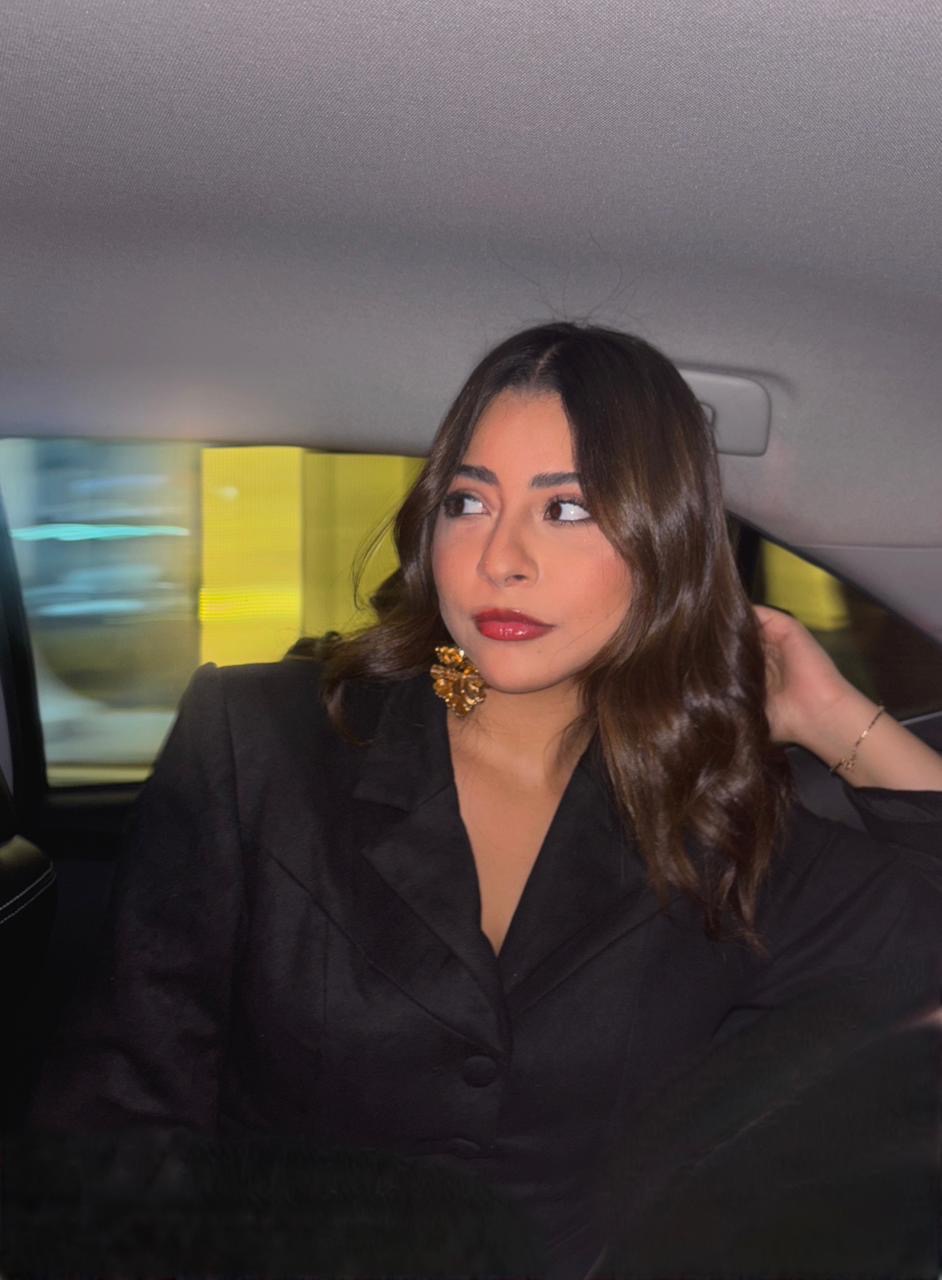
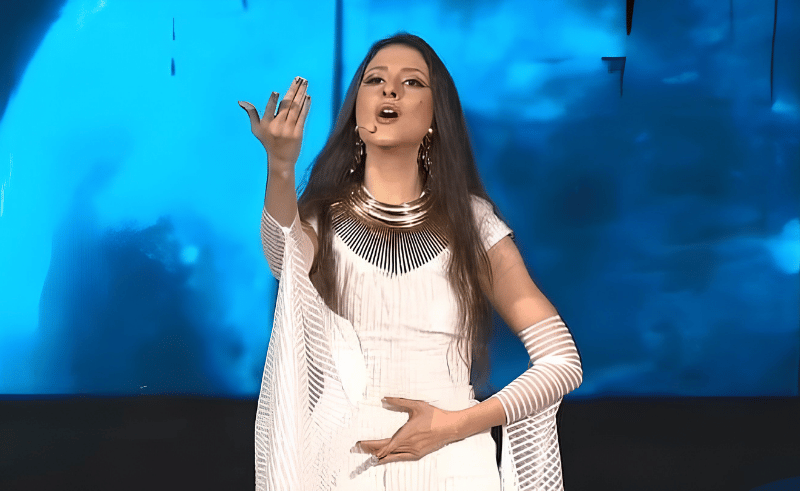
On the night of November 25th, 2021, a young woman in a white, ancient Egyptian inspired gown walked to the centre of the Avenue of the Sphinxes in Luxor and began to chant in ancient Egyptian, in what was one of the first times the language had been performed aloud at a public ceremony of this scale. By the time the ceremony ended, people were asking who she was, and - beneath that - what it meant to hear ancient Egyptian spoken aloud again, in 2021, on a lit road in Luxor.
Shahd Ezz was only 22 years old at the time.
What most people pieced together in the hours that followed was that she was the daughter of the singer Ezz El Ostool - who performed that same night, singing the Amun-Ra chant - and that she was a languages and translation student at Cairo University who had been developing her practice in private for years. "I think this kind of singing really started with me during the Tareq El Kebash opening ceremony," she says, "and even before that with the Pharaohs' Golden Parade and other projects related to Ancient Egypt. I had always hoped to do more work like this."
Ezz wasn't discovered that night so much as finally given a stage large enough to hold what she had been building, a vocal style rooted in improvisation, heritage and a specific sense of cultural ownership. "This is about a language and a civilisation that belong to us," she says.
The path to Luxor was accidental. Her father heard her singing a Mawwal and sent a recording to conductor Nader Abbassi, who would go on to score the ceremony with 160 percussionists and the United Philharmonic Orchestra. "At first they thought they needed a man's vocals," she says. "Then they simply changed their minds." She was asked to perform 'The First Call', a song drawn from hymns inscribed on temple walls, sung in the Coptic language, and composed in collaboration with Abbassi and musician Ahmed el Mougy. The text was translated with the help of an Egyptologist, Dr. Maysara Abdalah Hussein, whose role was to source and verify the ancient language before a melody was shaped onto it.
That process of building sound over text is central to how Ezz understands her own work. "I asked what this had to do with ancient Egypt," she recalls of an early conversation about the project, "and the answer was that it's about improvisation, about creating a melody that feels personal to us, our culture." What she produced was genuinely without precedent. "It was something completely new. I built it line by line, creating the melody over the text, and then layering everything together."
In the years since, she has continued working at that same crossroads of language, voice and historical material, although the work is not always visible. A short film called 'Ahlem Dendara', directed by Sabrine, currently making its way through the festival circuit, features a song she recorded in ancient Egyptian A short film called 'Ahlem Dendara', currently making its way through the festival circuit, features a song she recorded in ancient Egyptian by composer Hayat Selim; she can say little more about it until it's released. Ezz has also been working with artists in Germany and Greece, and she released 'Daybreak' in late 2025, a sparse, two-minute track made with Greek composer Panos Topalidis that is closer to the experimental end of what she does. She has also worked extensively in dubbing for Disney and Netflix, in both Egyptian dialect and Modern Standard Arabic, voicing characters across 'Sleeping Beauty', 'Snow White', 'The Little Mermaid' and others. "I've worked in dubbing, with languages and translation," she says, "and I think that really shaped how I approach sound."
Alongside all of this, Ezz is currently taking opera sessions at the Cairo Opera House with Dr. Iman Mostafa. “My goal is not to become an opera singer in any formal sense, but because operatic training is the foundation that makes everything else possible. It’s like the gym for the voice,” Ezz says.
Ezz describes the music she makes as a fusion of influences that stretches across the wider eastern region - "Sharqi, Turkish, Azerbaijani, Moroccan, Algerian, Tunisian" - all shaped and elevated through an operatic sensibility without being reducible to opera. "It becomes a fusion," she says. "Everyone brings their own identity and culture into it, and then you're asked to shape it and elevate it. In the end, it transforms into something closer to an operatic style, but it carries all of those influences within it. It's like a fusion of everything — almost tribal in feeling.”
- Previous Article SceneNoise x Amsterdam Dance Event Present CROSSFADE: Egypt
- Next Article UAE to Lower Legal Age of Adulthood to 18 in June 2026
Related Articles
Trending This Week
-

-
-
 Sep 28, 2026
 -