





How Squash Dreamers is Changing Refugee Girls’ Futures in Jordan
In Amman, Squash Dreamers is helping refugee and underserved girls not only graduate from high school, but step onto international squash courts and into universities abroad.
When executive director Daisy Van Leeuwen-Hill joined Squash Dreamers as an English language volunteer in 2018, she was confused about the concept of teaching squash to refugees. “But as soon as I walked in and met the girls,” she says, “it all made sense.”
Walk into the Squash Dreamers centre in Hashemi, East Amman, or onto the squash courts during practice, and you’re likely to be greeted with no fewer than 10 hugs.
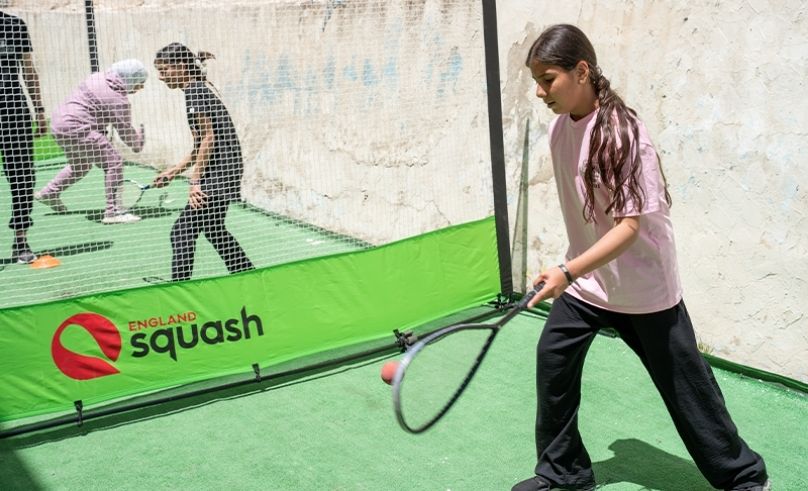
Each Squash Dreamers session begins with the same routine. Girls from eight to 18 years old gather in a circle outside on the concrete, holding the hands of volunteers who have come from as close as nearby Ammani suburbs or as far as the US. Community liaison Shadia Ammar, or ‘Miss Shadia’, quiets the girls down who are busy joking with their friends, sharing the details of the day or two since they last saw each other. Daisy begins the go-around in a mix of English and near-perfect Syrian Arabic, which she learned from Miss Shadia. A favourite prompt is: “What is something you are proud of?”
“I am proud of getting 100% on my English exam,” one girl says, congratulated with a round of applause from the circle.
“I am proud of winning my squash game,” another says, followed by another common response: “I am proud to be part of Squash Dreamers.”
-e9ee92fd-b92d-4699-b04e-69137709cf03.jpg) Miss Shadia beams standing between two of the younger students. She is a refugee in Jordan, like the majority of the 105 Squash Dreamers girls. Many of them are from Syria like her, along with Sudan, Palestine, Iraq and underserved communities in Jordan. The girls live in households of up to 13 people with an average monthly income of $340 USD. And they all attend government run schools that run on morning and afternoon shifts, which means attending school for around 3-5 hours per day in overcrowded classrooms—conditions that often lead young women to drop out of school and marry before turning 18.
Squash Dreamers is not only trying to keep the girls in school until high school graduation; it is trying to expand their horizon of possibilities for higher education and self-actualisation. Their intensive programme runs five days a week along two main categories: education and sports, tied together, necessarily, with wellbeing. Strength in the former cannot be achieved without the latter. That’s why the team focuses on nutrition, making sure the girls have a full meal at every session, which for some girls is their only meal that day. They also run mental health sessions, where the girls learn how to talk about their feelings and express their emotions. They cover topics like dealing with jealousy and anger, and what it means to be a refugee.
Miss Shadia beams standing between two of the younger students. She is a refugee in Jordan, like the majority of the 105 Squash Dreamers girls. Many of them are from Syria like her, along with Sudan, Palestine, Iraq and underserved communities in Jordan. The girls live in households of up to 13 people with an average monthly income of $340 USD. And they all attend government run schools that run on morning and afternoon shifts, which means attending school for around 3-5 hours per day in overcrowded classrooms—conditions that often lead young women to drop out of school and marry before turning 18.
Squash Dreamers is not only trying to keep the girls in school until high school graduation; it is trying to expand their horizon of possibilities for higher education and self-actualisation. Their intensive programme runs five days a week along two main categories: education and sports, tied together, necessarily, with wellbeing. Strength in the former cannot be achieved without the latter. That’s why the team focuses on nutrition, making sure the girls have a full meal at every session, which for some girls is their only meal that day. They also run mental health sessions, where the girls learn how to talk about their feelings and express their emotions. They cover topics like dealing with jealousy and anger, and what it means to be a refugee.
-d27dfec4-fbe4-448c-b906-b04af936cecb.jpg) The Squash Dreamers week runs Monday through Thursday evenings in Hashemi, where the girls learn English, review homework, and workout in fitness sessions. And on Saturdays, they spend the day at the Jordanian National Squash Federation for hours of sports practice and technical training.
“Squash Dreamers has grown massively since I started as executive director at the end of 2021, going from 7 to 105 students, and from squash and informal English to a fully holistic intensive long-term programme,” Van Leeuwen-Hill says. “We have celebrated much success over the past five years: 22 scholarships abroad and in Jordan, acceptances to the Jordanian National Team Academy for squash, participation in international squash tournaments, and our first ever high school graduate.”
Her name is Sabah. She is the oldest student at Squash Dreamers and the first person in her family to graduate from high school. In Jordan, almost 40% of Syrian girls under 18 are married, and only 34% of refugees attend school. This is a milestone that Sabah and the Squash Dreamers community have been working towards since she started the programme at 11 years old.
“Sabah’s story shows that [these statistics] don’t have to be a reality,” Squash Dreamers wrote in their 2025 annual report. “When girls are invested in, and given the support they deserve, they can thrive.”
The Squash Dreamers week runs Monday through Thursday evenings in Hashemi, where the girls learn English, review homework, and workout in fitness sessions. And on Saturdays, they spend the day at the Jordanian National Squash Federation for hours of sports practice and technical training.
“Squash Dreamers has grown massively since I started as executive director at the end of 2021, going from 7 to 105 students, and from squash and informal English to a fully holistic intensive long-term programme,” Van Leeuwen-Hill says. “We have celebrated much success over the past five years: 22 scholarships abroad and in Jordan, acceptances to the Jordanian National Team Academy for squash, participation in international squash tournaments, and our first ever high school graduate.”
Her name is Sabah. She is the oldest student at Squash Dreamers and the first person in her family to graduate from high school. In Jordan, almost 40% of Syrian girls under 18 are married, and only 34% of refugees attend school. This is a milestone that Sabah and the Squash Dreamers community have been working towards since she started the programme at 11 years old.
“Sabah’s story shows that [these statistics] don’t have to be a reality,” Squash Dreamers wrote in their 2025 annual report. “When girls are invested in, and given the support they deserve, they can thrive.”
-4bba6bf3-7605-4872-b227-9b2f4a7ec26e.jpg) Sabah thrived academically, but especially on the squash court. As a member of Squash Dreamers’ high-performance squash team, Sabah trained up to five times a week in focused training sessions with their head coach. She has competed in tournaments against the Jordanian National Team, and in December 2025, she flew to Malaysia as one of eight girls who competed in the RedTone Junior Squash Championships. Sabah placed 18th in her U19 category.
“I wouldn’t be here today if it wasn’t for Squash Dreamers,” Sabah said. “They have been my family, and my biggest supporters. I know I am a role model for the girls, but truly, they are mine.”
In addition to a strong focus on squash, a core pillar of Squash Dreamers is their English language programme taught by full-time staff, volunteers, and a Fulbright English Teaching Assistant. It is the key that has opened doors to 22 scholarships in Jordan, the UK and the US for both intensive summer programmes and full-time study abroad.
“The scholarships that girls at Squash Dreamers have received are truly life changing, and have altered the course of their futures,” Van Leeuwen-Hill says. “Even shorter-term scholarships revolutionise the girls’ level of English and self-confidence and act as a step towards further success.”
Fatima made history in 2025 as the first Syrian student to be accepted as a Davis Scholar at the Westminster School in Connecticut, US—and the first Squash Dreamers student to study abroad full-time.
“When I started at Squash Dreamers, Fatima was one of the students who really needed additional support,” Van Leeuwen-Hill says. She was struggling in school, and especially in English. “We worked intensively with Fatima to develop her English from illiteracy, to where she received her first scholarship to study in the UK in 2023.”
Sabah thrived academically, but especially on the squash court. As a member of Squash Dreamers’ high-performance squash team, Sabah trained up to five times a week in focused training sessions with their head coach. She has competed in tournaments against the Jordanian National Team, and in December 2025, she flew to Malaysia as one of eight girls who competed in the RedTone Junior Squash Championships. Sabah placed 18th in her U19 category.
“I wouldn’t be here today if it wasn’t for Squash Dreamers,” Sabah said. “They have been my family, and my biggest supporters. I know I am a role model for the girls, but truly, they are mine.”
In addition to a strong focus on squash, a core pillar of Squash Dreamers is their English language programme taught by full-time staff, volunteers, and a Fulbright English Teaching Assistant. It is the key that has opened doors to 22 scholarships in Jordan, the UK and the US for both intensive summer programmes and full-time study abroad.
“The scholarships that girls at Squash Dreamers have received are truly life changing, and have altered the course of their futures,” Van Leeuwen-Hill says. “Even shorter-term scholarships revolutionise the girls’ level of English and self-confidence and act as a step towards further success.”
Fatima made history in 2025 as the first Syrian student to be accepted as a Davis Scholar at the Westminster School in Connecticut, US—and the first Squash Dreamers student to study abroad full-time.
“When I started at Squash Dreamers, Fatima was one of the students who really needed additional support,” Van Leeuwen-Hill says. She was struggling in school, and especially in English. “We worked intensively with Fatima to develop her English from illiteracy, to where she received her first scholarship to study in the UK in 2023.”
-85db602e-62cd-44f2-beb4-a5d20e10456d.jpg) “Alongside her English study, attending Squash Dreamers helped her grow in self-confidence, and find a place where she could thrive,” Van Leeuwen-Hill continues. In 2024, Fatima received a second scholarship to study psychology at Cambridge College, which ultimately led her to apply to independent schools in the US. Now, Fatima is living in Connecticut, playing on the squash team, and studying new subjects like Spanish. In Grade 10, she is the highest educated member of her family. Fatima imagines where she will attend university, a dream that through this scholarship, and Squash Dreamers, has become a given.
“This award not only covers her studies at Westminster,” Van Leeuwen-Hill says, “but also offers a generous scholarship of $100,000 towards university studies in the US, where Fatima hopes to reach her dream of training as a psychiatrist, to support other young women like her.”
When Fatima left Jordan to study in the US, her family returned to Syria after the fall of the Assad regime in 2024. The question of whether or not to return is on the minds of many of the Squash Dreamers families.
“The end of the Syrian Civil War has been met with huge celebration in our community, but also there is uncertainty,” Van Leeuwen-Hill says. “In the aftermath of so much violence and destruction, we hope that Squash Dreamers can find a way not only to support refugees in Jordan, but also those who choose to return.”
“Alongside her English study, attending Squash Dreamers helped her grow in self-confidence, and find a place where she could thrive,” Van Leeuwen-Hill continues. In 2024, Fatima received a second scholarship to study psychology at Cambridge College, which ultimately led her to apply to independent schools in the US. Now, Fatima is living in Connecticut, playing on the squash team, and studying new subjects like Spanish. In Grade 10, she is the highest educated member of her family. Fatima imagines where she will attend university, a dream that through this scholarship, and Squash Dreamers, has become a given.
“This award not only covers her studies at Westminster,” Van Leeuwen-Hill says, “but also offers a generous scholarship of $100,000 towards university studies in the US, where Fatima hopes to reach her dream of training as a psychiatrist, to support other young women like her.”
When Fatima left Jordan to study in the US, her family returned to Syria after the fall of the Assad regime in 2024. The question of whether or not to return is on the minds of many of the Squash Dreamers families.
“The end of the Syrian Civil War has been met with huge celebration in our community, but also there is uncertainty,” Van Leeuwen-Hill says. “In the aftermath of so much violence and destruction, we hope that Squash Dreamers can find a way not only to support refugees in Jordan, but also those who choose to return.”
-3f800239-4d69-4264-a844-989b327f5b3c.jpg) In 2026, Squash Dreamers is extending their holistic approach to the entire family with a new mother's programme, to help them support their daughters academically, emotionally and nutritionally—and to support the mothers themselves.
When reflecting on how far the program has come, and the community that has made that possible, Van Leeuwen-Hill thinks about students like 15-year-old Wamda who is a refugee from Sudan. After her first Squash Dreamers session in 2023, Daisy found her crying.
“She was worried that she wouldn’t be good enough for us to let her stay,” Van Leeuwen-Hill recalls. "Just as I was approaching to reassure her that her place was with us no matter what, another student, Amira, beat me to it. Amira, who was once an incredibly shy girl, told Wamda that she was with us to learn, and that we all loved her and would support her to reach her dreams. She didn’t need to worry about where she came from, or her weaknesses, Squash Dreamers was her family now.”
A couple years later, Wamda wrote an essay about her experience at Squash Dreamers herself, in English. She writes eloquently about her improvement in school, in English, and her health. And through it all, the confidence she found inside herself.
“My personality has become more leadership oriented and I love helping others. I’m more understanding, more patient, and I enjoy exploring aspects of myself I didn’t know existed, or rather I was afraid to explore,” Wamda writes. “I started planning my future better, with a long-term perspective, and focusing on more ambitious dreams. At Squash Dreamers, we are one big happy family from different countries, and this allows us to adapt anywhere, love others, and learn about new and wonderful cultures.”
In 2026, Squash Dreamers is extending their holistic approach to the entire family with a new mother's programme, to help them support their daughters academically, emotionally and nutritionally—and to support the mothers themselves.
When reflecting on how far the program has come, and the community that has made that possible, Van Leeuwen-Hill thinks about students like 15-year-old Wamda who is a refugee from Sudan. After her first Squash Dreamers session in 2023, Daisy found her crying.
“She was worried that she wouldn’t be good enough for us to let her stay,” Van Leeuwen-Hill recalls. "Just as I was approaching to reassure her that her place was with us no matter what, another student, Amira, beat me to it. Amira, who was once an incredibly shy girl, told Wamda that she was with us to learn, and that we all loved her and would support her to reach her dreams. She didn’t need to worry about where she came from, or her weaknesses, Squash Dreamers was her family now.”
A couple years later, Wamda wrote an essay about her experience at Squash Dreamers herself, in English. She writes eloquently about her improvement in school, in English, and her health. And through it all, the confidence she found inside herself.
“My personality has become more leadership oriented and I love helping others. I’m more understanding, more patient, and I enjoy exploring aspects of myself I didn’t know existed, or rather I was afraid to explore,” Wamda writes. “I started planning my future better, with a long-term perspective, and focusing on more ambitious dreams. At Squash Dreamers, we are one big happy family from different countries, and this allows us to adapt anywhere, love others, and learn about new and wonderful cultures.”