




What Makes the 2026 World Cup Match Ball the Most Sophisticated Yet?
With an AI chip and climate-adapting materials, 'Trionda' differentiates itself from previous official balls.

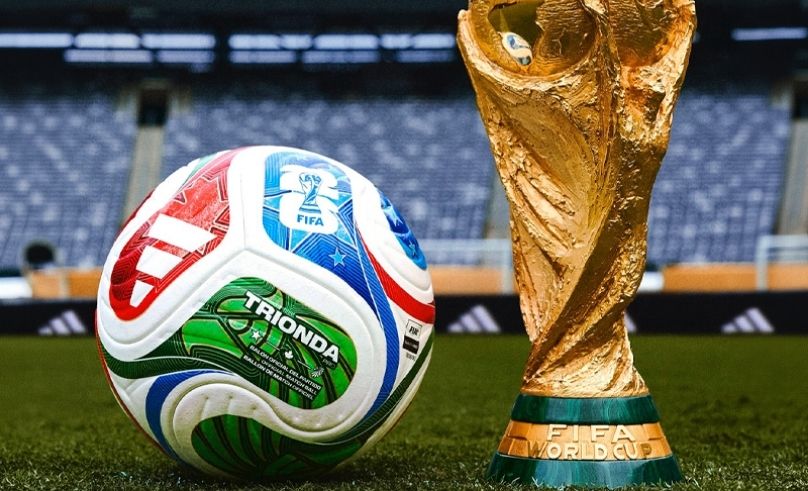
With every new edition of the FIFA World Cup, FIFA and Adidas have unveiled a new official ball that blends visual identity of the host nations with technological advancement. For the 2026 World Cup, set to kick off on June 11th, both parties have revealed the new official ball named Trionda. With an AI chip and climate-adapting materials, it’s one of the most technically sophisticated balls in World Cup history.
A Design That Reflects the Host Nations' Identity-06f1ce34-4faf-4fed-8309-35d1f95d48c7.jpg) The name means "three waves" in Spanish, a nod to the three host nations: Canada, Mexico and the United States.
The ball features a blend of red, green and blue, with symbols unique to each country — the maple leaf for Canada, the eagle representing Mexico, and the star for the United States — alongside golden motifs in tribute to the World Cup trophy itself.
Trionda also stands out for its distinctive design, built from just four panels that connect to form a triangle at the centre of the ball. This isn't purely an aesthetic choice; it's engineered to improve stability and aerodynamics during movement and flight.
Technical Innovations for Better Performance
The name means "three waves" in Spanish, a nod to the three host nations: Canada, Mexico and the United States.
The ball features a blend of red, green and blue, with symbols unique to each country — the maple leaf for Canada, the eagle representing Mexico, and the star for the United States — alongside golden motifs in tribute to the World Cup trophy itself.
Trionda also stands out for its distinctive design, built from just four panels that connect to form a triangle at the centre of the ball. This isn't purely an aesthetic choice; it's engineered to improve stability and aerodynamics during movement and flight.
Technical Innovations for Better Performance-78a878c5-00b4-46e1-8bd9-4619b38d27d6.jpg) Adidas explained that the new ball was designed to deliver greater stability in flight, thanks to deep seams and a specially constructed outer structure that helps distribute air resistance evenly.
Adidas explained that the new ball was designed to deliver greater stability in flight, thanks to deep seams and a specially constructed outer structure that helps distribute air resistance evenly.
The company also added subtle raised textures across the ball's surface to improve control during strikes and dribbles, particularly in humid or high-moisture conditions.
Trionda underwent an extensive series of scientific tests in specialized laboratories and wind tunnels, in collaboration with Loughborough University, to evaluate the ball's speed, accuracy, and in-flight stability.
An AI Chip Inside the Ball-78bab94b-aea7-41c9-9845-75313abe6083.jpg) Following in the footsteps of "Al Rihla," the official ball of the 2022 FIFA World Cup, Trionda contains an AI-powered sensor chip operating at 500Hz, sending real-time data to match officials to assist with decisions, particularly in offside situations.
This time, however, Adidas introduced new modifications to the technology: the chip has been relocated to the side of the ball rather than its centre, and the system has been upgraded to deliver faster, more precise data.
Following in the footsteps of "Al Rihla," the official ball of the 2022 FIFA World Cup, Trionda contains an AI-powered sensor chip operating at 500Hz, sending real-time data to match officials to assist with decisions, particularly in offside situations.
This time, however, Adidas introduced new modifications to the technology: the chip has been relocated to the side of the ball rather than its centre, and the system has been upgraded to deliver faster, more precise data.
The chip's role doesn't stop at assisting referees. It also enables tracking of granular details such as the number of touches, dribbles, the ball's direction, and its speed — data that was previously extremely difficult to capture through traditional means.
Adidas describes the ball as the "last frontier" in football performance tracking, especially as the sport evolves tactically and matches see ever-increasing rates of passing, sprinting, and rapid attacking runs.
The First Ball Built for Multiple Climates-87029c84-dce8-413d-a7d8-dab821b8722a.jpg) Trionda is the first official World Cup ball developed with multiple climate conditions in mind. The tournament will span 16 cities stretching from Vancouver in the north to Mexico City in the south, with significant variations in temperature, humidity, and altitude.
For that reason, Adidas worked to develop a surface that gives players a consistent feel regardless of the weather conditions or the venue.
Trionda is the first official World Cup ball developed with multiple climate conditions in mind. The tournament will span 16 cities stretching from Vancouver in the north to Mexico City in the south, with significant variations in temperature, humidity, and altitude.
For that reason, Adidas worked to develop a surface that gives players a consistent feel regardless of the weather conditions or the venue.
The company also tested the ball in environments simulating varying humidity levels before taking trials to several host cities, where players from clubs including Vancouver Whitecaps FC and Tigres UANL had the opportunity to try the ball as part of the development process.
Testing Continues Ahead of the World Cup-124f4116-5043-46e8-9e5a-40738ae80e04.jpg) Trionda’s testing isn't over yet. Several tournaments and clubs will use the ball ahead of the World Cup's opening, and participating national teams will begin training with it before the tournament begins, giving players time to adapt to its new technical characteristics.
Trionda’s testing isn't over yet. Several tournaments and clubs will use the ball ahead of the World Cup's opening, and participating national teams will begin training with it before the tournament begins, giving players time to adapt to its new technical characteristics.
With all of these advancements, Trionda is shaping up to be far more than a football for match play — it's a fully integrated technological project through which Adidas and FIFA are looking to transform how the game is played and understood in the future.