


Amira Ayoub Paints the Uneasy Bond Between Mothers and Children
In her first solo body of work, Egyptian painter Amira Ayoub turns mothers and children into merging, distorted forms shaped by care, fear and the possibility of loss.
A spider wrapping its prey in a web is an unlikely reference for a painting about motherhood. Egyptian painter Amira Ayoub, 24, found in that scene a way to interpret one body surrounding another, with protection and confinement held in the same image.
"I drew inspiration from kangaroos and cocoons, but I'm particularly drawn to spiderwebs, especially the way a spider wraps its prey in its web," Ayoub tells CairoScene. "I was trying to describe something between containment and dissolution, between protection and the loss of boundaries."
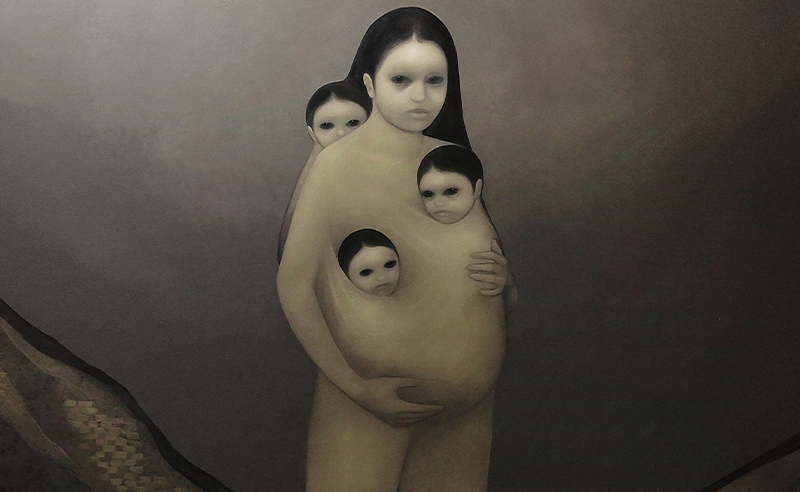
Elongated, pale-skinned women hold children at varying distances from their bodies. Children curl inside sacs that seem to grow out of their mothers' bodies. Others hover in translucent cocoon-like spaces, still carried by the mothers. Elsewhere, they multiply into crowds, their large black eyes staring directly at the viewer.
-8f714596-c83a-4151-84ee-52b74bb94bdc.png) Ayoub is unmarried and has not experienced motherhood herself. Her interest comes from what she has observed through friends, family members and, most intimately, her own mother.
"I see motherhood as an experience of human emotions in their most extreme form," she says. "I see it in my own mother, in her sadness, her exhaustion and the way she is constantly trying to protect us. Watching her go through all of this deeply affects me."
Motherhood's central place in Ayoub's work grew from an earlier focus on the figure of the child. Interested in human vulnerability, protection and the relationship between life and death, Ayoub initially used the child as a symbol.
"I saw the child as pure and unformed, perhaps still possessing knowledge that we lose as we grow older," she says.
Her interest in children and loss was already evident in A Bird's Funeral, a painting exhibited at the 35th Youth Salon in December 2024. Ayoub received the Salon Award for Painting and an Acquisition Award at that edition. She had previously received the Encouragement Award and an Acquisition Award at the 34th Youth Salon in January 2024.
The work addressed children affected by war and displacement, with a dark-eyed girl at its centre, bearing witness.
Ayoub's 2025 graduation project at the Faculty of Fine Arts in Zamalek turned directly to motherhood and loss. In two large oil paintings, she depicted a mother trying to collect and revive her children. The children and the mother were already dead.
In Of Woman Born, 1976, feminist poet Adrienne Rich distinguishes between motherhood as a woman's lived experience and motherhood as an institution shaped by social expectations. In its first chapter, "Anger and Tenderness”, Rich writes about the coexistence of love, exhaustion and anger in motherhood.
-f97d53e2-5fd6-42e4-a265-a671b2c8f33f.png) Writing about Julia Kristeva's work on maternity, philosopher Kelly Oliver describes pregnancy as destabilising the mother's sense of self, with the child initially experienced as an "indiscernible double" before becoming a separate individual. In Ayoub's paintings, mothers and children are often hardly distinguishable from one another because their bodies merge.
"The scenes that feel most truthful to me are the more complicated ones,” Ayoub says, speaking of motherhood and the fear of loss. “I'm not searching for something beautiful as much as I'm searching for something truthful. I was interested in the contradictions between tenderness and fear, between protection and loss."
Ayoub says she does not consider the paintings a direct critique of social expectations placed on women. "For me, the mother and child are also an entrance to a much wider world that is closer to my own emotions."
Ayoub communicates those emotions through the bodies themselves. Her figures have unnaturally long limbs, still expressions and disproportionately large eyes.
"For me, changing the body's proportions or distorting its form is like the trace of an event, the result of a particular emotion I want to communicate, almost as though the body is carrying a scar."
Ayoub's influences include Goya's Black Paintings, particularly Saturn Devouring His Son; Swiss Symbolist Arnold Böcklin's Isle of the Dead; Alberto Giacometti's elongated human figures and Margaret Keane's paintings of children with large eyes.
Ayoub was also influenced by Carl Jung's mother archetype, which carries associations with care, growth and fertility alongside darkness, death and poison.
The eyes are perhaps the most recognisable feature of her figures. The children and mothers share the same black gaze. Ayoub imagines them experiencing the world differently.
-76ea0887-5e03-4d65-9e98-676cd91a156d.png) "The children's black eyes are eyes that perceive the truth. They see what others cannot see,” she says. “The mother's black eyes, on the other hand, are more afraid of the truth. She doesn't want to accept what she's seeing. Instead, she's trying to save whatever remains of herself and her children."
ArtTalks founder Faten Mostafa Kanafani chose the title The Ones We Carry after recognising in the paintings a form of care bound up with responsibility and survival.
"We don't only carry people. We also carry our fears and parts of ourselves,” Ayoub says. “In my paintings, the mother is trying to gather as many of her children as she can, or perhaps she's gathering the scattered parts of herself."
The exhibition followed Ayoub's prizes at the Youth Salon and her first-prize win in the second edition of ArtTalks' Masr Wallada competition, which gave her the opportunity to present her first solo show at ArtTalks Gallery in Zamalek in September 2026.
The exhibition has concluded. The works remain available for purchase through ArtTalks Gallery or by contacting Ayoub directly via Instagram DM.
"I think working on this exhibition has left me with more questions rather than answers," Ayoub says.
- Previous Article Everyone You Need to See at uth Festival 2026
- Next Article Cairo Intl Book Fair to Honour Magdi Yacoub & Ahmed Lotfi El Sayed
Related Articles
Trending This Week
-

-
-
 Nov 08, 2026
-
 Nov 09, 2026