





Egyptian Artist Esraa Zidan Only Paints Happy Barefoot Women
Esraa Zidan spent a decade painting fat women at ease, absorbed in themselves; now her work traces deeper truths.
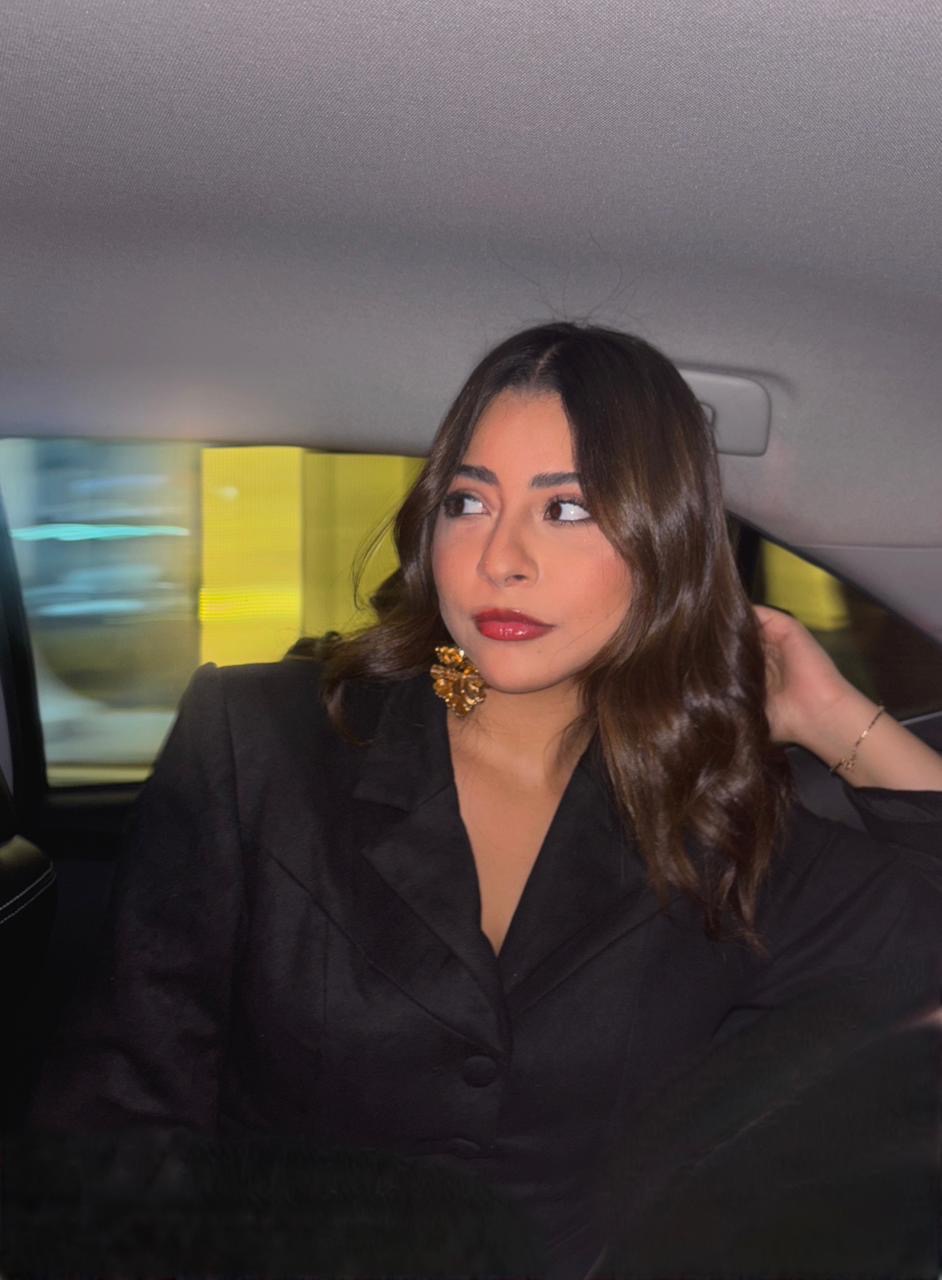
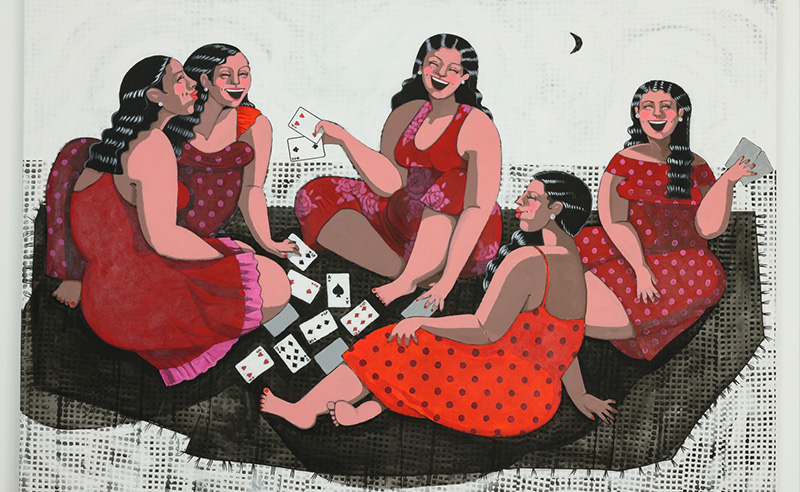
Esraa Zidan has spent the better part of a decade painting women who exist entirely for themselves. They stand barefoot in gardens, turned away from whoever is watching, absorbed in the uncomplicated fact of their own existence, playing ouds, laughing at nothing in particular, occupying space. For years, that was the whole of it: fat, joyful women.
Three years ago, Zidan's grandmother died, and something broke open.
The last painting she made shows her grandmother in heaven, finally catching her breath. "I started antidepressants after my grandmother passed away," she says, "and somewhere in that period, I looked honestly at my own work." What she saw, spread across a decade of canvases, was a world she had built out of a feeling she no longer had. "I realised I drew happy women before because it was how I felt. But now I am not happy. Why am I only drawing happy women? I want to be honest with myself."
Zidan grew up overweight and cannot remember being otherwise. "I was brought up understanding comfort comes first," she says. The ease with which her painted women radiate is not entirely compensatory; some of it she simply knew, from her own body and from a household that had not taught her to compromise on her comfort. "I never saw my mother wearing things that were too tight or putting on heavy layers of makeup. She would choose shoes that felt comfortable, clothes she could breathe in, and there was no pressure to be otherwise," she adds.-578a2056-aeab-462e-8216-148aaf8d4161.png)
Zidan studied at Helwan University's Faculty of Applied Arts, graduating in 2012, then went directly into a master's degree in human anatomy for artists, followed by a PhD. For years, she lived almost entirely inside the academy: teaching, researching, writing papers on what she had already, intuitively, begun to do on canvas.
In 2016, Zidan joined Instagram more or less simultaneously and found herself on a platform then at the height of a cultural moment in which women were pushing back, publicly and furiously, against the narrowing of what a body was allowed to look like. “I had always felt a slow accumulation of external judgment absorbed without registering, pressure to look a certain way.”
"I always thought I wanted to paint the body differently," she says. "Not just in terms of size, but in presence and posture. I wanted the body to speak its own story, to occupy space unapologetically, to carry both vulnerability and strength in ways that hadn’t been shown before."
“I spent years analysing every significant artist who had put oversized women on canvas for my PhD, Botero inevitably among them, and came away from that research with a discovery: almost no one had ever drawn them happy.” Botero's women are monumental, self-possessed, legibly confident, but they face you. They know you are there. Their ease is performed outward, toward a viewer whose presence they have already accounted for. Zidan’s perspective was different: "My subjects are never wearing shoes, and they are never looking at an audience. They don't need the viewer's permission to exist."
For her first solo show, she reached for Mahmoud Darwish, specifically a poem that catalogues every possible form of woman and calls all of them beautiful, the weak and the strong, the near and the far, the poor, the lonely, the tall, the short. الجميلات هُنَّ الجميلات. The beautiful are the beautiful. All of them. The show was called Neighbours of the Rainbow - جارات قوس قزح, and it was, in retrospect, the fullest expression of what that first decade had been building toward.-a6797a29-9bc8-4792-9c2e-656da9cbaf8d.png)
That decade is over now. "By time, the palette of my colours changed," she says. The muted tones she had always kept in the skin began to spread outward into the surrounding world of the canvas, until the happiness that had once felt like the whole point began to feel like one register among several. "Women are not too joyful now," she says of the project she is currently preparing. "Some of them stay still, gasping in the moment. I shifted from the too-joyful nature. Now I make my characters seek inner peace, or that feeling when something bad ends and you take your breath again. Like my grandmother exhaling in heaven."
- Previous Article Mo Salah’s Record-Breaking Liverpool Legacy in Numbers
- Next Article The Ancestral Resilience of Omar El Farouk’s Fayoum Home