



Hani Mahfouz Is the Youngest 60-Year-Old Artist
After four decades of making art, Hani Mahfouz still can’t introduce himself as an artist.
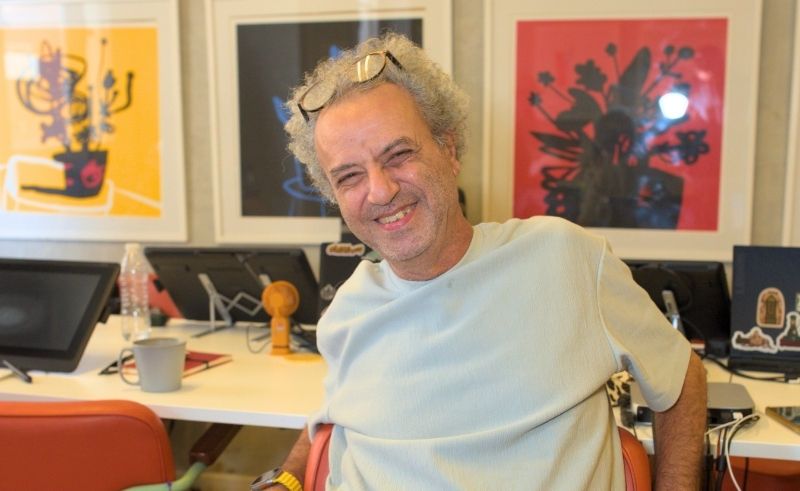
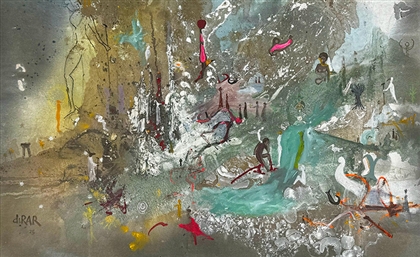
Visual artist and designer Hani Mahfouz’s studio is an open-plan gallery of his work. It’s personal - the first wall when you enter holds a framed blog entry he wrote, pictures of his family, a folded-up ping pong table, a small bookshelf (that inspires and surprises him to this day), and early art projects that, in his words, “were supposed to become a book but that hasn’t happened yet”. Like him, Mahfouz’s studio is vibrant, joyful and young, in terms of both staff and character. His walls are lined with playful abstract illustrations of flowers and fish, with many more framed posters lined up against the wall, waiting for their turn.
Before starting our interview, Mahfouz joked about not being able to accurately introduce himself. His colleagues and friends introduce themselves as artists and engineers, but he finds himself saying, “Hi, I’m Hani Mahfouz, I’m a Fine Arts graduate from Alexandria University.” It makes sense, though, because Mahfouz interacts with the world with the openness and childlike excitement of someone seeing everything for the first time.
In 2014, we, CairoScene, called Mahfouz an accidental artist because he studied design and discovered his interest in art by force of circumstance. Eleven years later, Mahfouz still enjoys his spontaneity, but it is a privilege he can only enjoy because it exists within very intentionally designed structures. The structures - an office, a commitment to the 9-to-5 workday, a team - allow Mahfouz to keep his art fun.
Mahfouz doesn’t believe his art needs to carry a message. It’s not going to change the world. “I don’t think anyone knows whether art is instinctual or carefully constructed,” Mahfouz tells Cairo Scene, “My definition of art is closer to spontaneity. It’s just something you practice. I don’t want to send a message or serve humanity or change how people behave; I just want to draw. It’s simple.”
Mahfouz’s approach to art took a long time to become what it is today; he was taught that art-making was supposed to be this deeply soulful process, where your subconscious can speak to the canvas and all that. Gradually, he gathered enough experience to allow himself to place his emphasis more on the craft and less on the outcome. “I think part of the reason I’m so drawn to abstract art is the fact that it doesn’t need you to send a message. I mean, eventually it communicates something, but I get to not think about that at all during the process.”
At 60, Mahfouz continues to build a body of art that remains relevant to a younger audience, because he himself moves with a young buoyancy. His name is still spoken in circles of Fine Arts fresh graduates; he hasn’t faded into the books of Those Who Have Come Before like others in his generation. Mahfouz preserves his youth by following the handbook he detailed in his 2012 TEDx talk The Second Death.
In the talk, Mahfouz essentially publicly dismantles his fear of death, particularly an untimely one, and claims that when someone dies, they actually die twice: once when they physically pass away, and another when they are forgotten. “I think it’s a great coincidence that I’m involved in abstract art and concerned with conceptually surviving, because abstract art is more permanent. I’m lucky I don’t paint any chairs or cups that would eventually look outdated.”
“Even if I’m not working on any projects, I have to come in, and I have to stay until five,” Mahfouz told Cairo Scene, “Sometimes I have nothing to do, but I still have to come in. This routine gradually removes the perceived sanctity- and tension - of art-making; it flattens the job into any other job. I come in and I draw - there doesn’t really have to be a reason other than my own enjoyment.”
He’s currently less concerned with designing for other people or working on branding, and more into exploring his own art, revisiting past projects (turning fish illustrations into birds, for example), and venturing into new mediums - all of which are not time-sensitive projects, but his studio time is sacred to his artistic process.
In 2023, Mahfouz worked with local design studio Cairopolitan on a project called Nine to Five, in which he planned to create five exhibitions in the span of one year to break what he calls the sanctity of exhibiting. “You’d think that as you get older, the fear of displaying your work would subside, but it didn’t for me. So I came up with this project so I would be less scared; to let the process of art-making consume me, as opposed to the process of preparing for an exhibition.”
Mahfouz currently finds himself in a novel position, one where he is expected to be teacher. To him, refusing to embody the white-beared image of wisdom is what enables him to mentor younger generations. “When young artists create art organically, the way they feel is instinctual, it’s inspiring. I think the disconnect happens when they start wondering how they could make art like older generations - how to be what they consider ‘real artists’.”
Because of how various art mediums have evolved over time, Mahfouz believes younger artists have the privilege of being able to pay less attention to the complexity of the techniques they use. Even people who don’t have a background in art can explore modern tools and enter the art scene. This change in accessibility has allowed Mahfouz to explore and develop his own work further. The horizon ahead of him, in his view and ours, is still vast.
- Previous Article 3ala Mazag: Nour [Curated Playlist]
- Next Article Egypt Rises 10 Places in World Bank's Women, Business & the Law Report