






Egyptian Artist Habiba Sawaf is Reimagining Khayamiya
Habiba Sawaf fell in love with Khayamiya years ago. Now, she works to reinvigorate the craft by collaborating with its original masters.
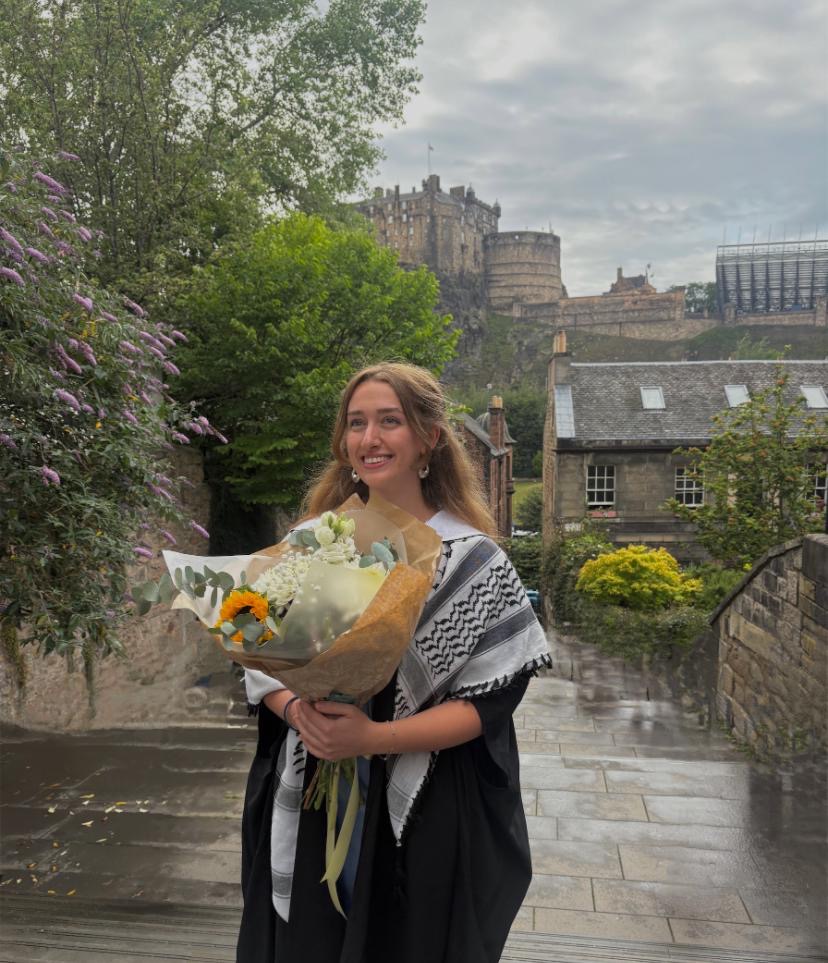
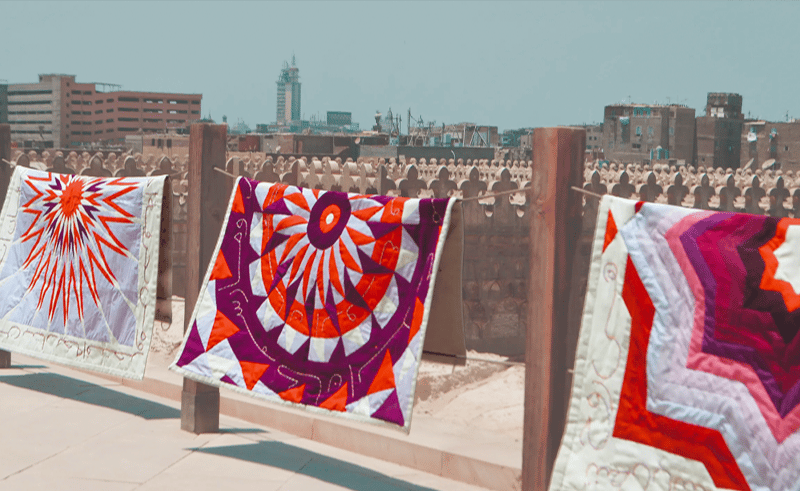
The first time Habiba Sawaf visited Sharia al-Khayamiya - Cairo's centuries-old street of the tentmakers - she met a man named Mostafa Elleithy. She went to better understand the craft, and learn directly from its makers. When she met Mostafa, he told her that he was new to the street, that she should go ask someone next door. He was, as she quickly learned, one of the oldest and most skilled khayamiya makers on the street - he just didn’t want to be bothered.
Sawaf went back anyway, deciding he was exactly who she wanted to learn from - Mostafa’s father and grandfather were both skilled khayamiya artisans. Now in his seventies, his knowledge and dedication to the craft are what drew 26-year-old graphic designer and visual artist, Sawaf, to his quaint stall.
"I have always been interested in fabric and textiles," says Sawaf. "It wasn't really until my bachelor's degree, though, that I really got to learn about the history of khayamiya." Like many Cairenes, she had grown up with a particular image of the craft in her mind. "Before I really started researching the history and visiting the street, I had this misconception that khayamiya meant those textiles you see during Ramadan" - thin red and blue tapestries with cartoon people printed onto them, or repeating floral patterns. Most often, these aren’t even made in Egypt - shipped over from China in large quantities for the festive month.
What Sawaf quickly learned from her time on Sharia al-Khayamiya, and from its artisans like Mostafa, was that the craft was far older, richer, and more alive than she had imagined. This shift in perspective was in large part due to her bachelor’s degree, in which she wrote a thesis on storytelling through textiles in Egypt.
Rather than researching online, she threw herself into the craftspeople and their stories. “I fell in love with the street of the tentmakers,” Sawaf tells CairoScene. “I loved seeing all the designs and talking to all the people there.”-2dcfc62d-e108-4b1d-b74e-085261765335.png) Her thesis took the form of a series of three khayamiya pieces, each carrying a verse of a poem she wrote collaboratively with the craftsmen she met on the street. "It was a very messed-up sketchbook of different verses written by all of us," she says with a laugh. The first verse spoke of the craft's past; the second of its present; the third of its legacy. Each line was hand-stitched onto the tapestry - an act that was as much an homage to the process as it was to the subject.
Her thesis took the form of a series of three khayamiya pieces, each carrying a verse of a poem she wrote collaboratively with the craftsmen she met on the street. "It was a very messed-up sketchbook of different verses written by all of us," she says with a laugh. The first verse spoke of the craft's past; the second of its present; the third of its legacy. Each line was hand-stitched onto the tapestry - an act that was as much an homage to the process as it was to the subject.
The relationship Sawaf and, an initially reluctant Mostafa, have built is central to how she works. "My pieces are always a dialogue with him," she says. “He's very honest. He'll say he doesn't like this design or this element, so we go back and forth debating it.” It is not always a gentle exchange. Mostafa is opinionated, exacting, and deeply passionate - qualities that have, over time, become her own. “He will call me at 2am, saying he has an idea, that he has been thinking about the fabric I want to use and has thought of a way2 am to use it.” She pauses. "If he is in a bad mood, he works much more slowly than if he is in a good mood. He really is an artist - what he is feeling comes out in his work.”
What she has taken from him, from both observation and practice, goes beyond technique. "I think the amount of passion he has for his craft is passed onto me," she says. "I see how he really puts his whole heart and soul into what he is doing, and I feel like I have to do the same. It is really a transfer of passion and dedication." While Mostafa may have needed convincing at first, when she now visits his shop - often without a project in mind - she stays for three or four hours.
Khayamiya has existed in Egypt for centuries, dating back to the Fatimid period between the 10th and 12th centuries. Sawaf is now part of a new generation of artists reinvigorating this ancient craft - modernising its uses while respecting its layered heritage. Her description of her current relationship with Mostafa seems, in many ways, to be a symbiotic one: he teaches her traditional methods and forms, while she brings new eyes to a craft he has spent a lifetime mastering. Neither one, however, seems to be done learning from the other.
“All my khayamiyas are inspired by the past and the culture around me,” she explains. “Whether it's Egyptian history or folklore, we are not reinventing anything - it is always taken from another context.” She looks at what already exists within the tradition - Islamic geometry, Pharaonic motifs - and then reframes it in a way that feels personal, “a way that feels close to me,” she says.
The appeal of the craft, for her, is inseparable from its physical process. She describes it as layered in the same way a feeling can be layered: “It's kind of like a puzzle - you try to navigate a feeling into the layers of khayamiya, and yet at the same time you're working with someone who has so much experience. It's really a dialogue.” She loves being present for every step of creation - the choosing of fabrics, the testing of colours, the moment when separate pieces of cloth begin to become something whole. “I love the process of picking the fabrics, using different materials, and seeing how the fabrics come together.” Bold colour, she says, is non-negotiable.
When creating a design for a piece, her visual research often begins on the ground, letting the city - its colours, movement, and textures - inspire her. She visits old neighbourhoods, watches how things are arranged, photographs colours, and observes patterns in the everyday environment around her. Only once she has done this kind of research does she return to the studio to begin translating what she has gathered into a digital drawing, which is then brought to life in fabric through a collaboration with one of the talented tentmakers on Sharia al-Khayamiya.
One of the clearest examples of how Sawaf moves from street to studio is her collaboration with Yousef Sabry of Rizo Misr, a Cairo-based Risograph printing studio. The project began as a conversation between the two about what it might look like to merge Risograph printing - known for its vivid, layered ink - with khayamiya.
"I found that Risograph was also a very layered process, like khayamiya. Both shared very bright and bold colours." The image that first surfaced, while searching for inspiration, was Mawlid - “its people, streets, crowded places, colours everywhere, children running around."
The result was a series of two khayamiya pieces - one centred on the iconic swings of the Mawlid and the colour and movement around them, the other inspired by the sugar doll and the beloved songs associated with the celebration. Their shape was inspired by the banners hung across the city during the festivities. For the photoshoot, she and Sabry went to Darb al-Ahmar just weeks before the actual Mawlid, found a classic swing, strung up lights, and let children pose beneath the finished pieces - recreating, in miniature, the very festival that had inspired them initially.
Khayamiya, to Sawaf particularly, can take many forms. Extending beyond their typical tapestry form, she sells miniatures in the form of bucket hats. The hats came out of a request from art historian Seif El Rashidi, wanting to create pieces of khayamiya that people could connect with easily and take home. The hats feature simple, but no less beautiful, renditions of classic patterns. This, to Sawaf, was a way to make khayamiya more accessible to admirers. "On Khayamiya street, they think the more detail and elements they have, the better it will look - which is true in many cases. But other times you can extract some elements and make it simpler while still making it a curated piece."
Earlier this year, in fact, Sawaf's work travelled to Rabat, Morocco, as part of ‘Dialogue Under the Tent’ - an exhibition curated by El Rashidi at the Abla Ababou Gallery. The show brought together traditional craftsmen and contemporary artists from Egypt, Morocco, and France to tell the story of the tent and its makers across borders and centuries. Sawaf contributed several pieces she had made independently, drawn from her existing body of work.-6e967e51-217f-4fdb-9e62-6ce5af63ba3b.png) Here, she found the Moroccan audience uniquely receptive. “They're very aware of craft. They're not a culture that doesn’t know the value of craft. They know it very well." That shared understanding made conversations about khayamiya feel different from what she sometimes encounters in Cairo.
Here, she found the Moroccan audience uniquely receptive. “They're very aware of craft. They're not a culture that doesn’t know the value of craft. They know it very well." That shared understanding made conversations about khayamiya feel different from what she sometimes encounters in Cairo.
The future of khayamiya, as imagined by Sawaf, is one where the craftsmen on the street are freed from the commercial pressure of producing only what will sell. “I would love to see the street itself and its craftsmen really focus on their speciality, and not be afraid to create freely - to develop their own taste over the market's taste,” she says. “Each one of them really is an artist, not only a craftsperson. At the moment, they're not encouraged to innovate and create new designs as they are afraid they won't sell.”
Her relationship with artists like Mostafa has inspired optimism, however. Much has changed since she first met him, and the many other makers of Sharia al-Khayamiya during COVID. Sawaf has seen the mood on the street shift from uncertain and at times, depleted, to rejuvenated by a growing interest in the craft and its potential. Young people are coming to the street for personal projects, for interior design, or even to learn the art form for themselves. “All these new people and new ideas started pushing the people on the street to start thinking about new ways to use khayamiya” - fabric that once lived exclusively in ceremonial tents now appears on clothes, jackets, and everyday objects.
The craftsmen of Sharia al-Khayamiya have watched many things change around them - the city, the market, the taste of a new generation. What has not changed is the work itself: slow, deliberate, built from layers of artisanal knowledge and historical tradition.
“The limitations of khayamiya are endless in terms of what it can be used for, and people now appreciate it more than ever in terms of understanding the value of craft and knowing this took time and effort,” concludes Sawaf.
- Previous Article SceneNoise x Amsterdam Dance Event Present CROSSFADE: Egypt
- Next Article The Abandoned Architecture of Villa Badran by Gamal Bakry
Related Articles
Trending This Week
-
 Oct 06, 2026
 -

-
-