




If These Walls Could Talk: The Art of Khayamiya in Egypt & Morocco
Art historian Seif El Rashidi’s newest exhibition, 'Dialogue Under the Tent', tells the story of a historic art form in a contemporary gallery from January 29th to March 17th in Rabat.
The tents of Egypt have borne witness to life, to history, to change. They have sheltered the joy of weddings, the grief of funerals, framed royal ceremonies and political proclamations of change, and echoed the laughter of feasts beneath Cairo’s public squares. Built to last, each khayma lives a long, working life, raised and dismantled time and time again until decades of careful use finally wear the beloved textile to shreds.
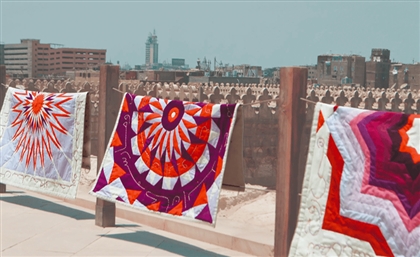
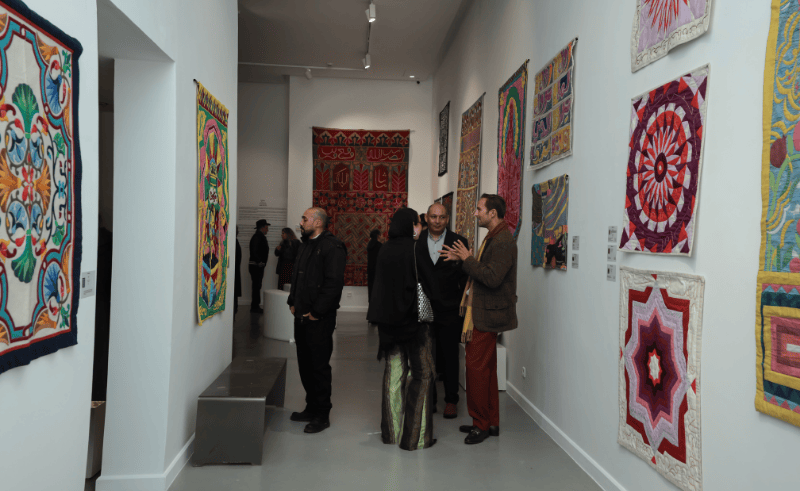
It is from this tradition that the exhibition 'Dialogue Under the Tent' takes its name. Now on view at Abla Ababou Gallery in Rabat until March 17th, the exhibit tells the stories of the tents and their makers - the khayamiya. Lining the gallery walls are hand-stitched panels of ancient motifs and intricate geometries that carry centuries of memory in every appliquéd seam. Contemporary designers and traditional craftsmen from Egypt, Morocco, and France display their work to highlight the range of form and history this craft takes on. In this way, the exhibition becomes a dialogue between past and present, between countries, between tradition and reinvention, and craft and contemporary art.
At the heart of the exhibit is Egyptian art historian and curator Seif El Rashidi, who, in partnership with Egypt’s Ambassador to Morocco, Ahmed Nihad Abdel-Latif, has brought these layered histories to life beyond Egypt’s borders. The exhibition combines traditional pieces from the streets of Cairo, handpicked by El Rashidi himself, with contemporary works by artists including Egyptian Habiba Sawaf and French Louis Barthélemy.
Along with the classic patterns typically seen on the khayma - birds flying, palm trees, intricate geometric patterns - the gallery displays beautiful modern reinventions of the classic khayma. Barthélemy, who splits his time between Egypt and Morocco, creates adaptations of ancient and traditional scenes full of bold colour and character. His work is just as much a testament to the origins of the craft as it is a glimpse into how it can be carried into the future with fun, creativity, and joy. Similarly, Sawaf’s work on display offers a take on original patterns with modern colours and bold reinterpretations. The placement of all these varying designs side by side - old and new, traditional and unconventional - is part of El Rashidi’s goal to bring this ancient craft into everyday scenes of contemporary life.-efb86bef-1b79-4440-90c8-05ca1d591ebf.png) El Rashidi’s relationship with khayamiya began not in a gallery, but in Cairo’s historic Darb al-Ahmar, while working with the Aga Khan Foundation. He became fascinated by the street of the tentmakers - a place where, despite centuries of production, few could fully trace the craft’s documented history. “It came from the question of trying to understand the history of a craft that not many people knew about,” he recalls. While many Egyptians knew of khayamiya, not many understood its historical significance. To counter this, El Rashidi co-authored 'The Tentmakers of Cairo' alongside Sam Bowker to fill in the gaps in the craft’s art historical research.
El Rashidi’s relationship with khayamiya began not in a gallery, but in Cairo’s historic Darb al-Ahmar, while working with the Aga Khan Foundation. He became fascinated by the street of the tentmakers - a place where, despite centuries of production, few could fully trace the craft’s documented history. “It came from the question of trying to understand the history of a craft that not many people knew about,” he recalls. While many Egyptians knew of khayamiya, not many understood its historical significance. To counter this, El Rashidi co-authored 'The Tentmakers of Cairo' alongside Sam Bowker to fill in the gaps in the craft’s art historical research.
Khayamiya in Egypt dates back to the Fatimid era, between the 10th and 12th centuries. “They're not just utilitarian tents,” El Rashidi explains, “they're decorative, large tents, that were used to host hundreds, sometimes thousands of people.” In the pre-modern era - before photography, before social media - the tent combined spectacle and statecraft. “The public appearance of the ruler or the state was a very important part of the relationship between the ruler and the people,” he says. That is why Mamluk sultans erected vast ceremonial tents below the Citadel for the Prophet’s birthday and other state occasions, allowing the public to witness power draped in geometry and colour.
“The interesting thing about Egypt is not that khayamiya exists, but that it continues," El Rashidi explains. While many similar traditions faded elsewhere, Egypt’s tent culture has persisted, evolving and adapting with each new generation.
When 19th-century tourism in Egypt demanded a revival of ancient Egyptian motifs, tentmakers began to incorporate pharaonic designs into their work, “drawing inspiration from ancient Egypt. This is where the bird design comes from”, El Rashidi tells me, “inspired by the Ancient Egyptian Tree of Life." Over the last century, blue and red tents have become synonymous with Ramadan celebrations, a phenomenon that “probably didn’t exist 100 years ago." Egypt’s long and rich history has seen rulers, cultures, faiths, and trends come and go. With each one, the khayamiya adapts and evolves to suit its contemporary needs. Today, that evolution continues. “Their designs are distinctive, and they’re constantly evolving,” El Rashidi says, “you might go today and find something that never existed before."
This continuity and reinvention lie at the heart of El Rashidi’s work in Egypt. He shares how one thing he found “annoying was that people abroad appreciated the tentmakers’ work, but in Egypt, they didn’t seem to”. To battle this, he has spent the last five years organising exhibitions that do more than display textiles as they are. “It isn’t just about displaying things. It’s also about improving the design and thinking about how you can link designers to craftspeople so that they produce contemporary art inspired by the past."
Collaborating with local brands, artists, and designers, El Rashidi has attempted to bring the art of khayamiya into the future as something “less folkloric” and more contemporary, hoping to pair this historic and traditional craft with contemporary and modern designs.
El Rashidi points out that this exhibition is “unusual - maybe even the first - in that it is sponsored by an Egyptian embassy in a contemporary art gallery. So it represents Egypt officially abroad as a contemporary art form." That distinction matters. To see tentmaking presented in Morocco not as a historical relic, but as a living, contemporary art form worthy of contemporary designs and themes is a step toward reshaping how the craft is perceived at home.
Egyptian Ambassador to Morocco, Ahmed Abdel-Latif, played a crucial role in organising the exhibit. “Had it not been for his love of art, this exhibition would have never happened," El Rashidi admits. Their partnership began almost by accident. A few years ago, at an exhibition in Cairo, El Rashidi had quietly admired a geometric piece, hoping to purchase it after the show. It sold before he could. “I asked the gallerist what had happened to the one I liked," he recalls. “She said, oh, you see that man over there? He's the one who bought it. So I went to speak to him." That man was Abdel-Latif. In fact, the same thing happened again at a later exhibition. “There were two pieces I liked. They got sold, and I found that he had bought them again," El Rashidi laughs.
Together, they conceived 'Dialogue Under the Tent': an exhibition that would officially represent Egypt in a contemporary art space. For El Rashidi, the setting of the exhibition, a contemporary art gallery in Rabat, represents an important idea. "Displaying the khayamiya in a modern art gallery is a very good model for Egyptian crafts - it shows that historic crafts still have a space in the contemporary realm to represent Egypt culturally."
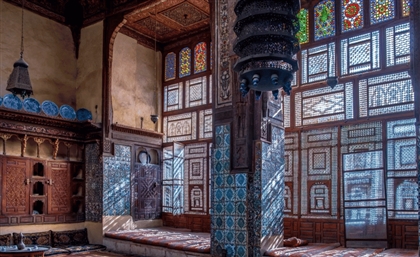
In Morocco, the dialogue feels particularly resonant. “In Morocco, actually, tent making is more alive in a certain way because I think Morocco has a stronger sense of tradition than Egypt,” El Rashidi observes. “Egypt has a very long history and it has many traditions, but I would say modern Egyptians in some ways are less bound to tradition than Moroccans." Many Moroccan homes maintain a traditional salon, richly decorated and still used in its historic function. While their tentmaking traditions vary from Egypt’s, the existence of this historical room shows a continuity of tradition that has been diluted in Egypt. “In Egypt, it’s become much more of an art form,” he explains. "Most tents are purchased because of their artistic value, not because someone’s actually going to sit in a tent or room."
The variety of cultures, functions, and designs shown at the exhibition ensures khayamiya is not presented as static heritage. Instead, it reveals an art form shaped by centuries of exchange. Across the Middle East, arabesque and geometric designs on these textiles share a visual language. They tell a story of the trade and political links under the Mamluks that connected Egypt to North Africa and to Central Asia and beyond. In many ways, khayamiya has always been the result of cross-cultural dialogue - a core component of the Rabat exhibition.
When I asked him about the future of Khayamiya, El Rashidi is hopeful. He strives for the craft not only to be recognised as a seasonal decoration or tourist souvenir, but as a part of everyday Egyptian life. “I hope that it becomes more widely recognised as part of Egyptian culture to the extent that people use it and have it in their homes." From soft furnishings to canopies and curtains, bedspreads and everything else, El Rashidi hopes to see these designs everywhere. “There’s no reason not to have handmade Egyptian things in your home," he says.
Partnering with local Egyptian brands like Markaz, the art historian looks to the future as he collaborates and experiments with curtains and pouffes made from khayamiya - small but significant steps in reintegrating the craft into daily interiors.
However, the challenges remain. “In an impatient world of people with short concentration spans, khayamiya, like all crafts, requires patience. I fear not many people seem to have the patience to learn it." Yet, the tradition has survived for centuries - through dynasties, revolutions, urban changes, and modern industry - so, as El Rashidi says, “hopefully it will continue."
This Ramadan - a season when tent fabrics bloom across Egypt’s streets - the Rabat exhibition offers a timely reminder. The tent has always been a space of gathering, of dialogue, of shared experience. In Morocco, under gallery lights rather than Cairo’s open streets, that space has been reimagined.