





UN-backed Fund Is Racing to Pay for Egypt's Newly Protected Coral Reef
Egypt's coral reefs earn roughly $7 billion a year, and the country has just placed its Great Fringing Reef under protection. The Egyptian Red Sea Initiative is raising the money to make it hold.

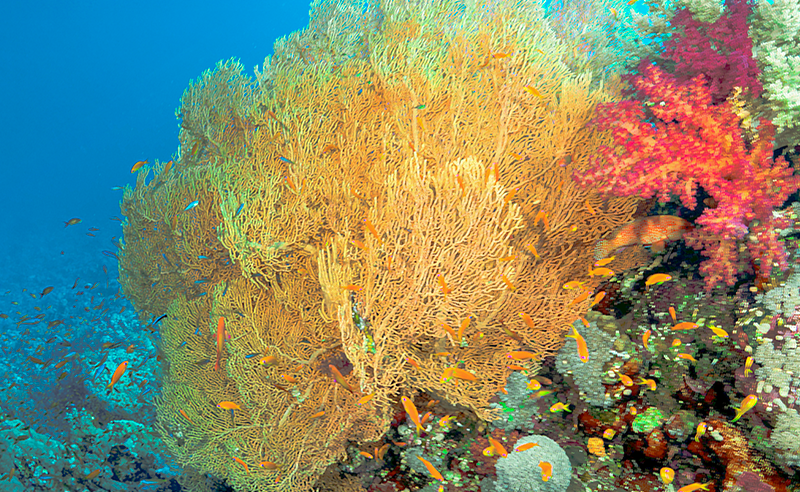
Egypt's Great Fringing Reef stretches roughly 2,000km down the Red Sea coast. Most Egyptians know it in pieces: the Blue Hole in Dahab, Ras Muhammad National Park, Elphinstone off Marsa Alam.
Taken as a whole, it is one of the most valuable natural assets the country has. Egypt's coral reef tourism generates about $7 billion a year, roughly half of the country's tourism revenue before the pandemic, according to the World Bank. It is, by that measure, the largest reef tourism economy in the world.
In December 2025, Egypt placed the entire reef under protection, designating it a marine protected area. The question now is how to make that protection hold, and who pays for it.
That is the job of the Egyptian Red Sea Initiative (ERSI), a programme spearheaded by the United Nations Development Programme (UNDP) with $15 million in support from the Global Fund for Coral Reefs to protect the reef while keeping the tourism economy it supports alive.
CairoScene spoke with Chitose Noguchi, UNDP Egypt's Resident Representative, about what the initiative is, how it plans to fund itself, and why the reef's survival is an economic question as much as an environmental one.
Why do you think an initiative like this one was needed, and why now?
Egypt is home to some of the world's most remarkable and climate-resilient coral reefs. They are among the most heat-resistant reefs on the planet: while reefs elsewhere are bleaching and dying as oceans warm, many of Egypt's Red Sea reefs are still showing exceptional resilience.
Scientists consider places like this among the world's most important climate refugia for coral reefs. That gives Egypt, and the world, a real opportunity and responsibility to protect them. The "why now" is about timing.
These reefs are resilient, but they are not immune. They still face serious local pressures, including pollution, unsustainable fishing, heavy tourism, and coastal development. So now is the moment to put the right protections, partnerships and financing in place. Acting now is far cheaper and far more effective than trying to repair damage later.
What are the biggest threats facing Egyptian coral reefs right now?
Most of the serious threats are local and human-made, which is also encouraging because these are pressures we can reduce. Human action can change.
The biggest threats we've identified are land-based pollution, including solid waste and microplastics; marine pollution from ships and ports; high tourism pressure including physical damage from anchors, divers, and snorkelers; coastal construction linked to tourism and real estate; and unsustainable fishing.
Climate change adds another layer of pressure. Even though Egypt's corals are unusually heat-tolerant, warming seas can still increase disease and invasive species. The logic of ERSI is to reduce local pressures so reefs remain strong enough to withstand global ones.
How does ERSI fit within existing efforts by the Egyptian government?
The Egyptian government's commitment to protecting the Red Sea is symbolized in the recent designation of the entire 2,000 km-long Great Fringing Reef of the Red Sea as the country's 31st natural reserve under a Prime Ministerial Decree. So Egypt has already taken important steps to protect the Red Sea, and ERSI builds on this national momentum.
And that for us is really important because that means that the government is serious about protecting it, and that means also that we're able to use that as a symbol of national ownership and the government's real commitment and dedication to this initiative, and we can build on that to achieve broader recognition and engage more stakeholders.
A key component of ERSI is making citizens understand that the protection of coral reefs is an economic matter, not just an environmental one. Is that correct?
Yes. At its heart, ERSI is about ensuring that protecting nature also creates economic opportunity. We do not see conservation and development as competing priorities. We see them as mutually reinforcing.
This is true especially in Egypt. Because the Red Sea is very famous for divers and snorkelers, it's a natural asset. And if you don't protect the natural asset, then you won't have the tourists coming to Egypt anymore.
So it's really about how we can support shifts in practices and decision-making, both in terms of the local communities like fishermen but also in terms of the visitors that come here, as well as businesses and the government and the managerial capacity of the protected areas. It's about creating a system that actually allows for protection.
In practical terms, how do you do this?
We're doing this by establishing the Egyptian Fund for Coral Reefs, which is a dedicated fund to keep financing flowing into reef protection over the long term. We're also setting up a business incubator to support local entrepreneurs, especially women and youth, to build "reef-positive" businesses. And we're supporting community-led ecotourism around Wadi El Gemal.
More immediately, we're supporting Hurghada's organic waste into compost instead of letting it threaten the sea. We're also supporting aquaculture projects that breeds giant clams and corals to help restore reef ecosystems, and upgrading moorings so boats do not drop anchors onto living coral.
So this model is really about protection, partnerships, and funding. There aren't many models that are combining the protection of nature with economic opportunities and bringing different stakeholders together to provide the financial resources, so for us it's really about creating this model. And if it's successful, then it can be replicated around the world.
Can you tell us more about the Egyptian Fund for Coral Reefs?
The Egyptian Fund for Coral Reefs is being designed as a blended-finance platform that brings together a grant facility and an investment facility to sustain both conservation efforts and the economic activities that depend on healthy coral reef ecosystems.
While direct investment in conservation can be difficult to mobilize, reef-positive businesses and economic opportunities can attract investors seeking measurable returns. EFCR is therefore intended to bridge this gap by combining public, philanthropic and private finance within a single platform—using grants and catalytic capital to protect the reef, reduce investment risks and unlock responsible business opportunities.
Designed to become the first dedicated coral reef conservation fund of its kind in Egypt and the region, EFCR will protect one of the Red Sea's most valuable ecological and economic assets: its coral reefs and the livelihoods built around them. It aims to operate as an independent, nationally led platform that attracts public and private capital into responsible investments capable of delivering both environmental and economic sustainability.
Ultimately, EFCR is about looking beyond immediate needs and building the financial foundation required to safeguard the Red Sea and its communities for the future.
What about the business incubator component of ERSI?
The business incubator is designed to bring together venture capital, financial institutions, and technical experts with entrepreneurs who are coming up with businesses that are reef positive. Essentially, these are the businesses that are able to have a positive impact on the reef—protect it, not extract from it. For example they could be related to aquaculture or the tourism sector or something else entirely.
The incubator is also intended to build the future pipeline of the Egyptian Fund for Coral Reefs. It will help identify promising reef-positive businesses at an early stage, strengthen their technical and commercial models, improve their investment readiness and connect them with potential financiers.
Does the money for the coral reef fund come from ERSI itself?
ERSI is putting in USD 5 million in seed funding, with the aim of attracting an additional USD 45 million and more from donors, foundations, and private investors.
What challenges do you foresee in achieving this?
With regards to the fund, the challenges are many—even setting up a fund is really complicated. There's a legal aspect to it, a financial aspect, and a regulatory aspect. We're weighing several different options right now.
Another key challenge is finding and building a strong pipeline of credible, investment-ready reef-positive businesses that can attract financing while delivering measurable environmental impact. This includes not only supporting new reef-positive businesses, but also helping existing businesses and economic activities—particularly in tourism, fisheries, aquaculture and waste management—shift toward more sustainable practices and become eligible for future financing.
We need to strengthen data and scientific monitoring and build local technical capacity. These are complex challenges, and because the Red Sea is also a security-sensitive area, that means access and approvals can sometimes be difficult. The important thing is that the partners are aligned, the vision is clear, and the opportunity is significant.
There are many partnerships at play here — can you break down each partner's role in ERSI?
ERSI works because each partner has a clear and complementary role. The Government of Egypt, through the Ministry of Local Development and Environment, is the national owner of the programme. It sets the strategic direction and leads on policy. The Egyptian Environmental Affairs Agency plays a central role in managing protected areas and reef conservation on the ground.
The Global Fund for Coral Reefs brings global financing and investment expertise to support coral reef protection. UNDP supports implementation, brings partners together, manages the programme day to day, and helps ensure international standards and safeguards are met. Then there are local players such as NGOs like HEPCA, the Chamber of Diving and Water Sports, and the Egyptian Hotel Association, as well as the private sector.
The Red Sea Governorate is also key local partner, especially in coordinating with communities, tourism operators and local stakeholders. It is a shared effort, but importantly, it is nationally led. Egypt is firmly in the driver's seat.
Behind the scenes, how long have these partnerships been in the works?
This initiative is the result of a genuine multi-year effort.
The Government of Egypt first announced its intention to launch the Egyptian Red Sea Initiative at COP27 in Sharm El-Sheikh in November 2022, together with the Global Fund for Coral Reefs and UNDP. From there, it took the better part of two years of careful design, which included a country-wide call for information in early 2023, a major consultation workshop in Hurghada in mid-2023, and dozens of meetings with government, experts, NGOs, tourism operators, fishers and local communities. This process helped shape the programme before it was formally signed in September 2024, and kicked off with an inception workshop in Hurghada on June 7th, 2026.
Now that it's launched, are you hoping to attract more partners?
Definitely. ERSI was designed as an open platform, not a closed circle—its seed funding is an invitation for others to join.
The key approach here is that local communities and civil society are not only beneficiaries. They are part of the decision-making process.
Is there a set timeline for the project?
The programme itself (ERSI) is a five-year programme running until the end of 2030, but the most important point is what happens after 2030. The Egyptian Fund for Coral Reefs is designed to continue for 25 years or more. So while ERSI has a defined timeline, it is designed to leave behind something lasting.
It's still very early in the project's life. Can you point to any early success stories?
The first success is the partnership itself: bringing government, communities, NGOs, experts and financing partners around one shared vision. ERSI is still in its early stage, but we have already achieved something very important by building such a strong coalition, and also by building on strong local experience.
For example, HEPCA has developed one of the largest reef mooring systems in the world with more than 1400 moorings, helping protect reefs from anchor damage. HEPCA has also worked for years on aquaculture, including breeding giant clams. ERSI allows us to take these proven local efforts and scale them up.
The ultimate goal is a sustainable blue economy. What does that mean to UNDP?
A sustainable blue economy means managing marine and coastal resources wisely, so Egypt can keep tourism and fisheries healthy over the long term, attract sustainable investment, create new green jobs, and open opportunities for women, youth and local communities. It means that the sea can continue to generate jobs and income and opportunity without degrading the natural assets that make it valuable.
Lastly, I know this project is quite personal for you. Can you tell us why?
I'm a diver, so I actually go to the Red Sea quite frequently and I've seen how mass tourism has had a negative effect on the corals. And as a diver, if you see coral bleaching, then you're not going to come back to this site. But once we start protecting these areas, and we believe that the corals can become healthier and more vibrant, we will come back.
And we also know—scientifically, we know—that destroying is fast, but protecting takes time. We have to make that switch in our minds that it's not the short-term benefits that are important, but the long-term and lasting ones.
Egypt is a wonderful country with incredible people and so much natural beauty. I feel honoured that we as UNDP are able to contribute to preserving it, so more people can appreciate it - as I have had the privilege to.
- Previous Article SceneNoise x Amsterdam Dance Event Present CROSSFADE: Egypt
- Next Article The Intricate Beauty of Ben Youssef Madrasa
Related Articles

Trending This Week
-
 Oct 15, 2026
 -
-
-