





'Zi’ Review: Kogonada’s Returns to Intimate Existential Cinema
Even when it overstates its ideas, ‘Zi’ remains an ambitious work that feels both intimate and expansive.

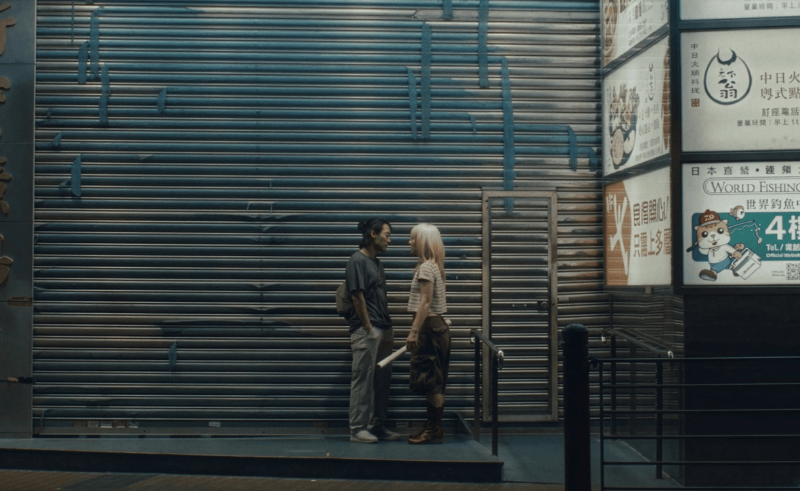
Kong feels like a city suspended between the present and the not-so-distant future. Neon lights flicker against damp concrete, trams hum past skyscrapers, and staircases slicing through its grid seem to lead nowhere and everywhere at once. It is a place built on layers and lives brushing past each other without ever fully meeting. And even though the city never stops moving, it is haunted by some sort of stillness. These moments feel like history is pressing gently against the present and imminent future.
In a quiet graveyard overlooking the city, Zi stands before her parents’ graves. She apologises to them for not looking at them more often when they were still alive. Through tears, she tells them she’s beginning to forget their faces. Her fear spills out in a moment of vulnerability. She’s afraid that when she dies and crosses to the other side, she won’t recognise them. That they will look at her with familiarity, and she will look back with uncertainty. She tells them this is all her fault. She should’ve looked at them more often.
These thoughts are not abstract or random poetic indulgences. Earlier that day, Zi was in a medical facility, and they explained to her that she may have a brain tumour. The results will come in twenty-four hours. A single day stretched into an unbearable eternity. Death and the afterlife are no longer distant ideas; they are suddenly impossible to ignore. Zi is experiencing the one thing we all do when we encounter death, the sudden awareness of our own mortality.
Throughout the film, we follow her as she wanders through Hong Kong in an existential haze, drifting through streets, cafés, and half-lit corridors. When she collapses onto a set of concrete stairs while crying, she is noticed by a stranger. What begins as a moment of concern turns into companionship. Together, they walk through the night, talking about work, art, loneliness, and the strange significance of chance encounters. Their connection feels effortless. Two people briefly aligned in time, aware that something fragile and unrepeatable is happening.
What drives the story forward feels like a plot addition that comes straight out of a sci-fi film. You see, Zi experiences déjà vu-like visions of the future. They arrive as fleeting images that appear without explanation. She and her companion try to make sense of them, wondering whether they are premonitions, misfires of memory, or symptoms of something darker. If Zi is going to lose her memory, this night may be her last chance to hold onto something new. A final night to remember before remembering itself begins to slip away.
Stylistically, the film openly wears its influences. It drifts through the romantic urban alienation of ‘Lost in Translation’, the quirky characters of ‘Eternal Sunshine of the Spotless Mind’, and the existential structure of 'Cléo from 5 to 7’. Some sequences even employ the step-printing techniques made famous by Wong Kar Wai in films like ‘Chunking Express’. On paper, it sounds like a film snob’s dream. And while it never quite reaches the transcendent heights of its inspirations, it comes close. Then again, what films ever do?
‘Zi’ is directed by one of my favourite modern filmmakers, Kogonada. He’s a video essayist turned director who announced himself with two quietly remarkable debut features, ‘Columbus’ and the very underrated ‘After Yang’. After drifting somewhat off course through more commercially oriented projects, this work feels like a genuine return to his indie roots. Shot spontaneously over just three weeks with little more than a loose conceptual framework, the film mirrors its own creative conditions. In many ways, Kogonada’s search for meaning during the making of the film parallels Zi’s existential wandering within it. This is further enriched by a beautifully understated jazz soundtrack.
The film is beautifully shot by Benjamin Loeb, whose images shape the emotional landscape by placing the characters against the vastness of Hong Kong’s urban metropolis. He trusts silence and composition to carry much of the film’s weight. Where the film falters somewhat is in its dialogue. Too often, the script leans on lengthy explanatory monologues that spell out ideas already present in the images. Rather than inviting the viewer to search for meaning, it tells us precisely what to think and feel. This is unfortunate, because the strength of the film’s visual language suggests a work confident enough to let ambiguity breathe.
Even when it overstates its ideas, ‘Zi’ remains an ambitious work that feels both intimate and expansive. This is precisely because it is driven by a filmmaker unafraid to wrestle with large existential questions of morality and chance. It reaches for something greater than itself. And even when it doesn’t fully grasp it, the attempt is genuinely moving. Like the city it wanders through, “Zi” exists in a state of constant flux. Perhaps more time would have refined its ideas, yet there is something fitting in a film that allows its search to remain unresolved. If nothing else, the film confirms that Kogonada’s most compelling instincts remain firmly intact.