





Review: ‘Undertone’ Is One of the Most Inventive Horror Films in Years
In his debut feature, writer-director Ian Tuason delivers an extraordinary exercise in sonic terror.

After Ian Tuason’s ‘Undertone’ ended, I walked over to congratulate the director on what will undoubtedly break through as the most terrifying horror film of the year. Not that he needed the reassurance. All one had to do was listen to the audible gasps from the audience throughout the screening to know he had completely knocked this one out of the park. “Undertone” is one of the most inventive and rigorously controlled entries in the genre I’ve seen in years. It follows in the footsteps of the greats that came before it by adhering to one essential rule. True horror isn’t found in loud noises or cheap jump scares, but in what lingers in the dark when the sound drops away.
This is perhaps the first time in my life I’ve heard an audience scream out loud while the screen remained completely silent. Imagine the domestic dread of “Hereditary” colliding with the paranoid acoustics of “The Conversation” or “Blow Out”. The result is a film that weaponises silence and perception so effectively, it may just possess one of the most accomplished soundscapes the genre has ever produced.
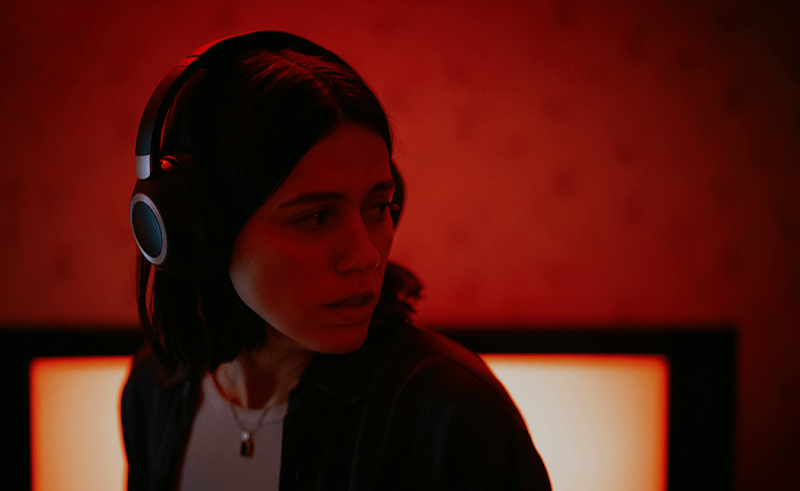
The film revolves around a popular paranormal podcast host who finds her scepticism unravelling when a series of disturbing recordings begins to haunt her. Struggling under the emotional weight of caring for her dying mother, Evy (Nina Kiri) retreats into the routine order of her work. Living alone in a house crowded with memories, she typically approaches the eerie audio submissions sent by her co-host Justin (Adam DiMarco) with disbelief. However, one folder containing ten previously unheard audio files proves different. They contain the voices of a young pregnant couple. Each one is more unsettling than the last.
In his debut feature, writer-director Ian Tuason delivers an extraordinary exercise in sonic terror. After the screening, Tuason revealed that the film was shot in the same apartment where his parents passed away. That revelation alone makes it unsettling, but what truly stands out is the film’s masterful sound design. With most horror films, the first instinct is to cover your eyes. Here, you’ll want to cover both your eyes and your ears. The fact that you can’t do either is precisely what plunges you into a state of inescapable fear.
I’ve seen thousands of horror films over the course of my life, and I’ve reached a point where the genre rarely manages to genuinely scare me. This one did, almost entirely through sound, or more precisely, its strategic absence. It comes as no surprise that Tuason noted the script contained more audio description than visual instruction, or that he spent more time shaping the film in post-production sound design than during the shoot itself. That alone should be enough to spark curiosity.
This is a film that demands to be experienced on a big screen or through an impeccable sound system. Then again, it might be just as devastating through state-of-the-art noise-cancelling headphones. Just make sure the sound is right. It’s the kind of film that will make filmmakers envious, because he achieves so much with so little. The film falls squarely within a tradition of demonic horror, but it delivers that terror by experimenting with film form in strikingly new ways.
I was reminded of how ‘The Exorcist’ used split-second flashes of Pazuzu embedded within the frame to disturb viewers on a subconscious level. Tuason adopts a similarly insidious approach. He repurposes old children’s songs and familiar melodies, stripping them of innocence until they become instruments of torment. The film also aligns itself with our natural curiosity toward conspiracy theories and real-life horror. I’ve always been drawn to that mode of storytelling, particularly podcasts like Mr. Ballen's fixation on the strange, dark, and mysterious. The crucial difference here is immersion. You’re not merely listening to a horror story; you’re sealed within it.
It describes the moment when something has become unsettling. A voice that sounds human but slightly off. A repetition that seems accidental until it isn’t. It’s the discomfort that arises when what once felt safe or ordinary returns in a distorted form. The uncanny works because it doesn’t announce itself as danger. Instead, it destabilises trust by making the recognisable feel unreliable. “Undertone” builds much of its fear around this principle.
Usually, the uncanny is most associated with familiar visual markers in traditional horror cinema. We see many of them here, like motionless religious figurines, old sketches of folkloric demons, or vintage dolls whose lifelessness feels disturbingly animated. What’s new is how the director shifts the uncanny from the visual to the sonic. Children’s songs, voices, and everyday audio cues are warped just enough to feel wrong.
“Undertone” isn’t the kind of horror film you simply watch and move on from. It’s the rare genre debut that feels fully assured of its own language. The type of horror film that terrifies you in the moment, while you’re listening (or rather listening) to it and long after it has ended. A twig snapping somewhere in the dark on your walk home might make you flinch. The slow click of a clock as you lie in bed, briefly stopping, then starting again, suddenly feels ominous. The smallest sound becomes charged. Few horror films are this sensory. Frankly, it’s one of the most inventive horror films in years, precisely because it experiments with film form to return to the simplest things that startle us most.