



Tech for Palestine is Building Infrastructure for the Boycott Movement
Part incubator, part advocacy network, Tech for Palestine is building the infrastructure of the boycott movement.
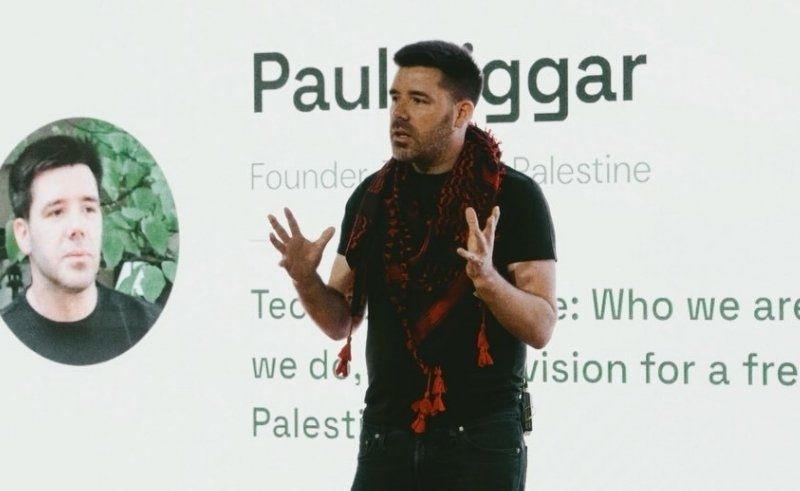
Tech for Palestine has a simple premise: to apply the logic of startup culture to the boycott movement. Formed in the months after October 7th and the subsequent genocide in Gaza, the US-based organisation emerged at a moment when conversations around Palestine were becoming increasingly difficult for tech workers to separate from their own industry’s role in Israeli war tech. Part organising network, part startup incubator, Tech for Palestine was built to turn outrage into infrastructure: backing projects, tools and campaigns designed to make boycotting easier, organising more accessible, and advocacy harder to ignore.
At the time, co-founder and CEO Paul Biggar says his own understanding of Palestine was still taking shape. “I didn’t know, for example, about the Nakba or even the geographical split between the West Bank and Gaza,” he recalls. “We decided from the very start that we were not going to sugarcoat things. We were going to name Israel as the perpetrator in the genocide.”
The incubator traces back to a viral blog post written by Biggar in December 2023 titled, I Can't Sleep. Part personal reckoning, part call to action, he detailed the Israeli military’s conduct in Gaza and ended with a direct appeal to tech workers to boycott organisations, workplaces and venture capital funders supporting Israel.
The response was immediate. Thousands of people reached out, offering skills, ideas and projects.
Their founding story is unusually diffused. Biggar says between 25 and 40 co-founders were involved in the early stages, many of whom eventually moved on. As a non-profit, there is no equity and no traditional funding rounds; it runs on continuous donations.
Prior to its official launch, the incubator gradually emerged through a succession of projects that launched and later collapsed. The goal was to get people to start new initiatives advocating for Palestinian liberation within tech.
“Eventually, after a couple of months of continual iteration, we got to the Tech for Palestine incubator as our main product,” Biggar says. “The core realisation was that rather than being hands-off and just creating a space, we were going to be very hands-on.”
Officially opened to the public on 2 January 2024, Biggar characterises its launch as something shaped by urgency and reactivity rather than long-term planning.
Unlike traditional startup incubators built around equity and returns, Tech for Palestine operates more like an advocacy support network. While some projects become startups, Biggar says around 60% are non-profits or informal initiatives. “The purpose of what we’re doing is supporting the creation of advocacy initiatives,” he explains. “We exist not to make money but to make the world a better place. We ask if the projects we take on can create meaningful impact.”
Projects move through a rolling application process, with accepted teams receiving strategy support, mentoring, marketing assistance and micro-grants, while being guided through startup-style frameworks like customer development, MVP testing and product-market fit.
The support continues well beyond launch. Tech for Palestine helps connect projects to investors, non-profit infrastructure and wider Palestine advocacy networks. Biggar points to BoyCat, an app that checks products and brands against the boycott, which eventually became an official partner of the BDS National Committee through introductions made by the incubator itself.
Today, projects moving through the incubator range widely in form, but many attempt to answer the same question: how do you make advocacy easier to participate in and harder to ignore?
“There’s not a lot of people working on scaling up boycotts,” Biggar says. “We have a number of initiatives doing that in different ways.”
Some projects focus on boycott infrastructure. One tool allows users to connect their bank statements to scan for boycott-related purchases. Another analyses retirement portfolios for investments tied to Israel.
“We also support consumer tools, alongside projects focused on ethical investment, ethical VCs, ETFs and broader boycott infrastructure.”
Elsewhere, the organisation supports what it calls “protest tech”, digital tools designed around organising itself. One of the incubator’s earliest projects, Find a Protest, now receives half a million visits a week from users searching for demonstrations.
Other projects move through less expected spaces. Zines for Palestine distributes Palestine-focused zines through independent art communities, expos and coffee shops. A Gazan-founded Arabic learning app connects learners with Palestinian educators. Ethical advertising systems are building alternatives to traditional ad networks.
The goal was not necessarily awareness but systems: tools that make boycotting easier, organising more accessible and advocacy harder to ignore at scale. Biggar frames Tech for Palestine’s projects not as campaigns people encounter and move on from, but as systems people return to.
The organisation’s visibility has also brought complications. Biggar describes recurring issues with financial compliance systems flagging transactions associated with the word “Palestine”.
“Once, transferring money for an event triggered flags simply because the event rooms were named after Palestinian cities like Nablus and Jenin,” he says.
“At one point, people were training others on how to edit Wikipedia, and some Zionist groups spun that into ‘Tech for Palestine is mass manipulating Wikipedia’, which was completely false.”
Biggar adds: “That narrative was amplified by the Anti-Defamation League and some American Israel Public Affairs Committee-aligned representatives.”
Despite backlash, Tech for Palestine has remained intentional in how it positions itself publicly. In the early months of the war, when many companies and institutions rejected the Palestinian cause, the organisation chose not to soften its language.
“We were not just pro-Palestine in a peaceful, wishy-washy sort of way,” he says. “We are explicitly against the occupation.”
Using a startup mentality, Tech for Palestine’s projects are based in the United States and Europe rather than within Palestine itself. Biggar says the organisation focuses primarily on advocacy within western tech spaces, though some initiatives connect directly with Palestinians through mentorship programmes, educational tools and collaboration. “We are very much about scaling, and we scale quite aggressively,” he says. “We back projects earlier, experiment more, and try new things constantly.”
Recently, the organisation introduced the Tech for Palestine membership model, built around people coming to the organisation wanting to help. From there, volunteers are placed into projects and initiatives across the network.
“That’s been a major focus this year, and we’ve already launched around 15 new initiatives through it.”
At one point during the conversation, Biggar briefly mentions discussions around whether the structure itself could eventually expand beyond Palestine. “I wonder whether one path for scaling might eventually involve Tech for Palestine, Tech for Syria, and similar models for other causes. It’s not a major focus right now, but it could become an interesting long-term direction.”