






Lebanon's Off-Grid 'Lifehaus' is Every Fantasy Fan's Dream Come True
Nestled in the Lebanese mountains, Lifehaus blends sustainable design with storybook fantasy, making you wonder if a hobbit might wander in for tea.

Originally published on March 28th, 2026
Architecture is perhaps the closest humans come to inhabiting fiction. Unlike books or films, which invite us to imagine other worlds from the outside, a building allows us to step inside a story, to touch its surfaces, feel its contours and move through it at our own pace. That is why certain spaces feel almost cinematic. They seem to belong to the same worlds we have only ever encountered on screen or in the pages of fantasy novels.
It is precisely this feeling that makes the work of Lebanese architect Nizar Haddad resonate with fantasy fans. His designs often appear less like conventional houses and more like fragments of a hidden world. Nowhere is this more evident than in Lifehaus, his experimental sustainable home nestled in the mountains of Baskinta, Lebanon.
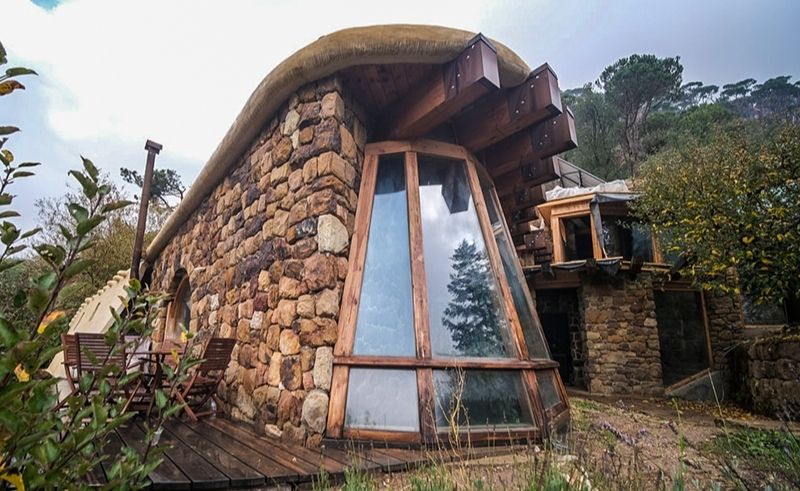
At first glance, Lifehaus looks as though it has been pulled straight from the hills of Middle earth. Circular windows puncture its curved façade, its green roof allows vegetation to spill across its surface and its low profile makes it appear as though the mountain itself has gently swallowed it. The resemblance to a Hobbit dwelling is unmistakable. Haddad himself is a lifelong admirer of fantasy. His favourite film trilogy, he says without hesitation, is The Lord of the Rings.
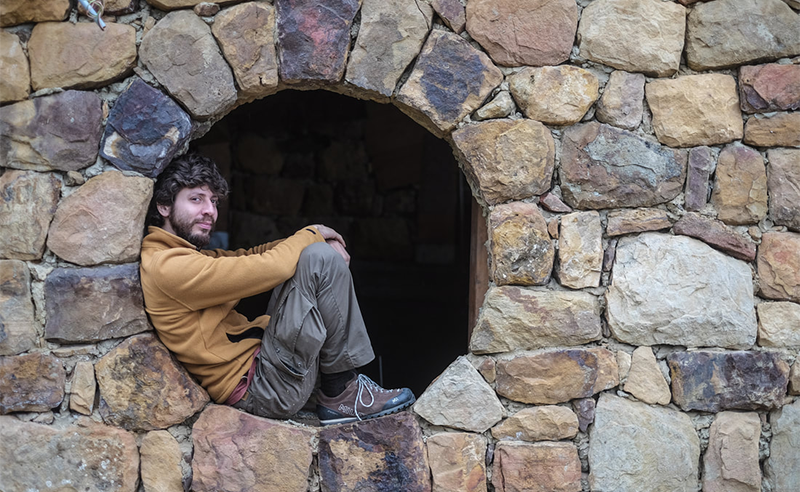
For anyone who has watched the films or read Tolkien’s books, the parallels are easy to see. The homes of the Shire are famously built into the hills, their round doors opening directly onto lush landscapes, their architecture shaped more by the land than by rigid design principles. Lifehaus seems to follow a similar philosophy, though its origins lie not in imitation but in a deeper idea about how humans should build.
Completed in 2017 in Beqaata En Nahr in Mount Lebanon, Lifehaus was the first project of its kind for Haddad. It was conceived as a fully self-sufficient, low-cost prototype designed to explore what architecture might look like if sustainability and circular design were placed at its very centre.
“Architecture should be a shelter that answers human and nature’s needs, without harming the environment.” With that philosophy in mind, recycling became the backbone of the design. The rocks used in the house were sourced directly from the ground on which it was built. Soil excavated during construction was reused in the walls themselves. Rubber tyres that would otherwise be burned in landfills were packed with earth and integrated into the structure, giving them new life as part of the building’s thermal mass.
Other details reveal the same principle. Beer bottles collected from a nearby pub were cut and transformed into glass bricks, forming a luminous wall that filters daylight through fragments of recycled glass. Lifehaus also harvests rainwater and recycles it four times, ensuring that not a single drop is wasted; this water is used to irrigate the surrounding land, creating a self-sustaining micro-ecosystem.
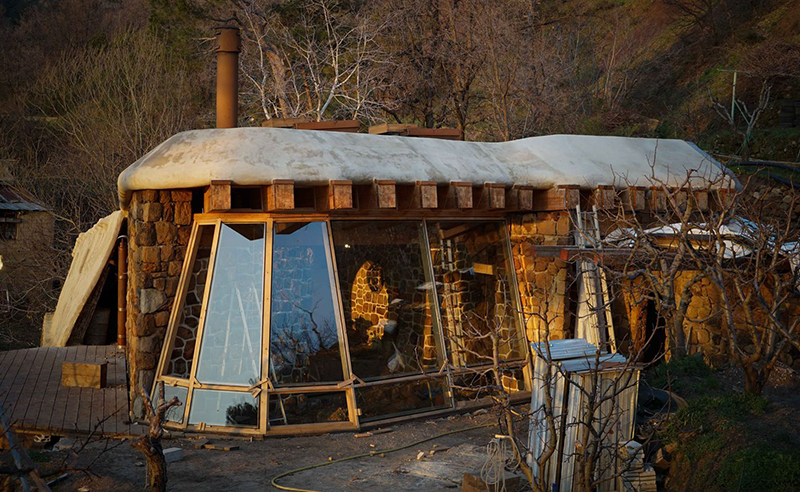
Circular elements appear again and again throughout the house, from the iconic round windows to curved openings and organic interior forms.
“I thought the best thing is to do, like a big circle… it’s very beautiful, it’s organic, it’s perfection, it’s the cycle of life, so it has a lot of symbols behind it.”
For Haddad, the philosophy behind Lifehaus is rooted in a lifelong fascination with landscapes and traditional architecture. Growing up in Lebanon and spending years hiking through its valleys and mountains, he became captivated by abandoned mills and rural stone houses that seemed to melt back into the terrain. These vernacular structures, built from local stone, earth and wood, offered a blueprint for architecture that responds to climate, terrain and human need without overwhelming the environment.
“Architecture today is in crisis,” Haddad explains. “Humans have become completely disconnected from nature.”
His work attempts to close that gap by rethinking how buildings interact with their surroundings. In many ways the idea mirrors the quiet environmental wisdom often embedded in fantasy worlds. In Tolkien’s Middle earth, nature is not something to conquer but something to live alongside. Forests, mountains and rivers shape the way communities build their homes. Architecture becomes part of the landscape rather than something imposed upon it.
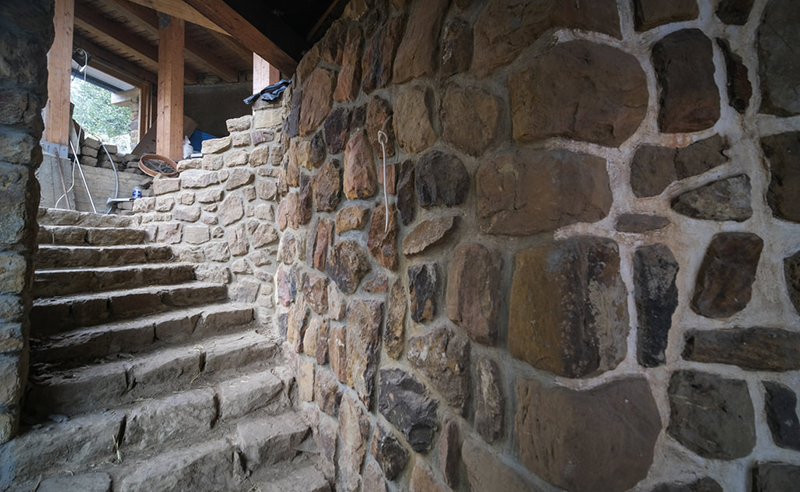
Lifehaus became the ultimate testing ground for this idea. During its construction Haddad took on an unusually hands on role, acting simultaneously as architect, client and site manager. Volunteers from around the world were invited to participate in the build, turning the project into a collaborative learning environment where participants could experiment with sustainable construction techniques.
The experience was as much social as it was architectural. Craftsmen, labourers and volunteers worked side by side, sharing knowledge and rediscovering traditional building methods, including the efficient process of making adobe mud bricks by hand. For Haddad it was a reminder that architecture is never the work of a single person but the product of collective effort.
Inside, the goal was not simply to shelter occupants but to immerse them in the landscape itself. “Actually, I wanted to feel like I am in nature,” he says. The interior is intentionally irregular, with organic curves replacing rigid geometry. “There is not a lot of straight lines… it’s like you’re in nature, irregular.” Yet the design stops short of mimicking a cave. Instead, clean glazing and modern openings create a careful balance between nature and contemporary comfort. “I don’t want to go completely purist… I want signs of human intervention… a mix between the organicity of nature and rationality.”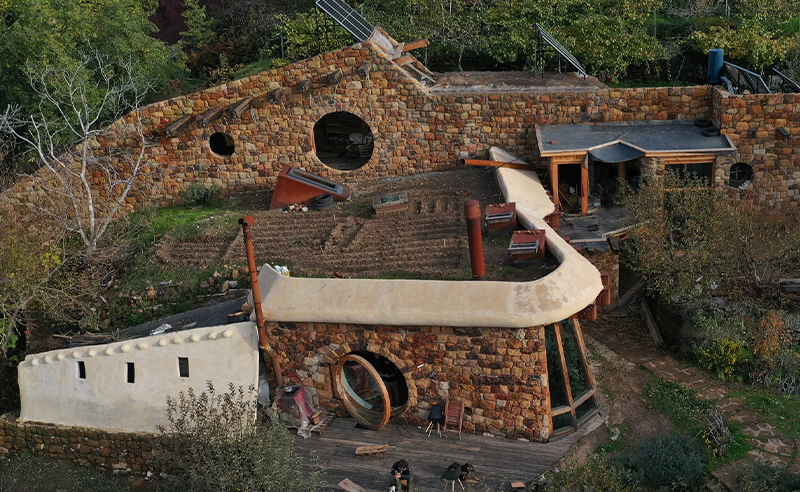
The effect is subtle but powerful. Standing inside Lifehaus, one does not feel like they are merely occupying a building. Instead, the experience is closer to inhabiting a place that might once have belonged to a story, a home carved gently into the earth, where architecture becomes an extension of the landscape itself.
Perhaps that is why Haddad’s work resonates so strongly with fans of fantasy. Much like the worlds imagined by Tolkien, his buildings suggest that the most magical places are not entirely imagined. They already exist in the real world, waiting for someone to listen carefully enough to the land and build accordingly.
- Previous Article SceneNoise x Amsterdam Dance Event Present CROSSFADE: Egypt
- Next Article The Intricate Beauty of Ben Youssef Madrasa
Related Articles
Trending This Week
-
 Oct 06, 2026
 -
-

-